
Overturned Truck Spills Sodium Hydroxide on Mobile’s Addsco Road
A truck hauling about 800 gallons of sodium hydroxide overturned on Addsco Road in Mobile. Hazmat crews oversaw cleanup; the driver was treated for minor.
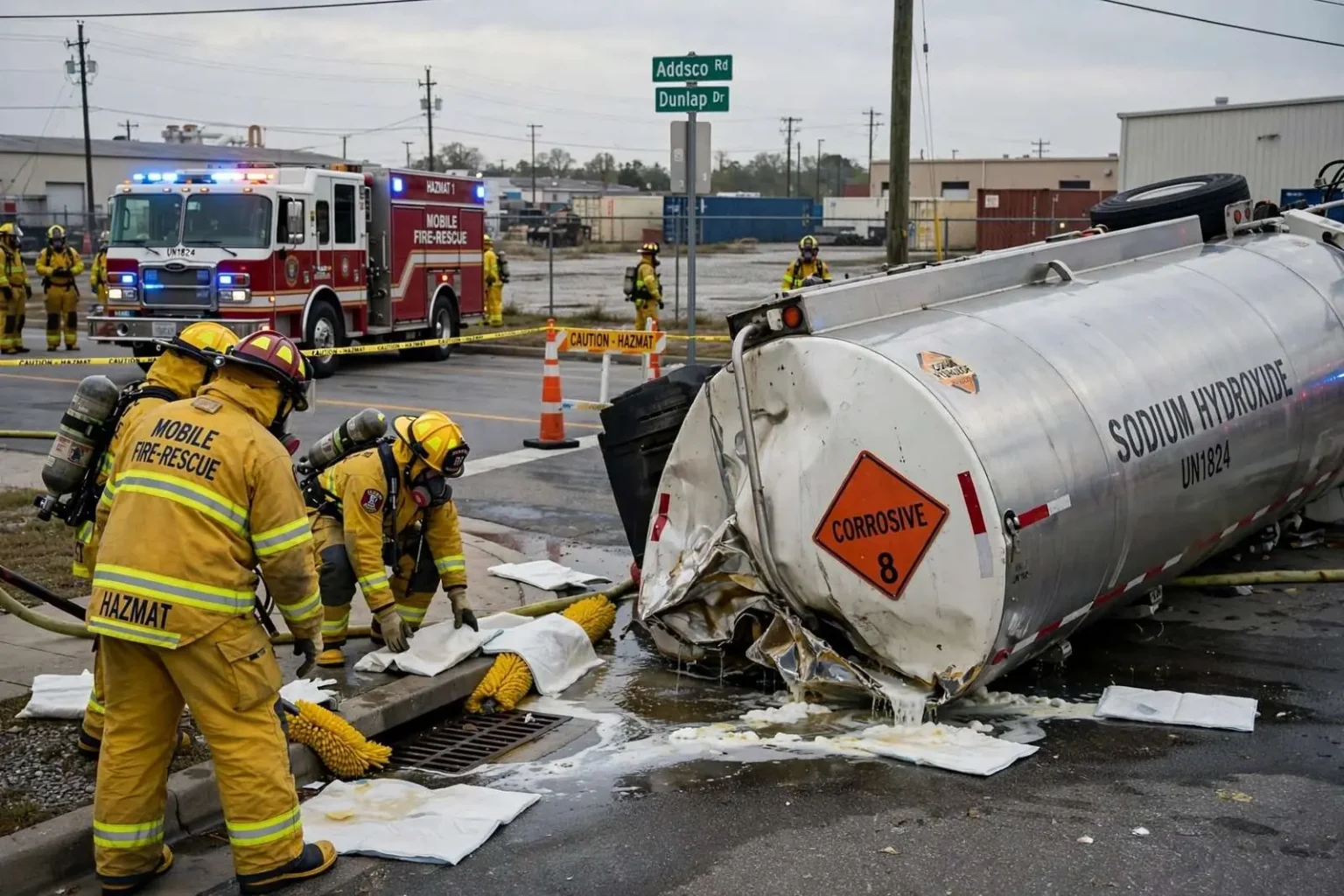
A tanker truck carrying roughly 800 gallons of sodium hydroxide solution overturned at the intersection of Addsco Road and Dunlap Drive in Mobile on November 20, 2019, sending hazardous-materials crews scrambling to contain an unknown amount of leaking fluid. The afternoon crash in one of Mobile’s industrial corridors triggered a multi-agency response that stretched into the evening as crews worked to keep the caustic liquid off the ground, out of storm drains and away from nearby waterways.
Mobile Fire-Rescue said crews were called to the scene around 4:24 p.m. after a single vehicle hauling the caustic chemical solution flipped in the roadway. The driver was treated for minor injuries and transported to a local hospital, according to the department. No other vehicles were reported involved in the crash, and authorities did not announce any road closures beyond the immediate intersection while the cleanup was underway.
Cleanup crews take over the scene
Because the load involved a corrosive industrial chemical, a third-party cleanup contractor was brought in to handle the spill, with Mobile Fire-Rescue hazmat teams standing by and overseeing mitigation of the scene. The division of labor is standard practice for chemical spills: fire crews secure the area, identify the substance and stabilize the scene, while a licensed environmental contractor performs the actual recovery, disposal and site remediation that federal and state rules require.
The contractor’s work in a spill like this typically involves plugging leaks in the damaged tank, diking and absorbing the material that escaped, collecting contaminated soil, and testing the area before releasing it back to normal traffic. Everything collected — spent absorbents, contaminated soil, rinsate and recovered liquid — must be manifested and hauled to licensed disposal facilities, a paper trail that keeps hazardous waste accounted for from roadside to final disposal.
Officials did not immediately say how much of the solution escaped the overturned vehicle. That open question matters for the cleanup’s scope: a tank that held its load requires a far smaller operation than one that drained onto the roadway, and the difference shapes how long the intersection stays tied up, how much material must be excavated and how extensively runoff protection must be maintained.
Understanding sodium hydroxide
Sodium hydroxide — commonly known as lye — is a highly corrosive substance used in manufacturing and water treatment. In solution, it is a strong base that can cause severe chemical burns to skin and eyes on contact, and its vapors can irritate the respiratory tract. It is one of the most widely used industrial chemicals in the world, showing up in pulp and paper production, soap making, aluminum processing, food processing and the treatment of municipal water supplies.
Transported by tanker truck in concentrated liquid form, sodium hydroxide falls under the hazardous-materials regulations that govern placarding, driver training and container standards. The solutions hauled for industrial use are typically strong enough that even brief exposure is dangerous, which is why responders treat a sodium hydroxide release with the same seriousness as an acid spill — the chemical burns in the opposite direction on the pH scale, but the damage to tissue is comparable.
Spills involving large quantities typically require specialized containment to keep runoff out of storm drains and nearby waterways. That is the urgent arithmetic of any chemical spill on a city street: storm drains are direct pipelines to the drainage system’s outfalls, and a corrosive liquid that reaches them can damage pipes, kill aquatic life and disrupt water treatment downstream. Crews responding to a chemical spill therefore move quickly to cover or block nearby drains before they do anything else — an unglamorous step that often determines whether an incident stays a road cleanup or becomes an environmental one.
How hazmat response works in Mobile
Mobile Fire-Rescue maintains hazardous-materials response capability precisely for incidents like the Addsco Road overturn. Hazmat teams train to identify chemicals from placards, shipping papers and container markings, to measure concentrations in the air, and to work in protective suits and self-contained breathing apparatus while managing a scene that ordinary responders cannot safely approach. The first tasks are always the same: isolate the area, keep unprotected people back, and stop the release from spreading.
The “standing by and overseeing” role the department described reflects a deliberate hierarchy of responsibility. The spiller — in this case, the trucking company and its contractor — bears the legal responsibility for cleanup under environmental regulations, while the fire department retains incident command and verifies that the work is done properly. That arrangement keeps specialized private resources doing the recovery work while public responders maintain control of public safety at the scene.
For residents of the neighborhoods around Addsco Road, the visible signs of a hazmat response — suited crews, barricades, vacuum trucks and absorbent piles — can look alarming, but the posture is precautionary. A single-vehicle overturn with no confirmed drain release and no reported exposures beyond the driver is, by the standards of chemical incidents, a contained one, and the response machinery that mobilized around it was working exactly as designed.
The industrial context of Addsco Road
The crash site sits in the industrial fabric of Mobile, a city whose economy has always been tied to the port and to the chemical, manufacturing and logistics operations that cluster around it. Tanker trucks moving industrial chemicals between port facilities, plants and distribution points are a daily sight on Mobile’s road network, and routes through the city’s industrial corridors carry that traffic past neighborhoods and drainage systems that were never designed with chemical spills in mind.
That reality is why the region’s responder network treats chemical transport as a standing risk rather than a surprise. Gulf Coast communities from Mobile to the Mississippi line plan for hazmat incidents the way inland cities plan for winter weather: with trained teams, mutual-aid agreements and contractors on call, hoping the preparation is never needed but knowing the odds over time. An overturn at an intersection like Addsco Road and Dunlap Drive is precisely the scenario those plans anticipate.
The intersection itself presents the typical challenges of a chemical spill in an urban-industrial setting: paved surfaces that let liquid sheet toward gutters, storm inlets that connect to the drainage network, and adjacent properties whose soil could be contaminated by any substantial release. Containing a spill quickly in that environment is the difference between a routine cleanup and a weeks-long remediation project.
What happens after the cleanup
Once the contractor finishes recovery work, the site’s return to normal involves verification. Environmental contractors typically document the cleanup with photographs, sampling and a closure report, and depending on the volume released and where it traveled, state environmental regulators may review the results. If any material reached a storm drain, the drainage system and its outfall may be checked as well, since a caustic release into the network can affect everything downstream of the entry point.
The trucking side of the incident follows its own review. Commercial vehicle crashes involving hazardous materials draw scrutiny of driver hours, loading practices, container condition and the securement of the load, with the findings feeding back into carrier safety programs. For the motor carrier involved, the costs of an incident extend well beyond the cleanup invoice: downtime, cargo loss, regulatory attention and reputational damage all follow a chemical release on a public road.
For the driver, minor injuries and a hospital evaluation were the immediate outcome — a comparatively fortunate result for a crash involving an 800-gallon load of caustic chemical. Overturns that release corrosive liquids can injure responders, bystanders and the drivers themselves far more seriously, particularly if a valve fails or a tank ruptures in the crash.
A reminder about chemical transport close to home
Incidents like the Addsco Road spill are worth attention precisely because they are uncommon. The overwhelming majority of hazardous-materials shipments arrive without incident, which is why the system works — placards, trained drivers, tested containers and prepared responders. But the infrequency of spills is also why a visible response like the one on November 20, 2019, draws interest: it shows, in real time, the machinery that stands ready when a routine shipment goes wrong.
By the time the response concluded, the intersection had been the site of a textbook coordination: fire crews securing and assessing, hazmat specialists overseeing, a licensed contractor recovering the material, and the driver safely in medical care. No other vehicles were involved, no widespread closures were ordered, and the caustic load that flipped on a Mobile afternoon ended up as a contained incident rather than a community emergency — the outcome every link in that response chain is built to deliver.
Staying safe around a chemical spill
For residents, the practical lessons from an incident like this one are straightforward. If a crash involves a tanker truck, put distance between yourself and the vehicle before calling 911, and never assume a clear liquid is harmless — corrosive chemicals give little warning before they burn. Stay upwind of any vapor or mist, keep children and pets away from puddles of unknown liquid, and leave scene management to responders, since unprotected contact with even a small spill can cause serious injury.
Storm drains deserve particular respect after any chemical release on a street. What flows into a drain does not go to a treatment plant — it runs through the drainage network to the nearest outfall, which means anything poured or spilled into the gutter can end up in the same waterways the response crews worked to protect. Mobile-area residents who witness a spill, however small, are better off reporting it than rinsing it toward the curb.
The Addsco Road response showed why that preparedness matters. Eight hundred gallons of lye solution overturned on a city street, and by the end of the day the driver was in stable care, the leak was being contained, and the storm drains stayed clean — a quiet result that is exactly what a well-rehearsed system is supposed to produce.