Overturned vehicle blocking right shoulder on US 90 eastbound at Bankhead Tunnel
An overturned vehicle is blocking the right shoulder on US 90 eastbound at the Bankhead Tunnel in Mobile; responders are on scene.
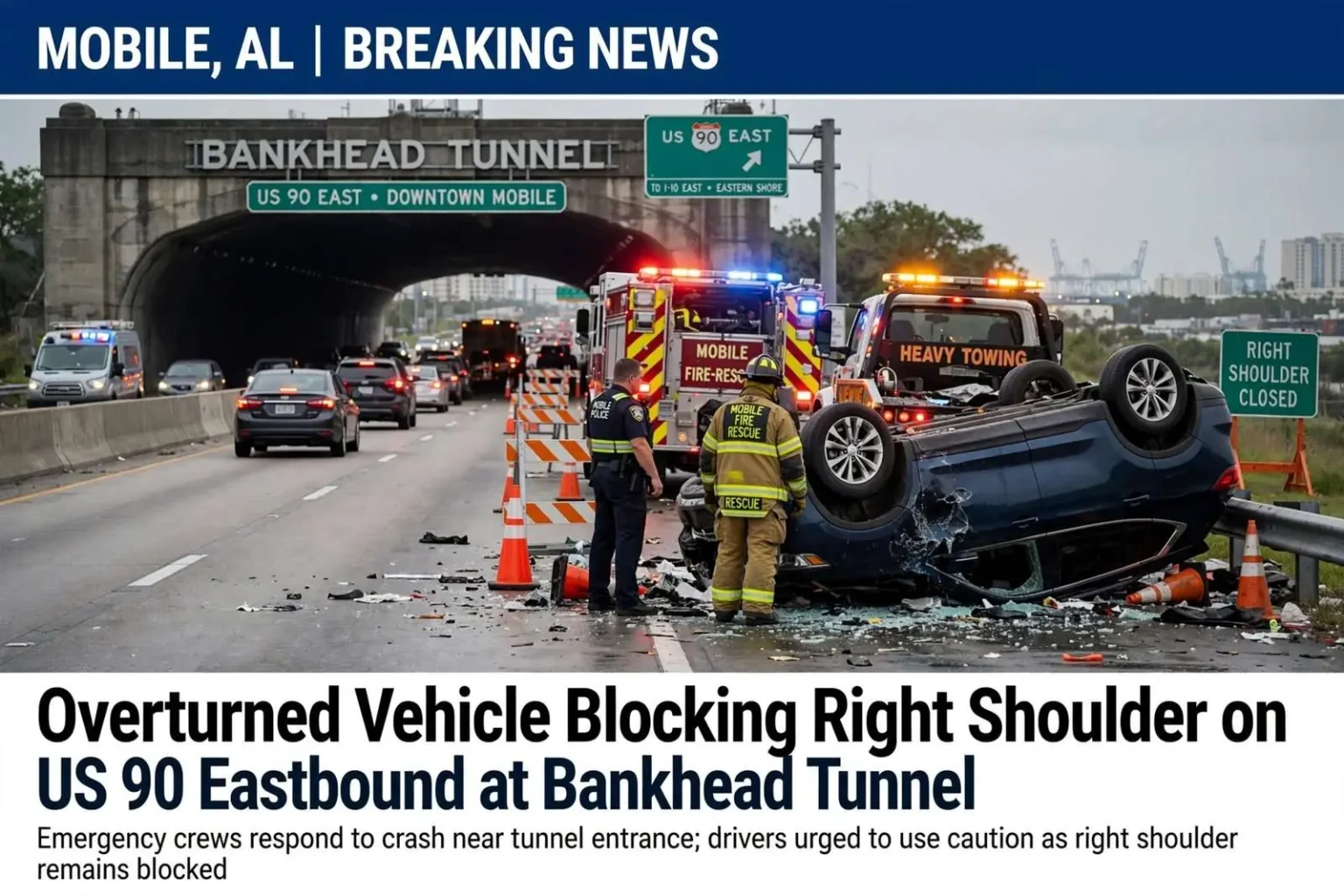
An overturned vehicle is blocking the right shoulder on US 90 eastbound at the Bankhead Tunnel in Mobile, creating a hazard for the heavy traffic that moves through the corridor and prompting a response from emergency crews. Drivers approaching the area are urged to use caution while passing through, as responders work the scene and the damaged vehicle occupies space along the edge of the roadway. Any incident at the approaches to the tunnel draws attention quickly, because the roadway narrows there and the volume of traffic passing between downtown Mobile and the east side of the river leaves little room for error.
An overturned vehicle is one of the more disruptive incidents that can occur on a busy roadway, even when the wreck stays out of the travel lanes. A vehicle on its side or roof typically requires specialized equipment to right and remove, heavy-duty tow trucks and, when occupants are trapped, rescue crews with hydraulic tools. The scene also demands manpower, since responders must manage the safety of anyone involved, control traffic past the wreck, and clear debris that may be scattered across the pavement. Until all of that work is done, the blocked shoulder constrains the roadway’s ability to absorb the incidents and breakdowns that the corridor normally handles without notice.
The right shoulder serves as the escape valve for a roadway like US 90 eastbound at the tunnel. Disabled vehicles pull onto it, emergency vehicles stage on it, and wreckers work from it. With the shoulder occupied by an overturned vehicle and the responders attending it, traffic that would normally flow past a minor breakdown instead stacks up, and every additional incident on the corridor compounds the delay. Drivers approaching the area encounter the classic combination of a wreck scene: slowing traffic, flashing lights, and lane narrowing that requires the full attention of everyone behind the wheel.
The Bankhead Tunnel Corridor
The Bankhead Tunnel is one of Mobile’s most historic pieces of infrastructure, carrying Government Street traffic beneath the Mobile River since the early 1940s. Built as part of the city’s effort to modernize its road connections across the river, the tunnel was an engineering milestone for its era and remains a working part of the region’s highway network generations later. Its approaches are marked by the kinds of features that older urban roadways share, curving alignments, limited shoulders, and portals where drivers pass from open roadway into the confines of the bore, and those features make the surrounding stretch of US 90 less forgiving of incidents than an open highway would be.
US 90 itself is one of the country’s historic coast-to-coast highways, and through Mobile it functions as a working artery connecting downtown to the communities east of the river, the industrial waterfront, and the routes that continue toward the Eastern Shore. Traffic on the eastbound approach to the tunnel includes commuters heading to work across the bay, freight and commercial vehicles serving the port and its surrounding industries, and local drivers moving between neighborhoods. That mix keeps the corridor busy throughout the day and makes any blockage there a matter of immediate concern for the drivers stuck behind it.
Drivers in Mobile know the alternatives well, because the city’s geography forces the same crossings onto everyone who moves between downtown and the east side. The interstate tunnels and the coordinating routes absorb traffic when one crossing slows, and navigation apps broadcast incidents on US 90 to drivers still miles away. An overturned vehicle on the shoulder does not close the roadway, so it does not trigger the wholesale rerouting that a full closure would, but it slows the corridor enough that some drivers choose the alternative on their own, redistributing the delay across the network rather than concentrating it at one point.
How Responders Handle an Overturned Vehicle
The response to an overturned vehicle follows a sequence that emergency crews drill on regularly. First priority is the people involved, confirming who was in the vehicle, assessing injuries, and providing medical care where needed. Stabilization comes next, because a vehicle resting on its side or roof is an unstable object that can shift while responders work around it or while crews cut into it. Only after the vehicle is stabilized, and occupants are out and in the care of medical personnel, does the work of recovery begin, bringing the vehicle upright and loading it onto a wrecker.
Traffic control runs through every stage of that work. Responders position apparatus to shield the scene from oncoming traffic, set out warning devices to channel drivers past the work zone, and in busier corridors request additional units to manage the backup that forms upstream. The goal is to protect both the people working the scene and the drivers approaching it, because crashes involving responders and passing vehicles are a persistent danger on active roadways. Drivers who slow down, move over when possible, and stay off their phones as they pass a scene are contributing to that safety effort directly.
Clearing the scene involves more than removing the wreck. Fluids that leak from a damaged vehicle, oil, coolant, fuel, and other liquids, leave slick spots on the pavement that must be absorbed or flushed before traffic can use the roadway normally. Debris from the vehicle, glass, trim, cargo, and pieces of the vehicle itself, has to be collected. In some cases the roadway surface itself is damaged. Until those steps are complete, the scene remains a hazard even after the visible wreck is gone, which is why crews often remain at a location after the heavy work looks finished to a passing driver.
What Drivers Should Do
For drivers approaching a scene like the one on US 90 eastbound, the guidance from safety officials is consistent. Slow down and scan ahead for responders and traffic patterns, move over a lane when the law and the roadway allow it, and never stop or brake abruptly in travel lanes to look at the scene. Distracted driving around an incident scene multiplies the risk of a secondary crash, and secondary crashes at congestion points are among the most dangerous events on urban roadways, involving higher speeds into stopped traffic and more vehicles per incident.
Anyone who encounters an overturned or damaged vehicle with people still inside should call 911 rather than attempting to move the vehicle or extract occupants themselves. Untrained handling of a stabilizing wreck can cause it to shift, and moving an injured person without proper precautions can worsen injuries. The most valuable help a passerby can offer is accurate information, a location, the number of vehicles and people involved, and whether anyone appears to be trapped, followed by keeping clear of the scene and letting trained responders do the work.
Incidents on the US 90 corridor at the tunnel also serve as a reminder of how infrastructure shapes traffic outcomes in Mobile. The city’s crossings of the Mobile River are few, aging in places, and heavily used, and every incident on one of them ripples outward to drivers who planned around the normal flow. As responders finish their work and the shoulder reopens, the corridor returns to its usual rhythm, but the episode illustrates the same lesson every time it happens: caution at the approaches, patience in the backup, and attention behind the wheel are the tools that keep a constrained, historic, and essential roadway working for the city that depends on it.
Rollover crashes, the kind that leave a vehicle overturned, have a distinct profile among roadway incidents. Vehicles with a higher center of gravity, including SUVs, pickups, and vans, are more susceptible to rolling when a driver swerves sharply, drops wheels off the pavement edge, or takes a curve or ramp too quickly. Speed multiplies the risk, as does any sudden maneuver that shifts the vehicle’s weight to one side. Once a vehicle begins to roll, its roof, pillars, and restraint systems are all that stand between occupants and the ground, which is why seat belt use is the single most important factor in how rollover crashes end for the people inside.
Recovery of an overturned vehicle also tests the resources of the crews responding. Heavy wreckers capable of uprighting a full-size SUV are not stationed at every corner, and the process of attaching straps, controlling the vehicle as it comes upright, and checking for hazards takes skilled operators. If the vehicle leaked fuel onto the roadway, fire crews remain on hand until the hazard is mitigated. The work cannot be rushed, because a botched recovery can turn a stable wreck into a moving one, and the shoulder of a busy corridor leaves little margin for mistakes.
Mobile’s crossings of the Mobile River are few enough that each one matters to the network. The Bankhead Tunnel, the interstate tunnels that carry the highway beneath the river, and the bridge crossings north of downtown carry the burden of every trip between the peninsula and the mainland, and each has its own geometry and constraints. Transportation planners have studied for years how to add capacity and improve resilience across those crossings, because the region’s growth keeps pushing volumes toward the limits of what the existing connections can handle. Until new capacity exists, incidents like the one on the eastbound approach will continue to be the moments when the system’s thin margins become visible to everyone stuck in the backup.
Weather and time of day shape how such incidents unfold as well. Rain on worn urban pavement increases stopping distances and contributes to the loss-of-control crashes that produce rollovers, and afternoon storms are a regular feature of Gulf Coast summers. Incidents that occur during peak commuting hours complicate the response, because responders must work in traffic that has nowhere to go, and the delay ripples outward through downtown streets as drivers seek alternate paths. Nighttime incidents bring their own challenges, with reduced visibility for both drivers and crews working at the edge of live traffic.
For the drivers who pass the scene while the work is underway, patience is the practical answer. The delay caused by a blocked shoulder is measured in minutes for most vehicles, and it ends as soon as the wreck is recovered and the debris is cleared. The temptation to maneuver aggressively through a backup, or to accelerate hard once past the scene, produces exactly the kind of secondary crashes that turn a manageable incident into a major one. The roadway returns to normal fastest when everyone near the scene slows down, spreads out, and lets the recovery finish.
As the response to the overturned vehicle on US 90 eastbound proceeds, the fundamentals remain what they always are at scenes like this one: responders working at the edge of a busy roadway, a corridor carrying more traffic than its shoulder can spare, and drivers asked to use caution while passing through. The incident will end the way these incidents usually do, with the wreck cleared, the pavement treated, and the traffic flowing again. Until then, the stretch of US 90 at the historic tunnel approaches will demand from every driver the one thing the situation requires most, full attention to the road ahead.