Finebaum’s Show Turns SEC Talk Into a Guide to South Alabama’s Political Fights
Paul Finebaum's show blended SEC football talk with South Alabama's political fights, touching on Lane Kiffin's Senate buzz, the Kennan ethics case, the Carl-Jones race and more.
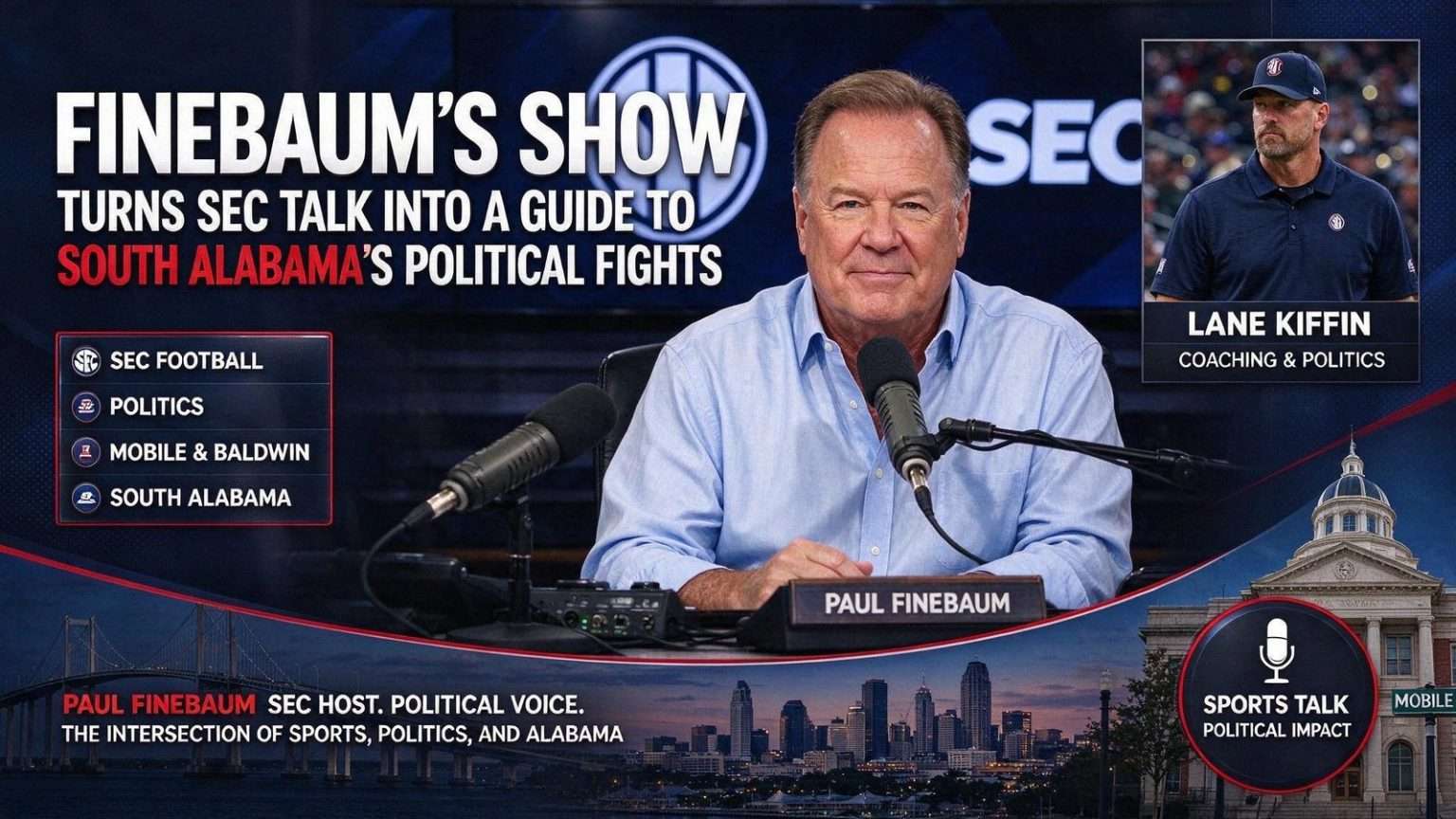
Paul Finebaum, the nationally syndicated radio and television host whose midday show anchors Southeastern Conference football talk across the league’s footprint, spent part of a recent broadcast working through the SEC’s marquee storylines before pivoting to the political battles playing out across Mobile and Baldwin counties.
Finebaum has spent decades building the show into an institution of Southern sports culture. What began as a Birmingham-based call-in program grew into a syndicated franchise and, through the SEC Network, a television presence watched across the league’s 14-school footprint and beyond. His audiences call not merely to discuss games but to perform — and his regulars have become characters in their own right. Over the past decade, Finebaum has also become an unexpected voice in political journalism, interviewing senators, governors, and presidential candidates and commenting on Alabama’s political currents from a platform that reaches far outside the sports world.
Finebaum touched on Tennessee coach Lane Kiffin’s increasingly serious flirtation with a run for the U.S. Senate, a subject that has generated buzz well beyond the football world given Kiffin’s national profile and his outspoken presence on sports talk radio and television. Kiffin’s willingness to engage publicly on politics and culture has made him one of the rare coaches whose commentary travels beyond recruiting boards, and the suggestion that he might trade a sideline for a campaign trail gave the show’s opening segment a story that crossed over into mainstream political coverage.
Local Political Fights Fill the Rest of the Broadcast
From there, the conversation shifted to a string of political storylines percolating across South Alabama. Orange Beach Mayor Tony Kennan’s ethics hearing timeline came up, as did the sparring between Jerry Carl and Clyde Jones over whether the two will meet in a debate ahead of their race for Alabama’s 1st Congressional District.
The congressional contest gave the discussion its stakes. Alabama’s 1st District spans the entire Gulf Coast — from Mobile and Baldwin counties east through the Wiregrass — and drew a competitive field when the seat opened. Carl, who held the seat before the redistricting-era shakeup, and Jones brought name recognition and political networks into the race, and their public disagreement over a debate format followed the familiar choreography of campaigns where each side calculates what a shared stage would cost. In coastal Alabama, where a single congressional race dominates two years of political conversation, the debate question was itself news.
U.S. Rep. Barry Moore’s pitch to name a bridge after former President Donald Trump also made the rounds, along with Jason Isbell’s planned appearance at a rally for Doug Jones in Mobile. Moore’s bridge proposal fit the symbolic fights that flourish in Alabama politics, while Isbell’s planned appearance — the Grammy-winning Alabama songwriter lending his profile to a Senate race rally — illustrated how the state’s music and political worlds keep colliding, and how Mobile remains a required stop for statewide campaigns.
The show additionally referenced the manslaughter verdict in the death of Victor Birch and Mobile County School Board member Johnny Hatcher’s ongoing dispute with the mayor of Semmes, two stories that have kept local courtrooms and city halls busy this month. Both are signature South Alabama stories: a homicide case working through Mobile County’s courts, and a school board-versus-city-hall feud in Semmes, the small municipality north of Mobile where municipal politics routinely generates outsized drama.
Football Season Bleeds Into the Political Conversation
Local football’s kickoff week wasn’t far from the discussion either, a reminder of how thoroughly college and prep football intertwine with daily life — and, increasingly, with political conversation — across South Alabama as the fall season gets underway.
In Alabama, the football season’s opening week functions as a civic season of its own. Friday nights belong to prep programs in Mobile and Baldwin County, whose rivalry games draw crowds that rival small-college turnouts, while Saturdays split the state between Alabama and Auburn camps and Sundays bring the professional debates that follow. Politicians long ago learned to work those crowds — appearing at games, predicting scores, and speaking the language of the fan base — and a host like Finebaum occupies the exact intersection where those worlds meet.
The intertwining runs deeper than pageantry. Coaches are public figures whose influence extends into endorsement politics and, occasionally, candidacies of their own — Kiffin’s Senate flirtation being the current example. Sports venues double as political stages, from campaign rallies in stadium towns to the legislative fights over public funding for athletic facilities. And the talk-radio format itself, built on passionate call-in argument, translates directly to political discourse, which is why sports hosts so often become political commentators and vice versa.
Finebaum’s show remains one of the most widely heard forums for SEC football commentary, and its willingness to fold in regional political storylines underscores how closely sports and politics are covered together in a state where both carry outsized cultural weight.
For South Alabama’s political players, a segment on Finebaum’s program is a form of reach that local outlets cannot match. A race for the 1st Congressional District becomes a topic of conversation from Huntsville to Mobile; a municipal dispute in Semmes finds an audience that includes listeners who have never set foot in the city. Candidates and officeholders monitor the show not because they expect football analysis, but because its host has demonstrated a knack for elevating state political stories into the wider Southern conversation.
Why the Blend Works
The formula works because the audiences overlap almost perfectly. Alabama’s political map is drawn through the same communities that populate the SEC’s footprint, and the demographic that calls sports radio by day votes, volunteers, and donates by night. National political strategists have taken note: appearances on the show have become a routine stop for statewide and national candidates courting Alabama voters, precisely because it offers a live, engaged audience that treats political discussion with the same fervor as a third Saturday in October.
As the season kicked off, the show’s blend of Kiffin chatter, congressional race sparring, ethics hearings, and courthouse verdicts captured the region’s media reality — one where the line between the sports page and the front page is thin, and where a radio host who built his name on football can spend an afternoon shaping the political conversation of two counties without ever leaving the studio.
The Stories Behind the Segments
Each storyline Finebaum touched carries its own local weight. The Orange Beach mayor’s ethics matter has been a slow-moving fixture of Baldwin County news, with the hearing’s timeline determining when the resort city’s top official answers questions that have shadowed his administration. Ethics proceedings in Alabama move through a state commission before any court involvement, and in a city like Orange Beach — where tourism revenues and development decisions shape everything — such cases draw intense attention from residents and business owners alike.
The Carl-Jones debate standoff speaks to the intensity of the 1st District race. Carl, a familiar figure along the coast from his years in Congress, and Jones brought competing visions of the district’s future into a contest that will influence everything from Port of Mobile funding to coastal insurance policy. Debate negotiations — venue, moderator, format — often consume weeks of campaign messaging, with each camp claiming the other is dodging. Finebaum’s audience, sprinkled across the district’s barbershops and job sites, treats the back-and-forth as part sport, part civic duty.
Moore’s bridge-naming proposal and Isbell’s rally appearance bracket the political spectrum of the moment. Honoring a former president with infrastructure taps into Alabama’s deep Republican identification, while a rocker-turned-activist headlining a Senate rally in Mobile signals the Democratic effort to energize voters in the state’s urban centers. Both stories generated the kind of cross-talk — sports fans, music fans, political junkies — that the show thrives on.
And the Birch verdict and the Hatcher-Semmes feud kept the broadcast tethered to the courthouse and city hall. The manslaughter verdict closed a chapter in a case Mobile County followed for months, while the school board member’s dispute with the Semmes mayor illustrates how municipal battles in the county’s smaller cities — over authority, money, and turf — can dominate a community’s civic life for a season. Finebaum mentioning them alongside coaching rumors says something about the region: these are the stories its people are already arguing about.
The Finebaum Effect on Local Politics
There is a practical consequence when a show with millions of listeners treats Mobile County stories as content. Local officials gain a statewide — even national — audience overnight, and stories that might have stayed in the Press-Register’s metro section suddenly circulate among Auburn tailgaters and Huntsville commuters. Past Alabama political cycles have proven the pattern: candidates who became regular callers or guests converted sports-radio fame into campaign momentum, and stories that caught Finebaum’s attention tended to follow him into interviews with national outlets.
The host’s own evolution mirrors the state’s media convergence. He has interviewed presidents, senators, and coaches in the same week, and his commentary on Alabama politics is now quoted as readily as his takes on the Iron Bowl. For South Alabama’s political class, that means kickoff week is no longer just about the game — it’s about what the game’s biggest microphone says about them while the state is listening.