Pedestrian struck on northbound Interstate 65 in Mobile
Mobile Fire-Rescue is investigating a crash involving a pedestrian on northbound Interstate 65 between the Airport Boulevard and Dauphin Street exits.
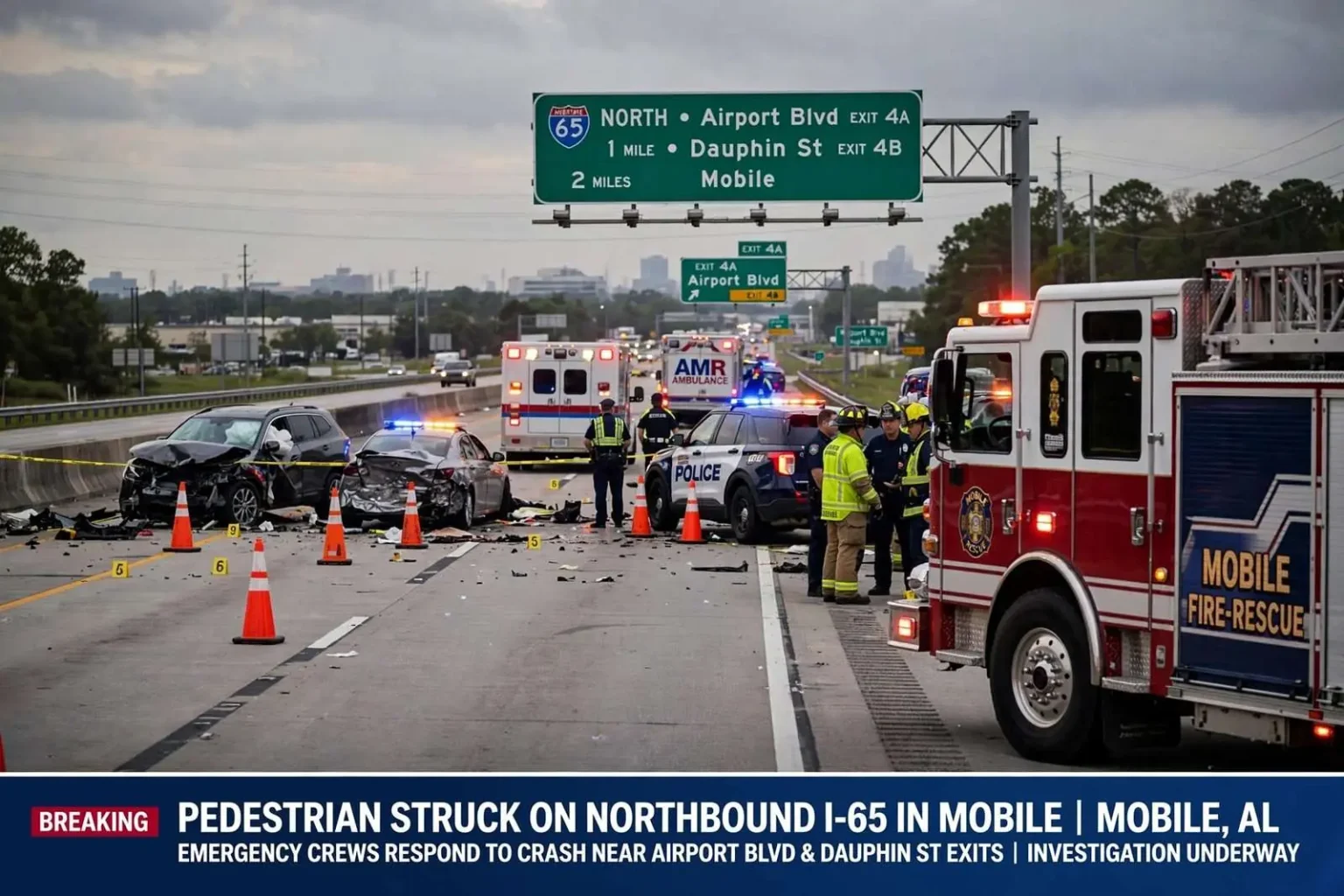
MOBILE, Ala. — Mobile Fire-Rescue is investigating a crash involving a pedestrian on northbound Interstate 65 between the Airport Boulevard and Dauphin Street exits. A viewer who passed the scene reported at least three vehicles were involved and that a person was down on the roadway. A news crew on the scene observed an ambulance leave without its sirens activated. Details on the pedestrian’s condition were not immediately available as investigators worked the crash.
Crashes involving pedestrians on an interstate are among the most dangerous and complicated incidents any traffic unit handles. Unlike surface-street collisions, interstate pedestrian crashes combine highway speeds, multi-lane traffic, and the fundamental question of how a person came to be on a roadway never designed for foot travel. The scene between the Airport Boulevard and Dauphin Street exits — a stretch of northbound lanes that carries commuters and freight through Mobile’s central corridor — was shut down as investigators documented vehicles, skid evidence, and the sequence of impacts that involved at least three cars and a person down on the pavement.
The details that could be confirmed were limited. A passing viewer reported the scene’s essentials — three vehicles, a person in the roadway — and a news crew arriving shortly afterward watched an ambulance depart without sirens, an observation that typically signals a patient whose condition is not immediately life-threatening, though it is not a definitive measure. Investigators had not released the pedestrian’s condition as they worked the scene, and the identity of the person and the circumstances that put them on the interstate remained part of the inquiry.
A busy corridor, a recurring problem
The segment of I-65 between Airport Boulevard and Dauphin Street is one of the busiest pieces of highway in the Mobile area, threading between interchanges that serve the city’s airport, medical district, and central neighborhoods. Pedestrians on interstate highways are a persistent nationwide problem, and it surfaces here as it does in urban corridors everywhere. Some pedestrians are drivers whose cars are disabled and who set out on foot; some are people experiencing homelessness moving along the corridors near service providers; some are individuals crossing deliberately; and some are struck after exiting vehicles involved in earlier crashes. Each scenario produces the same brutal physics: a person on foot against traffic moving at interstate speeds has almost no margin for error.
Traffic safety agencies have long studied pedestrian deaths on limited-access highways because they resist easy solutions. Engineering measures — fencing along rights-of-way, better lighting, signage — help at specific locations, but the corridors are long and the entry points many. Enforcement plays a role, with state troopers and local police removing intoxicated or stranded pedestrians from the roadway when they find them. And education campaigns remind drivers of a principle that applies on every highway: if your vehicle becomes disabled, stay in the car with seatbelts fastened and hazard lights on, and call for help rather than walking along or across the lanes.
The multi-vehicle character of this crash adds another layer to the investigation. When a pedestrian is struck, following drivers often brake or swerve, and secondary collisions among vehicles trying to avoid the scene are a common consequence. Untangling the chain — who hit what, in what order, and who could have done what differently — is the work of the traffic homicide investigators, who measure and photograph the scene before reopening lanes and then reconstruct the crash from physical evidence and witness accounts.
How investigators work the scene
Mobile Fire-Rescue’s role at a crash scene spans emergency medicine and hazard control. Paramedics triage and treat the injured, establish transport priorities, and coordinate with hospitals, while firefighters manage fuel spills, vehicle fires, and the traffic exposure that makes working on an interstate so dangerous. The decision about sirens on the ambulance ride to the hospital is made by the crew based on the patient’s condition; a quiet transport often means a stable patient, while lights-and-siren runs are reserved for emergencies where minutes matter.
Law enforcement investigators, meanwhile, work through a checklist that begins with scene safety and documentation. Lane closures are established to protect both the injured and the investigators. Vehicles are photographed and their positions mapped before they are moved. Skid marks, debris fields, and point-of-impact evidence are measured and recorded. Witness statements — from the drivers involved, the passing motorist who reported the scene, and anyone else who saw events unfold — are taken, and investigators will follow up as needed in the days afterward. Toxicology testing and vehicle inspections typically follow, and in serious cases the investigation feeds into potential charges ranging from traffic violations to felony counts, depending on what the evidence shows.
Mobile’s traffic units handle the busy corridors of the city with a familiar set of challenges: heavy commuter volume, freight traffic heading to and from the port, and the mix of local and through drivers that any interstate city sees. Pedestrian crashes on interstates remain comparatively rare next to surface-street collisions, but when they happen, they command the full apparatus of the region’s emergency services — as this one did.
What drivers should take from it
The economics of highway closures add context to how these incidents are managed. Every minute a travel lane is closed on a corridor like I-65 carries a measurable cost in delay and in secondary-crash risk, which is why incident commanders balance thorough documentation against the push to reopen. Alabama’s traffic incident management protocols push for clearance within set windows when possible, and tow operators on the region’s rotation contracts are measured on response and clearance times. None of that pressure, however, outweighs the investigative needs in a crash where someone was struck, and investigators will hold a scene as long as the evidence requires.
Incidents like this crash carry lessons for every driver who uses the corridor. The first concerns disabled vehicles: safety officials universally advise drivers whose cars fail on a highway to remain inside the vehicle if it is safely out of the travel lanes, keep seatbelts on, and activate hazard lights, because a person walking on or near high-speed lanes is far more vulnerable than a car standing still. If the vehicle is disabled in an active lane, the advice shifts — exit carefully through the side away from traffic and move behind a barrier, then call for assistance.
The second lesson concerns what drivers do when they come upon a crash. Alabama law requires motorists to move over a lane or slow down when passing stopped emergency vehicles, and the practice saves the lives of the responders and tow operators who work on foot beside live traffic. Drivers who report crashes while passing — as the viewer in this case did — provide a genuine service, since early notification brings help minutes faster than automated detection. Dispatchers need the location, the direction of travel, and what the caller can see, and even a brief call can shape the response.
Third, the ambulance that left without sirens is a small detail with a real meaning for observers trying to read a scene from a distance. Emergency transports run quiet when patients are stable, and jumping to conclusions from a single observation is unwise in either direction. Official confirmation of a patient’s condition typically follows the investigation’s initial phase, and until then, the details that circulate among passing drivers and on social media remain unverified.
The aftermath
Once the injured were treated and transported and the scene documented, the remaining work was logistical and investigative. The wrecked vehicles had to be removed, debris and fluids cleared from the lanes, and the roadway inspected before traffic could safely flow again — a process that kept at least part of the northbound side closed for a substantial period on a corridor where closures back traffic up quickly toward Government Boulevard and beyond. The crash report filed by investigators will record the vehicles, the people, the contributing factors, and the outcome, and it becomes the document on which any insurance claims or legal proceedings will rest.
For the drivers involved, the days after a multi-vehicle crash bring the familiar grind of adjuster visits, rental arrangements, and repair estimates, alongside whatever follow-up investigators require of them. For anyone injured, medical follow-up continues, and in cases where a pedestrian was struck, the person’s recovery — whatever its trajectory — will remain the central fact of the incident even as the highway returns to normal.
The crash also renews the questions that urban corridors like this stretch of I-65 keep generating: how to keep stranded drivers off the pavement, how to light and fence the rights-of-way, and how to reach the populations most at risk of walking along high-speed roads. Those answers come slowly and imperfectly, project by project and campaign by campaign. In the meantime, the corridor between Airport Boulevard and Dauphin Street resumes its daily traffic, and the reminder it offered on this day stands: a highway is no place for a person on foot, and the seconds after a vehicle breaks down are the most dangerous seconds a driver can spend deciding what to do next.
Authorities had not released the pedestrian’s identity or condition as investigators continued their work at the scene, and no charges had been announced in connection with the crash. Further details were expected as the investigation progressed.