Pensacola attorneys ask federal court to reject Skanska’s liability shield
A group of Pensacola law firms has asked a federal court to dismiss Skanska's bid to avoid liability for damage to the Pensacola Bay Bridge.
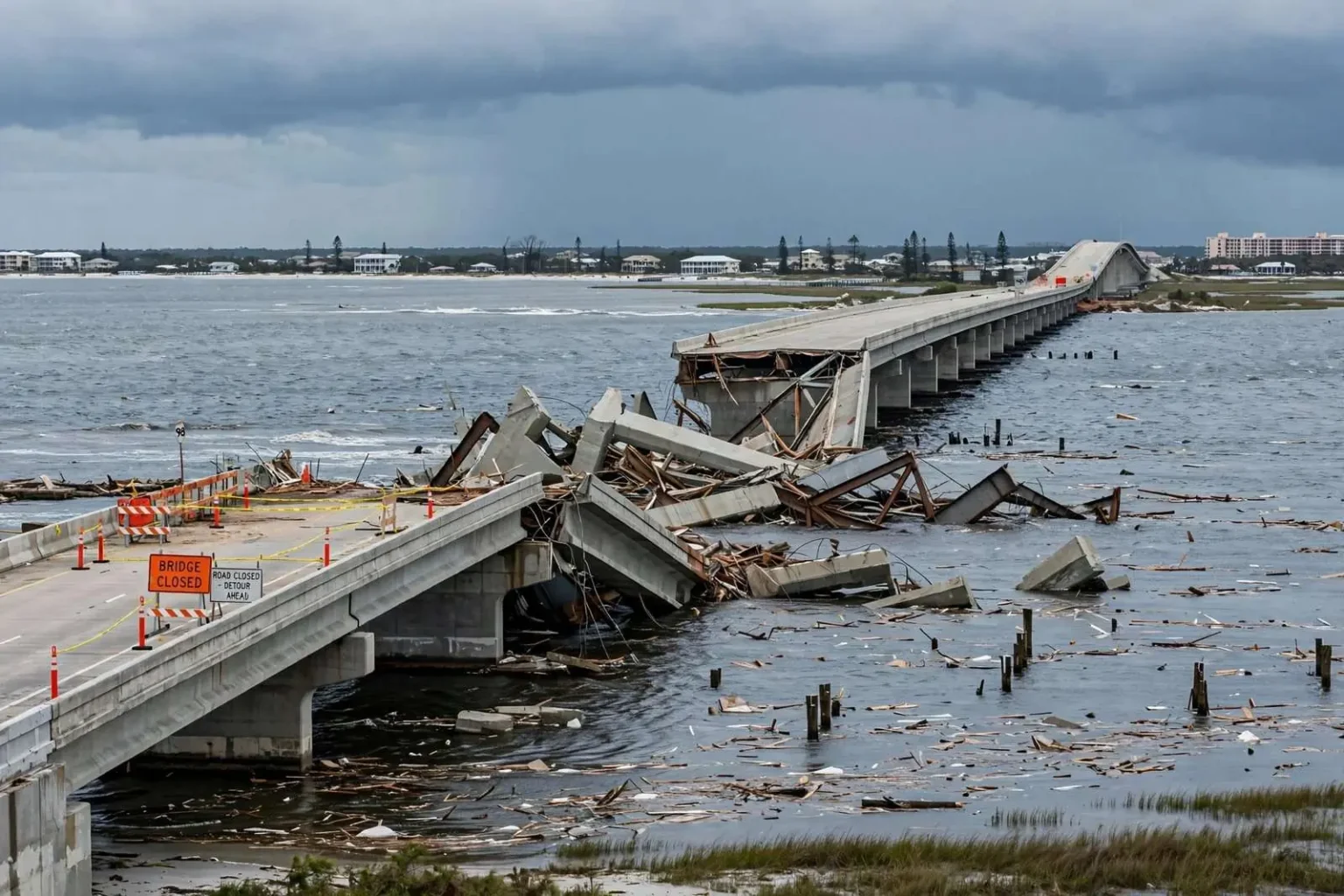
PENSACOLA, Fla. — A group of law firms has asked a federal court to toss out Skanska’s filings that sought to shield the construction giant from liability for damage tied to the Pensacola Bay Bridge. The legal maneuvering marks the newest phase of the long aftermath of the bridge’s hurricane damage, with Skanska facing more than 100 lawsuits filed by drivers and business owners on both sides of the bay who say the bridge’s closure devastated their livelihoods and daily lives.
The company has argued it should be exonerated and has asked federal courts to find it immune under maritime law, a legal theory that has become the central battleground of the litigation. Attorneys opposing the move say maritime law does not apply to a bridge builder, and they have urged the court to reject the filings outright. “Skanska failed to follow their own Hurricane Preparedness Workplan. I mean, that’s as red-handed as you get,” said attorney Sam Geisler of Alystock, Witkin, Kreis & Overholtz, one of several firms challenging the filings.
The bridge, the storm, and the closure
The Pensacola Bay Bridge carries U.S. 98 between Pensacola and Gulf Breeze across Pensacola Bay, linking the mainland city to the barrier-island communities of Santa Rosa County — Pensacola Beach above all. When the bridge was put out of service after Hurricane Sally’s assault on the Gulf Coast, the three-mile crossing that tens of thousands of vehicles used daily vanished from the region’s map, and the two sides of the bay were thrown back onto detours that stretched commutes from minutes to hours and stranded the beach communities’ commerce.
The closure’s consequences are what populate the docket. More than 100 lawsuits — filed by drivers and business owners on both sides of the bay — claim damage from the loss of the crossing: businesses on Pensacola Beach that lost their customers, businesses in Pensacola that lost their beach trade, workers who could not reach jobs, and residents who paid the price in time and fuel for as long as the span stayed closed. The bridge closure has cost businesses on both sides of the span, and owners have expressed frustration that Skanska is attempting to limit its liability rather than answer the claims directly.
The maritime-law argument
Skanska’s request that federal courts find it immune under maritime law is the company’s structural defense, and it explains why the fight is happening in federal court at all. Maritime law — the body of federal law governing navigable waters — carries its own limitation regimes and its own provisions under which parties can seek to cap or extinguish their exposure to claims. The strategy has a long pedigree in Gulf Coast maritime litigation, where vessels, ports, and offshore operations have used it for generations. What the plaintiffs’ firms dispute is its fit here: in their view, a contractor building a highway bridge is not a maritime actor, and a bridge — however much of it stands over navigable water — is not a vessel, so the doctrines Skanska invokes do not reach the claims at all.
The plaintiffs’ ask is straightforward: that the court toss out the filings that sought the shield, clearing the more than 100 lawsuits to proceed on ordinary negligence and contract principles in front of ordinary juries. Their confidence rests on the factual record they describe — a contractor’s own Hurricane Preparedness Workplan that they say went unfollowed when Sally arrived. Geisler’s formulation, “that’s as red-handed as you get,” compresses the theory: if the company wrote a plan and did not execute it, the liability questions are ordinary ones, not maritime mysteries.
The firms on the plaintiffs’ side
The challenge to Skanska’s filings involves several of the Pensacola area’s best-known plaintiffs’ firms. Alystock, Witkin, Kreis & Overholtz — the firm of attorney Sam Geisler, whose “red-handed” assessment of the abandoned workplan has become the plaintiffs’ shorthand — is joined by Levin Papantonio Rafferty, one of the region’s largest mass-tort and personal-injury practices; Beggs & Lane, one of Pensacola’s oldest firms; and Zarzaur Law, a prominent personal-injury practice based downtown. The concentration of local legal talent on one side of the case reflects both the scale of the claims and the case’s significance to the community the firms share with their clients.
The breadth of that roster matters procedurally as well as symbolically. Coordinated challenges to a defendant’s limitation strategy require substantial resources, and the involvement of firms with national mass-litigation experience alongside Pensacola’s established civil practices gives the plaintiffs’ side both depth and local standing. For the more than 100 claimants, the firms’ coordination is the mechanism by which individual grievances — a lost season of a beach shop, a missed commute, a shuttered restaurant — become a unified answer to a multinational contractor’s legal maneuvering.
What the claims look like on both sides of the bay
The geography of the claims tells the story of the closure’s economics. On the Gulf Breeze and Pensacola Beach side, the plaintiffs are businesses whose customer base arrived over the bridge — beach restaurants, retail shops, rental operations, and service businesses that saw their trade collapse when the crossing closed. On the Pensacola side, the plaintiffs include businesses dependent on beach traffic passing through and workers whose routes to employment ran across the bay. Drivers round out the docket — residents whose daily crossings became hours-long detours through the region’s inland corridors for the duration of the closure.
The detour economics deserve their own accounting, because they are what turned a damaged bridge into a regional liability event. With the crossing out of service, traffic between Pensacola and the beaches was pushed onto the region’s remaining routes, principally the long loop around the north end of the bay through Milton and the Garcon Point crossing, adding substantial distance and toll costs to every trip. A fifteen-minute commute became a hour-plus drive each way; a lunch customer from Pensacola became an all-afternoon expedition. Business owners on both shores watched revenue fall, and their lawsuits seek to place that lost revenue at Skanska’s door.
The frustration behind the filings
Owners on both sides of the span have expressed frustration that Skanska is attempting to limit its liability — a frustration the plaintiffs’ firms have channeled into their court filings. From the claimants’ perspective, the limitation strategy reads as an attempt to relitigate the case’s fundamentals before the merits are ever heard: if the maritime shield holds, the questions of preparation, planning, and the unfollowed workplan might never reach a jury at all, and claims might be capped or extinguished regardless of their strength.
That is precisely what the firms’ motion asks the court to prevent. By asking the court to toss out Skanska’s filings, the plaintiffs’ side is asking for the ordinary sequence — discovery, trial, verdict — applied to the ordinary claims. The court’s ruling on the maritime question will shape everything that follows, which is why both sides have fought it as the case’s decisive battle.
Skanska and the scale of the project
Skanska, the Swedish construction multinational that built the bridge as the region’s flagship infrastructure project, entered the litigation with a reputation to defend on both sides of the Atlantic. The new Pensacola Bay Bridge — a design-build replacement for the aging 1960 crossing — was one of the largest transportation projects in the Florida Panhandle’s history, and its completion was celebrated as a milestone for the region before the storm intervened. The company’s liability position in the lawsuits is therefore about more than the claims themselves; it is about how the firm’s most prominent Gulf Coast project will be remembered, and what the litigation says about the allocation of risk on major coastal infrastructure work.
The company’s position, as expressed through its filings, is that it should be exonerated — that its work did not cause the losses claimed, and that in any event the maritime framework limits what can be recovered. The plaintiffs’ position is that the company’s own planning documents tell a different story. Between those positions sits the federal court, now holding the motion that both sides treat as the case’s hinge.
Lessons embedded in the litigation
Whatever the outcome, the Skanska litigation has already become a reference point for Gulf Coast infrastructure and insurance conversations. The case poses, in a single docket, the questions every coastal community confronts after a major storm: who bears the cost when a critical crossing fails, how contractors’ storm plans are enforced, and whether the legal doctrines written for ships and sailors can be stretched to cover a highway bridge. The answers will be watched well beyond Pensacola Bay, by contractors, insurers, and coastal governments from Texas to the Carolinas.
For the Pensacola Bay area itself, the stakes are concrete: more than 100 claims by neighbors whose businesses and routines were upended, a bridge rebuilt and reopened, and a legal question — whether a bridge builder can claim the sea’s protections — that will decide how much of the storm’s cost the company that built the crossing will ever have to answer for. The plaintiffs’ firms have made their ask: reject the shield, and let the claims be tried. The court’s answer will write the next chapter of a dispute that began when the wind ended.
The case remains pending, and the descriptions of both sides’ positions above reflect their court filings and public statements rather than judicial findings. The more than 100 lawsuits continue forward as the maritime question is resolved.