
Pensacola Council Delays Decision on Proposed Youth Curfew
The Pensacola City Council took no action on a proposed curfew for unsupervised minors after debate, with members raising concerns and the mayor citing poor communication.
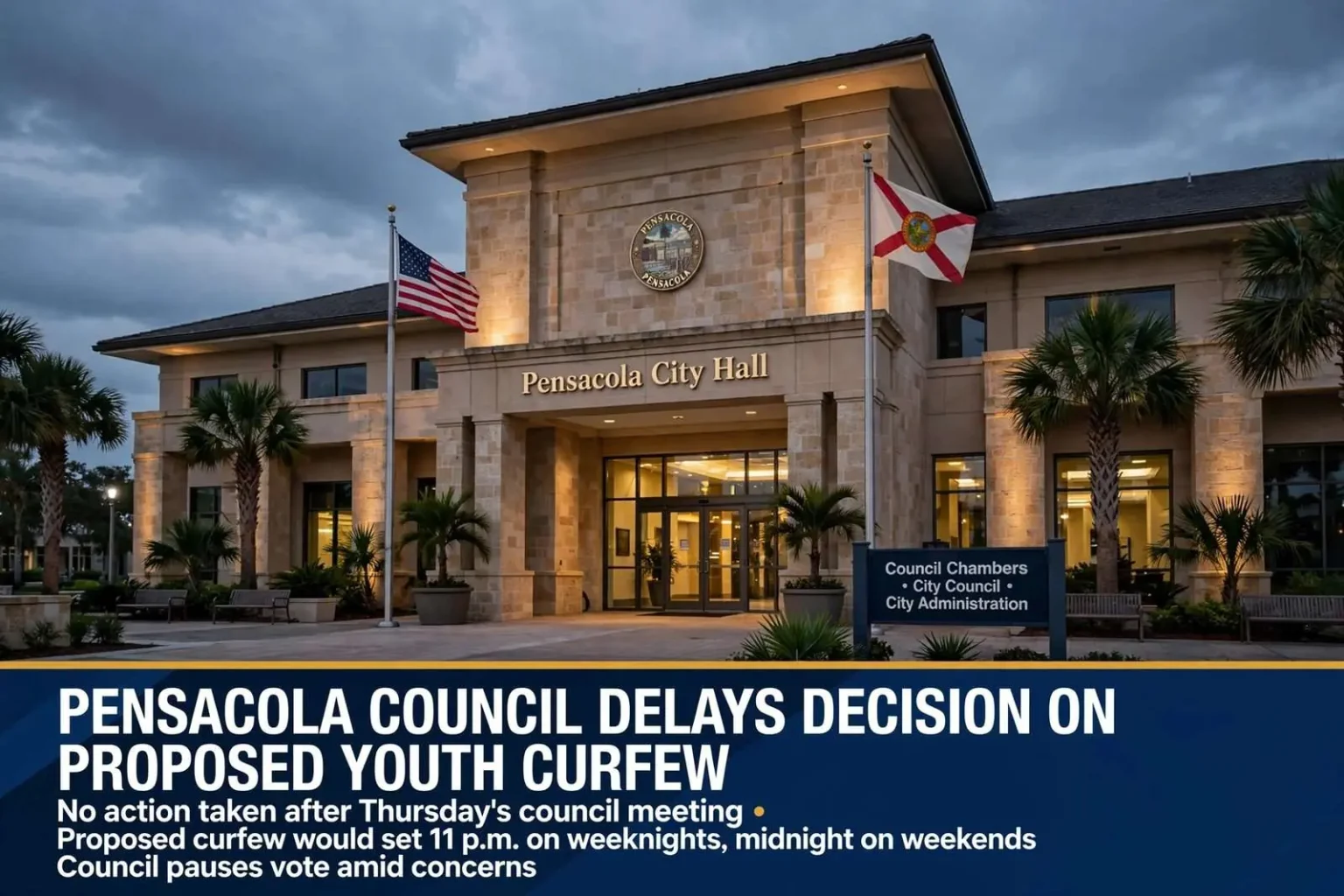
PENSACOLA, Fla. — The Pensacola City Council has put a pause on a proposed curfew for unsupervised minors. After a debate at last Thursday’s meeting, no action was taken on the ordinance.
Under the proposal, those under the age of 18 could be out until 11 p.m. on weeknights and midnight on weekends. Exceptions would be made for religious events, emergencies, and teens leaving work. Penalties would be civil rather than criminal and would increase for repeat offenders, with a possible $250 fine for minors and up to $500 for parents.
The structure of the proposal — civil penalties rather than criminal charges, graduated fines, and carve-outs for work and worship — reflects the legal and practical lessons cities have absorbed from decades of curfew ordinances. Courts around the country have struck down or narrowed curfews that failed to provide exceptions for First Amendment activity, emergencies and employment, and municipalities that have kept their ordinances on the books have generally written them with those carve-outs built in from the start.
Supporters of youth curfews typically cite safety in both directions: keeping minors out of situations where they are likeliest to be victims, and giving police a tool to break up late-night gatherings before they turn violent. Critics answer with questions of effectiveness and fairness — whether curfews actually reduce juvenile crime, and whether enforcement falls disproportionately on certain neighborhoods and on kids who are simply waiting for a ride after a late shift.
Pensacola’s debate surfaced both arguments and then some, and the council’s decision to take no vote suggests the questions were not rhetorical. An ordinance that goes into force over a divided council tends to draw legal challenges and uneven enforcement, and several members appeared unwilling to hand future administrations that inheritance.
Council concerns
Many council members raised concerns about the measure. “I know you say that we’re not going out and looking to enforce this. We’re not going out and searching for people who are underage, but my concern is that 10 years down the road, we don’t know who our police chief will be, we don’t know who our mayor’s going to be,” said Councilmember Casey Jones. “And in that case, is it someone that’s going to go out and be doing that and we’re going to be in a much different situation because of something that we voted on today? That concerns me.”
Jones’s argument gets at the durability of ordinances: a curfew adopted as a light-touch deterrent can become a heavy-handed enforcement tool under a different police chief with different priorities, and a future council would inherit a law rather than a choice. Municipal attorneys note that this is precisely why sunset clauses and periodic review requirements have become common in ordinances of this kind — they force the question to be asked again.
Councilmember Teniadé Broughton pointed to a lack of options for young people. “I just think that no one is touching that gap because the kids want to go somewhere,” she said. “We just don’t have the places for them to go.”
Broughton’s objection reframes the issue from enforcement to investment. Cities that have studied youth crime consistently find that structured evening programming — late-night recreation centers, athletic leagues, job training — does more to keep minors off the street than citation authority does, and that a curfew without alternatives simply moves the problem indoors. Her point about the gap: adolescents and teenagers have few public places that welcome them at night, and the absence is itself a policy failure.
Pensacola has invested in its downtown and waterfront in recent years, building an entertainment district that draws adults by the thousands on weekends, while the question of what the city offers its own teenagers after dark has drawn far less attention. Council members on both sides of the curfew debate acknowledged that imbalance, even as they differed on what to do about it.
Mayor cites communication gap
Pensacola Mayor Reeves said his disappointment lies in the lack of communication ahead of the meeting. “If there’s any council member that said, ‘Hey, look, we’re uncomfortable about 18 or 21,’ if that would have been brought up as a motion or an amendment in the meeting, that would have — you know, there was no pushback from us on that,” Reeves said. “But I think it just is a symbol of conversation that could have happened on August fourth or fifth or sixth or seventh or eighth or ninth, you know, all the way till the meeting, that we could have absolutely obliged and worked more collaboratively…”
The mayor’s complaint concerns process as much as policy. Municipal ordinances in Florida typically move through a first reading, public notice and a second-reading vote, and the weeks between are when amendments get negotiated. Reeves’s point was that the council had time to reshape the proposal — the age threshold, the penalties, the enforcement priorities — and that the disagreement surfacing at the meeting, rather than before it, left the city with a pause instead of a product.
That dynamic is common in council government, where any member can raise concerns at the last moment and send an item back to committee. Administrations that legislate successfully tend to count votes and collect amendments before the meeting; the ones that do not end up where Pensacola did, with a proposal everybody has an opinion about and nobody has voted on.
For the ordinance’s supporters, the delay is a setback but not a defeat. The proposal remains drafted and on the record, and councils routinely bring paused items back after refining them. The question when it returns will be whether the intervening weeks produce the collaboration the mayor asked for — or simply more of the concerns that stalled it.
What happens next depends on whether the proposal returns in its original form or in a revised one. Council members who hesitated have a menu of options used elsewhere: a higher age threshold, a warning-first enforcement policy, a sunset clause forcing the council to reauthorize the curfew after a year, or a parallel investment in youth programming that addresses the gap Broughton identified. Any of those could bring the hesitant votes along — or the item could simply lapse, as many paused ordinances do.
The police department’s role will be central to whichever direction the council chooses. Curfew laws are enforced by officers exercising discretion in the field, and departments vary widely in how they handle it — some issue citations, some transport minors home, some simply document the contact. A council adopting a curfew is, in practice, writing a script for thousands of individual encounters, which is why the question of who holds that power in ten years drew so much of Thursday’s debate.
The penalties themselves are modest by the standards of municipal fines but not trivial for the families most likely to face them. A $500 fine for a parent can consume a week’s take-home pay, and critics note that fining the parents of teenagers they cannot control can deepen the instability the ordinance is meant to address. Cities that have paired curfews with family services — counseling referrals, diversion programs, community service alternatives — report better outcomes than those that rely on fines alone.
Pensacola’s young people, meanwhile, remain subject to the rules that existed before the proposal: state law and parental authority, park hours and business policies, and the reality that most of the city’s evening entertainment is built for adults. Whether a curfew joins that landscape, and on what terms, will be decided at a future meeting — the next chapter in a debate the council has chosen to slow down rather than settle.
Nationwide, the track record of youth curfews is mixed enough that both sides of the Pensacola debate could claim the evidence. Some cities report drops in late-night juvenile incidents after adoption; researchers have countered that the drops often trace to factors other than the ordinance, and that curfews shift enforcement resources toward nonviolent contacts with teenagers. What virtually every study agrees on is that enforcement choices — who gets stopped, where, and for what — determine whether a curfew builds public trust or erodes it.
Florida municipalities that have adopted curfews have generally paired them with parental notification and clear exceptions, and courts there have upheld ordinances that are narrowly tailored. Pensacola’s draft followed that template, which is why much of Thursday’s disagreement centered not on the legal structure but on the policy judgment underneath it: whether the city needs the tool at all, and what it says about a city if it does.
The timing of the pause matters too. Council seats and administrations change, and proposals that stall during one term rarely return unchanged. Supporters of the curfew will need to rebuild momentum if the item slips past the current council’s agenda, while opponents will treat the delay as validation of their argument that the city’s energy is better spent on the youth programming gap Broughton described.
The pause, in the end, may prove to be the most consequential vote of the night. It preserved every option: the ordinance can return amended, return unchanged, or disappear into the file of proposals the council discussed and never adopted. Which of those happens will tell residents how their council weighs safety, liberty and the unfinished business of building a city that has something for its teenagers to do.