Pensacola group Project Unity reaches out to kids after recent gun violence
After recent shootings in Pensacola, the group Project Unity is using education and mentorship to steer children away from gun violence.
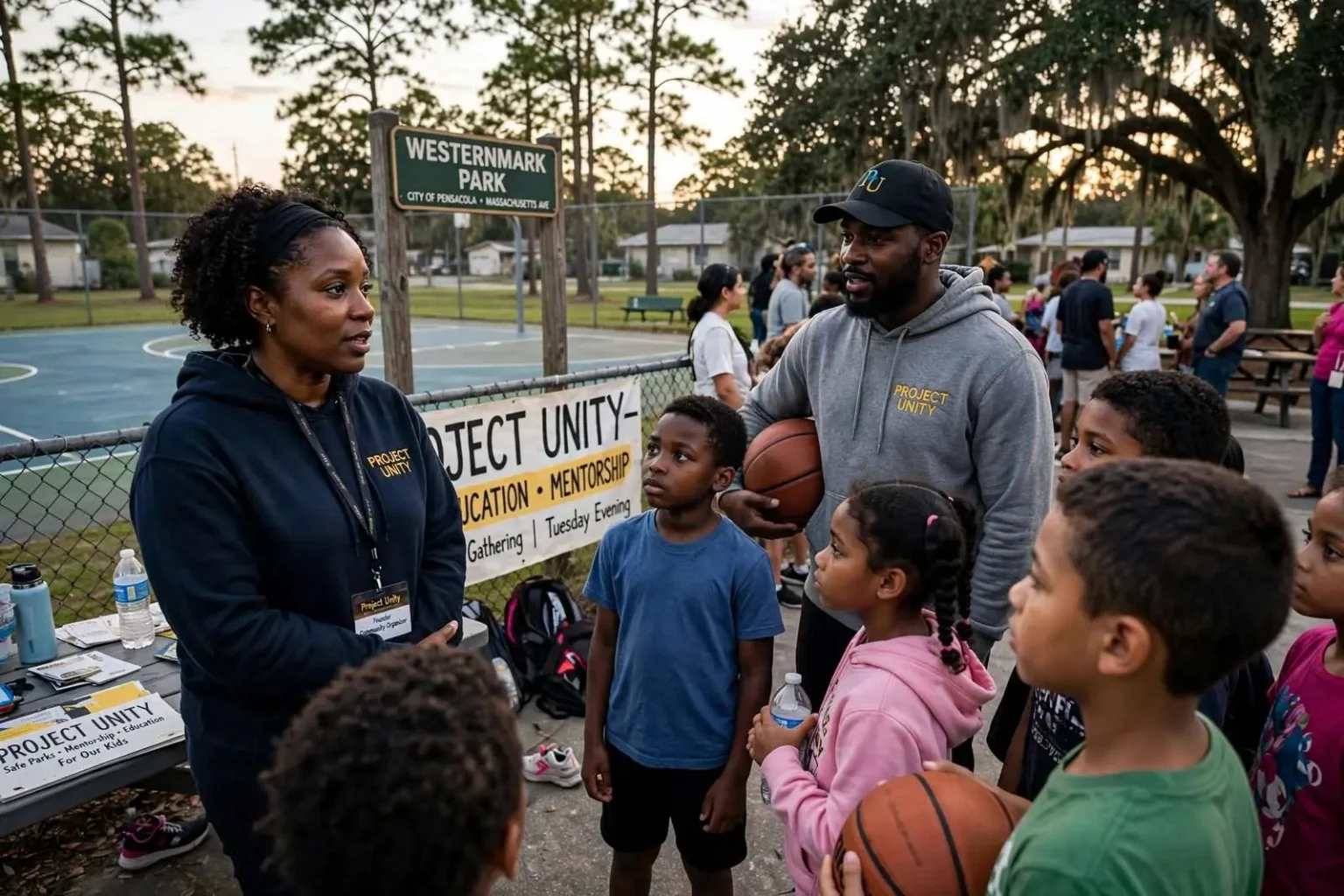
After a string of recent shootings and killings in the Pensacola area, a local organization is working to curb gun violence through education and mentorship. Marcella Powell and Antonio Royster founded a group called Project Unity, and they brought the community together Tuesday evening at Westernmark Park on Massachusetts Avenue, turning a neighborhood park into a gathering place for families and children who have watched gun violence move closer to their own streets and households.
“It takes unity,” Powell said. “It takes unification. It takes people standing together to develop a strong team that’s unbreakable to really take the community back by force.” Her words captured the philosophy behind the gathering: that violence in a neighborhood is a community problem that community members, not just police, have to confront directly, block by block and park by park.
Reaching Children Where They Are
Royster played basketball with children in the neighborhood and talked with them about the gun violence affecting their lives. The conversations were not abstract. One young boy’s cousin had been killed recently, a reminder that for the children at Westernmark Park, gun violence is not a news story but a family loss, and that the mentors working the park are often the first adults to hear about it. Royster said the effort is rooted in education and keeping children on a path to success.
“Our main mission is for them to not be dead or in jail,” he said. “We want to get you educated. Sports is not everything. Education is everything because you can’t take away their education but you can get injured in sports.”
That message, delivered on a basketball court rather than in a classroom, is deliberate. Mentorship programs that work in neighborhoods affected by violence tend to start with the activities children already choose, basketball, playground games, after-school gatherings, and build trust from there. Project Unity’s founders are applying that model in Pensacola’s neighborhoods, pairing athletic activity with direct talk about the choices and risks the children face.
The Context: A String of Shootings
The group’s outreach follows a string of recent shootings and killings in the Pensacola area, a pattern that has put pressure on neighborhood organizations, churches and the city to respond beyond law enforcement alone. Communities across the Gulf Coast have learned that arrests and prosecutions, however necessary, do not by themselves rebuild the sense of safety in neighborhoods that have lost residents to gunfire. The response that emerges most quickly usually comes from within the community itself, from residents who know the children by name and who can show up on a Tuesday evening when it matters.
Pensacola’s experience mirrors that of cities across the Panhandle and south Alabama, where gun violence concentrates in specific neighborhoods and claims victims who are often young. Public health approaches to violence, treating it like an epidemic that spreads through networks of relationships, have gained ground in recent years precisely because they emphasize interruption and mentorship at the street level. Project Unity’s founders are working that ground: park gatherings, basketball, one-on-one conversations and a message that education is the path out.
Westernmark Park, on Massachusetts Avenue, is the kind of public space where this work has to happen. Neighborhood parks in Pensacola serve as the informal centers of their communities, the places where children play after school and where families gather in the evenings. When violence strikes a neighborhood, the park is both a symbol and an opportunity: it is where children most need to feel safe, and it is where mentors can reach the largest number of them at once. By organizing there, Project Unity put its message in the middle of the daily life of the affected community.
The Tuesday evening gathering also demonstrated the format that community violence outreach tends to take: no podium, no formal program, just adults present and engaged. Royster’s basketball game with the children did more recruiting than any flyer could, and Powell’s appeal for unity framed the evening’s purpose for the adults standing around the court. The combination, recreation for the children and a direct message for everyone, is a template that has been used effectively in neighborhood anti-violence work for decades.
Education as the Long Game
Royster’s emphasis on education over sports carries a specific lesson for the children he was talking to. Young athletes in every community grow up hearing that sports can be their way out, and for a small number that is true. But the arithmetic is unforgiving: almost no one makes a living in athletics, while an education opens doors that remain open for life. Royster’s framing, “you can’t take away their education but you can get injured in sports,” is a mentor’s shorthand for that reality, and it reflects the practical wisdom of adults who have watched talented young people pin everything on athletic dreams that did not survive contact with circumstances.
The mission he stated, “for them to not be dead or in jail,” is blunter still, and it reflects the stakes in neighborhoods where shootings have become frequent. In that environment, mentors measure success in the near term by the children they keep engaged, in school, at the park, in conversation, and in the long term by the adults those children become. Programs like Project Unity do not publish their outcomes in statistics; their results show up years later in graduation notices and in the shootings that never happened.
The Work Ahead
For Powell and Royster, one Tuesday evening at Westernmark Park is a beginning rather than a conclusion. Community groups that take on gun violence face the same recurring challenges: sustaining funding, keeping volunteers engaged and maintaining trust with the children they serve over months and years, not just in the weeks after a killing. The organizations that endure are usually the ones embedded in the neighborhood, led by people who live where they work and who show up consistently enough that families begin to count on them.
Pensacola’s civic institutions, its churches, schools and neighborhood associations, have a track record of rallying after high-profile violence, and Project Unity’s founders are part of that tradition. What their work adds is a focus on the youngest residents, delivered in the setting where they spend their free time and carried by mentors who talk to them honestly about education, choices and survival. As the community continues to absorb the losses of recent months, the sight of adults playing basketball with children in a park on Massachusetts Avenue, and talking with them about what it takes to stay alive and out of trouble, is a small but concrete answer to the question of what a neighborhood can do for its own.
The founding partnership between Powell and Royster reflects the division of labor that makes grassroots mentorship groups function. One founder carrying the message of unity to adults, the other building trust with children through games and conversation, together they cover both halves of the work: mobilizing the community and reaching the young people the community is trying to protect. Groups led by pairs or small teams of committed residents tend to be nimble, able to organize a park gathering on short notice after an incident and to keep showing up without waiting for institutional approval or funding cycles.
Their approach also reflects lessons drawn from violence-reduction efforts across the country. Cities that have made measurable progress against neighborhood gun violence have generally combined law enforcement with credible messengers, residents who have standing in the neighborhood and can reach young people that institutions cannot. The credibility of a mentor who plays basketball with a child, learns that the child’s cousin was killed and keeps coming back is something no program can manufacture; it has to be lived. That is the asset Project Unity’s founders bring to Pensacola’s streets.
How Violence Reshapes a Neighborhood
A string of shootings changes a neighborhood in ways that residents feel daily. Children adapt their play to avoid certain streets, parents shorten or cancel outdoor time, and the normal informal supervision that parks and sidewalks provide weakens as people withdraw indoors. That withdrawal creates the vacuum in which further violence grows, which is why reoccupying public spaces, holding the park, playing the game, is itself a strategy and not just a gesture. Every evening a park is full of children and watchful adults, it is less available for the activity that neighborhoods fear.
The grief carried by children in such neighborhoods is also easy for outsiders to underestimate. A child whose cousin was killed carries that loss to school, to the playground and to every conversation about the future. Mentors who notice, who ask and who listen perform a function that sits between counseling and parenting, and the conversations Royster described, talking with children about the gun violence affecting their lives, are how that work begins. Naming the violence out loud, in the park where it happened nearby, strips away some of the silence that lets children process such losses alone.
The Gulf Coast Tradition of Community Response
Pensacola’s neighborhood response to violence sits within a broader Gulf Coast tradition. Communities from Mobile to Panama City have long relied on churches, fraternal organizations and volunteer groups to fill gaps that government programs do not reach, and anti-violence mentorship is a natural extension of that tradition. The region’s size works in its favor: neighborhoods are close-knit enough that the founders of a group like Project Unity know the families involved, and small enough that a Tuesday evening gathering can draw participants from several blocks in every direction.
The children playing basketball at Westernmark Park this week will grow up in the Pensacola that results from these efforts, whatever their outcome. The founders’ bet is that consistent presence, honest conversation and an insistence on education can tilt the odds for the children they reach, one park and one block at a time. Powell’s call for an unbreakable team standing together, and Royster’s insistence that education outlasts everything else, are the working principles of that bet, offered not from a podium but on the blacktop, where the children who need to hear them are actually standing.