Pensacola man held without bond on charges of child sexual abuse
A Pensacola man is held without bond after being accused of sexually abusing a girl under 12 over several years, the Escambia County Sheriff's Office said.
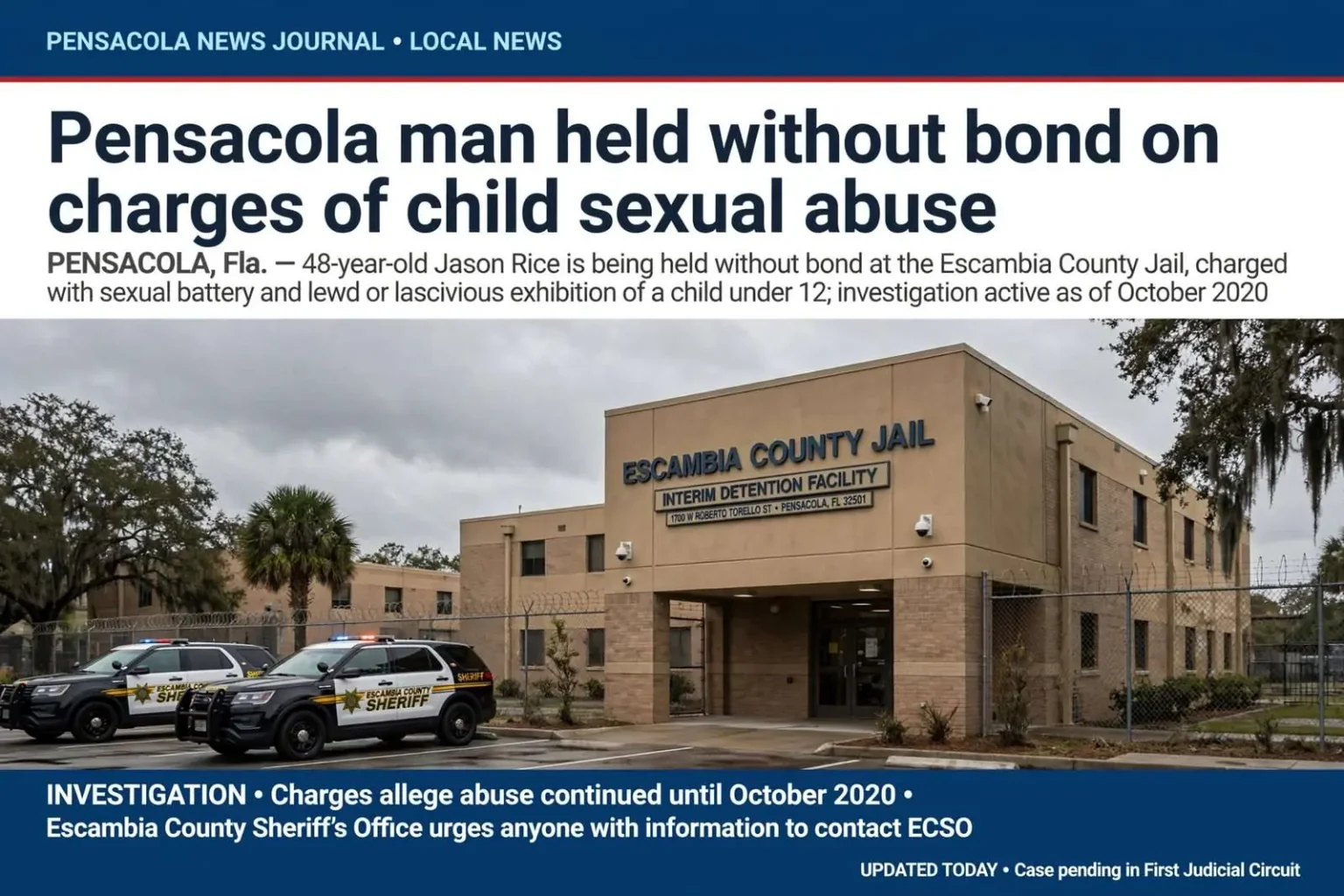
PENSACOLA, Fla. — A Pensacola man is being held without bond in the Escambia County Jail after he was accused of sexually abusing a girl under the age of 12 over a period of several years, according to the Escambia County Sheriff’s Office.
Jason Rice, 48, faces charges of sexual battery and lewd or lascivious exhibition of a victim younger than 12, authorities said. The alleged abuse continued until October 2020, according to the sheriff’s office, which has not released further details about how the case came to light or the relationship between the defendant and the child.
The investigation remains active, and anyone with information is urged to contact the Escambia County Sheriff’s Office.
The charges
Sexual battery on a victim under 12 is among the most serious charges in Florida’s criminal code, carrying potential penalties of life imprisonment upon conviction. The lewd or lascivious exhibition charge likewise covers serious felony conduct involving child victims. Together, the counts reflect the kind of case that Florida prosecutors handle through specialized units focused on crimes against children.
Because the allegations involve a child victim, details that would normally appear in an arrest report — names, ages of witnesses, the nature of disclosures — are withheld from public release. Florida’s courts and law enforcement agencies generally limit what is published in such cases to protect the identity of the child, whose testimony and privacy will shape the case going forward.
Held without bond
Being held without bond means a judge has determined that no release conditions — monitoring, supervision, distance requirements — can reasonably assure the safety of the community and the child while the case is pending. In Florida, pretrial detention without bond is reserved for the most serious felony categories and for defendants the court finds pose a specific danger if released.
The defendant will remain in the Escambia County Jail as the case moves through the system, with future hearings set by the court. First appearances, arraignments and, ultimately, trial or resolution will follow the standard timeline for major felony prosecutions, a process that often takes many months in cases of this kind.
During the pendency of the case, no-bond defendants remain in custody continuously rather than cycling through release and recall, and court dockets in the region schedule felony cases months out. Continuances are common as discovery proceeds, and defense counsel will test every element of the state’s evidence before any resolution.
How these cases are built
Investigations into long-term child abuse typically involve several agencies working together. In Escambia County, the sheriff’s office works with child protection investigators and the local children’s advocacy center, where forensic interviewers are trained to talk with children in ways that are legally sound and minimally traumatic. Medical examinations, when needed, are conducted by specialists, and evidence is reviewed by prosecutors before charges are filed.
Because the alleged abuse in this case continued until October 2020, investigators will be working to document a span of time rather than a single incident — collecting records, interviewing witnesses and correlating disclosures. Multi-year cases present distinct evidentiary challenges, and prosecutors generally move carefully before bringing them to a jury.
The sheriff’s office has emphasized that the investigation remains active, a signal that detectives are continuing to interview potential witnesses and are asking anyone with information to come forward. In cases with child victims, investigators frequently ask whether others had opportunities to observe conduct or disclosures that were never reported.
Reporting suspected abuse
Florida law requires everyone to report suspected child abuse, not just professionals in certain fields. Reports go to the Florida Abuse Hotline, which is staffed around the clock and accepts calls, faxes and online reports. Callers can remain anonymous, and the hotline screener determines whether the report meets the threshold for investigation by the Department of Children and Families or law enforcement.
In Escambia County, the sheriff’s office urged anyone with information about this case to contact the agency directly. Investigators note that delayed reports are common in child abuse cases — children often disclose years after the conduct occurred — and that information provided late can still be critical to an active case.
Resources for children and families
Pensacola and Escambia County are served by a network of child protection resources. The local children’s advocacy center coordinates forensic interviews, therapy referrals and victim support in one location, sparing children from repeating their accounts to multiple agencies. Victim advocates with the State Attorney’s Office guide families through each stage of a prosecution, from first appearance through sentencing.
Statewide, the Department of Children and Families handles protective investigations, and foster and kinship placement resources exist for children who cannot remain at home during a case. Counseling services for child victims of abuse are available through community providers regardless of whether criminal charges are ever filed.
The scale of the problem
Child welfare advocates stress that cases like this one represent a fraction of the abuse that occurs. National studies have consistently found that a majority of child sexual abuse is never reported during childhood, and that most victims know the person who harmed them — which is one reason disclosure is so difficult and why delayed disclosures are the norm rather than the exception.
That reality shapes how agencies investigate. Investigators are trained to corroborate cases through patterns, records and witness observations rather than relying solely on a child’s account, and prosecutors in Florida’s child-focused units build cases with those dynamics in mind. The state’s statutes of limitations for serious offenses against children are long, reflecting an understanding that disclosure often comes late.
The case ahead
Jason Rice, 48, remains held without bond at the Escambia County Jail as the case proceeds. The charges — sexual battery and lewd or lascivious exhibition of a victim younger than 12 — will be tested in court, and the defendant is presumed innocent unless and until proven guilty.
The Escambia County Sheriff’s Office has not announced additional arrests or charges. The investigation remains active, and anyone with information is urged to contact the Escambia County Sheriff’s Office.
Inside the Escambia County system
The arrest of a 48-year-old Pensacola man on charges involving a child under 12 is the kind of case that mobilizes several parts of the local justice system at once, from the sheriff’s detectives who built the file to the advocacy center staff who support the child. What follows is a long, careful legal process in which every step is documented and every disclosure is tested.
The Escambia County Sheriff’s Office is the primary law enforcement agency for the Pensacola area outside city police jurisdiction, and it investigates thousands of cases a year across a county of more than 300,000 residents. Its criminal investigations division handles crimes against children through detectives who receive specialized training in interviewing, evidence handling and the dynamics of abuse within families and households.
Cases that result in charges move to the State Attorney’s Office for the First Judicial Circuit, which covers Escambia, Santa Rosa, Okaloosa and Walton counties. Prosecutors there coordinate with investigators, review the admissibility of evidence, and prepare child witnesses for testimony with the help of advocates and, where permitted, remote or closed-circuit arrangements designed to reduce courtroom trauma.
What happens at each stage
After an arrest in a no-bond case, the defendant appears before a judge for first appearance within a day or two, where the charges are read and counsel is addressed. Subsequent stages — arraignments, discovery, pretrial motions and mediation or trial — unfold over months. Defense counsel will test every element of the state’s case, from the forensic interviews to the medical and physical evidence.
Most serious felony cases in the circuit resolve through negotiated pleas, but cases involving child victims sometimes go to trial when the parties cannot agree, and trials in such cases draw on careful jury selection. Sentencing in Florida for the most serious offenses against children is governed by mandatory minimums and, at the top of the scale, life imprisonment.
The community’s role
Sheriff’s officials use cases like this to remind residents that reporting suspicions early can protect children from continued harm. Teachers, coaches, neighbors and relatives are often the first adults a child tests with a partial disclosure, and how an adult responds — calmly, without interrogation, and with a report to authorities — can determine whether a case is ever investigated at all.
The investigation into the allegations against Jason Rice remains active. Anyone with information is urged to contact the Escambia County Sheriff’s Office.
Advocates also point caregivers and professionals to prevention education programs offered across the Panhandle, which train adults to recognize warning signs, minimize one-on-one isolation between children and adults, and open age-appropriate conversations with children about their bodies and boundaries. Programs of that kind are offered through schools, faith communities and child-serving organizations in the Pensacola area, and they remain the front line of a problem that law enforcement can only address after the harm has occurred.