Pensacola man sentenced to 20 years in DUI crash that killed two siblings
A Pensacola man was sentenced to 20 years in prison for a DUI crash on Kingsfield Road in Cantonment that killed two siblings.
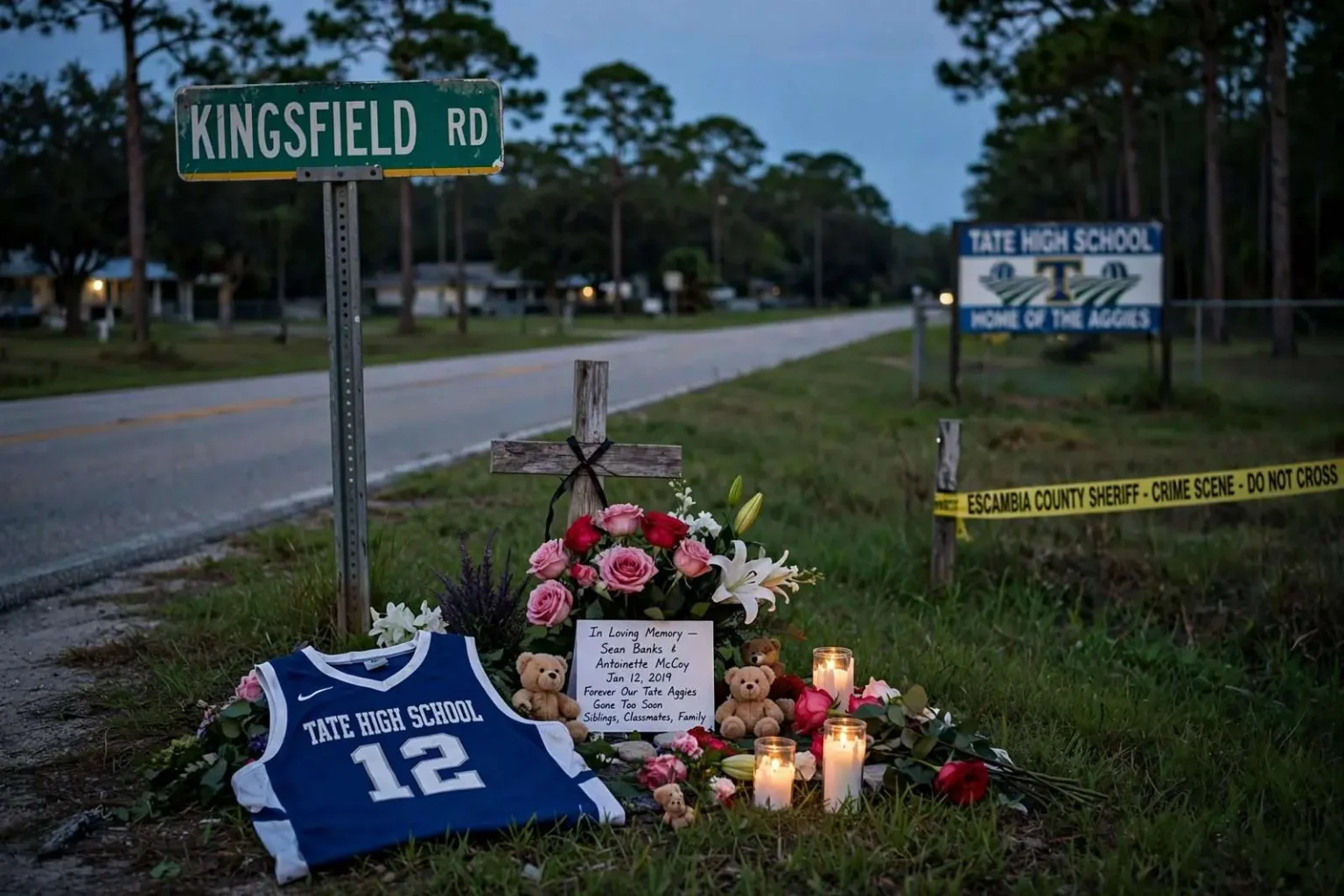
CANTONMENT, Fla. — A Pensacola man has been sentenced to 20 years in prison for a 2019 crash that killed two siblings, according to court records. The sentence resolves a case that has hung over the Cantonment community for years, since the head-on collision on Kingsfield Road that took the lives of a brother and sister and left a Tate High School community grieving two of its own.
Hunter Black was sentenced to 20 years in prison followed by 10 years of probation, and his driver’s license was permanently revoked. The combination of penalties — a two-decade prison term, a decade of supervised release afterward, and the loss of driving privileges for life — reflects the gravity with which the court treated the deaths, and it means Black will remain under some form of state supervision well into middle age before his sentence is fully served.
On Jan. 12, 2019, Black crashed head-on with another vehicle on Kingsfield Road in Cantonment, killing Sean Banks and his sister Antoinette McCoy. The rural roadway, which cuts through the unincorporated community north of Pensacola, carries a steady mix of commuter and local traffic between U.S. Highway 29 and the neighborhoods that fan out across the area, and head-on collisions on its two-lane stretches have been among the most serious crashes Escambia County deputies handle.
Investigators said Black had Xanax and cannabis in his system at the time. The toxicology findings shifted the case from a routine traffic fatality investigation into a driving-under-the-influence prosecution, because under Florida law a driver involved in a fatal crash who tests positive for impairing substances faces culpable negligence and DUI manslaughter exposure that carries dramatically longer penalties than ordinary careless-driving citations.
The crash and the investigation
The Escambia County Sheriff’s Office, which provides law enforcement services to Cantonment and the surrounding unincorporated areas, led the crash investigation. Deputies reconstructed the collision, obtained the toxicology results, and built the case that ultimately produced the plea and sentence. Fatal crash investigations of this kind routinely take months, as analysts map vehicle damage, roadway evidence and lab results before prosecutors decide on charges.
Head-on crashes on rural Northwest Florida roads are among the deadliest collisions deputies respond to, since the closing speed of two vehicles traveling in opposite directions multiplies the force of impact. Kingsfield Road, like many streets in the Cantonment area, developed from a rural farm road into a residential corridor as the Pensacola area grew northward, and its traffic load has risen with the subdivisions that now line portions of it.
The 2019 date placed the crash in the middle of a stretch when Escambia County saw repeated fatal collisions involving impaired drivers, a pattern that local law enforcement has addressed through DUI checkpoints, saturation patrols during holiday periods, and public awareness campaigns urging residents to report suspected impaired drivers before a crash occurs.
A school community’s grief
The deaths devastated the Tate High School community, where Sean had been a student athlete. Tate, one of the largest high schools in the Escambia County School District, sits in the heart of the neighborhoods its students come from, and the loss of a student athlete rippled through the school’s teams, classrooms and stands.
The school held a memorial at its first basketball game without him, leaving a jersey with his number and roses in his memory. The pregame remembrance — a folded jersey displayed courtside and roses laid beside it — gave classmates, teammates and families a place to direct their grief in the weeks after the crash. Tate’s student body has a long tradition of honoring its own at school events, and the basketball ceremony became the community’s most visible moment of mourning.
High schools across the Pensacola area have responded to similar losses over the years with moments of silence, memorial scholarships and dedicated seating, and grief counselors from the district’s student services office are routinely deployed when a school community loses a student. For classmates of the two siblings, the years between the crash and the sentencing meant the case remained present long after the initial shock faded.
The sentence and what follows
The 20-year term was followed by 10 years of probation, a structure Florida courts commonly impose in serious vehicular homicide cases so that supervision extends beyond the prison release. Probation conditions in such cases typically include substance abuse treatment, random testing, community service and restrictions on driving — though for Black, the permanent revocation means he will never legally drive in Florida again regardless of what happens on probation.
Permanent license revocation is reserved for the most serious driving offenses in Florida, including DUI manslaughter and homicide involving a motor vehicle. A driver whose license is permanently revoked may, after a lengthy waiting period, petition for hardship reinstatement in limited circumstances, but the default status is a lifetime bar from legal driving in the state.
Impaired-driving fatalities remain a persistent danger on Escambia County roads, where state and local agencies have tracked alcohol- and drug-related deaths year after year. The Florida Highway Patrol, the Escambia County Sheriff’s Office and Pensacola police all participate in regional impaired-driving enforcement campaigns, particularly around holidays, and prosecutors in the First Judicial Circuit treat fatal DUI cases among their highest-priority prosecutions.
For the family of Sean Banks and Antoinette McCoy, the sentencing closes the criminal proceeding, though the loss remains. Their deaths — a brother and sister taken in a single moment on a Cantonment road — are remembered at Tate High School and in the neighborhoods where they grew up, and the memorial at that first basketball game without Sean stands as the image most associated with how the community said goodbye.
The resolution of the case also illustrates how seriously Florida courts treat drug-impaired driving, which is harder to measure than alcohol impairment but carries the same criminal exposure. Unlike the well-known blood alcohol threshold of 0.08, there is no bright-line number for drugs such as Xanax or cannabis in Florida law; prosecutors instead must show that the substances impaired the driver’s normal faculties, which is where the toxicology findings, the crash dynamics and expert testimony come together. The presence of Xanax, a benzodiazepine that slows reaction time and judgment, alongside cannabis gave investigators a combined-impairement picture consistent with the head-on nature of the collision.
Black’s case moved through the Escambia County court system alongside the civil and administrative consequences that follow any fatal DUI. In addition to the criminal sentence, a permanent revocation triggers action on the driver’s record with the Florida Department of Highway Safety and Motor Vehicles, and any victims’ family members may pursue separate civil remedies outside the criminal case. Those parallel tracks explain why fatal crash cases continue to generate proceedings years after the wreck itself.
Community impact statements and the passage of time are recurring features of Pensacola-area fatal crash sentencings. Because these cases often take years to reach resolution — crash reconstruction, laboratory backlogs and motion practice all contribute to the timeline — the sentencing hearing frequently becomes the first and only moment the defendant, the victims’ family and the court occupy the same room. Judges in the First Judicial Circuit commonly use that hearing to recount the full timeline of the case on the record, from the night of the crash to the day of sentencing.
For drivers in Cantonment and the surrounding communities, the case is a local reminder of the stakes on two-lane roads like Kingsfield Road, where a moment of impairment can mean crossing the center line into oncoming traffic. The Escambia County Sheriff’s Office continues to urge drivers who suspect an impaired motorist ahead of them to keep their distance, note the vehicle’s description and direction of travel, and call 911 — guidance that deputies credit with preventing crashes before they happen.
Black will serve his sentence in the Florida Department of Corrections system, with his security classification and facility assignment determined by the department after intake. Upon release, the 10 years of probation begin, and the permanent revocation of his driver’s license will remain on his record for life, a lasting administrative echo of the January 2019 crash that killed Sean Banks and Antoinette McCoy on a Cantonment road.
Tate High School’s connection to the case runs deep in the Cantonment area, where the school draws students from the same neighborhoods that line Kingsfield Road and the surrounding corridors. Friday night athletics at Tate traditionally serve as community gatherings as much as competitions, drawing families from across the northern part of Escambia County, which is why the memorial at the first basketball game after Sean’s death resonated so widely. The jersey with his number became a lasting symbol for classmates who graduated in the years that followed, and the roses laid in his memory reflected the school’s long custom of honoring students and alumni who have died.
School district officials across Escambia County have leaned on structured grief support in the years since a series of high-profile student losses, pairing campus counselors with district-level crisis teams and, where families request it, outside grief organizations. The support typically extends well beyond the first week after a death, returning around anniversaries, graduation seasons and, as in this case, the milestones of a criminal prosecution that can reopen wounds years later.
Prosecutors and defense attorneys in fatal crash cases also weigh restitution and related financial matters, which in Florida can include funeral expenses and other documented losses ordered as part of the criminal judgment. Those orders run alongside any civil claims the family may bring, and they remain enforceable through the court system even after the prison term is served, another reason the consequences of a fatal impaired-driving case stretch far beyond the sentence announced in the courtroom.
Advocates against impaired driving in the Pensacola area often point to cases like this one when urging drivers to plan ahead: designate a sober driver, use rideshare services, and never assume that prescription medications or marijuana are safe to combine with driving simply because they are legal or prescribed. Law enforcement training in the region now emphasizes drug recognition, with officers certified to evaluate drivers suspected of drug impairment through standardized field testing that goes beyond the traditional breath alcohol screening.
The sentence closes the criminal chapter of a tragedy that began on a January evening in 2019 on Kingsfield Road, but for the Banks and McCoy families, and for the Tate High School community that mourned with them, the memory of the two siblings remains what defines the case — two lives lost in a single collision, and a community that chose to remember them at the games, classrooms and gatherings where they were best known.