Pensacola mayor says he wishes Skanska had funded ferry service during bay bridge closure
Pensacola Mayor Grover Robinson said he wishes Skanska had funded a ferry across Pensacola Bay after barges damaged the bay bridge during Hurricane Sally.
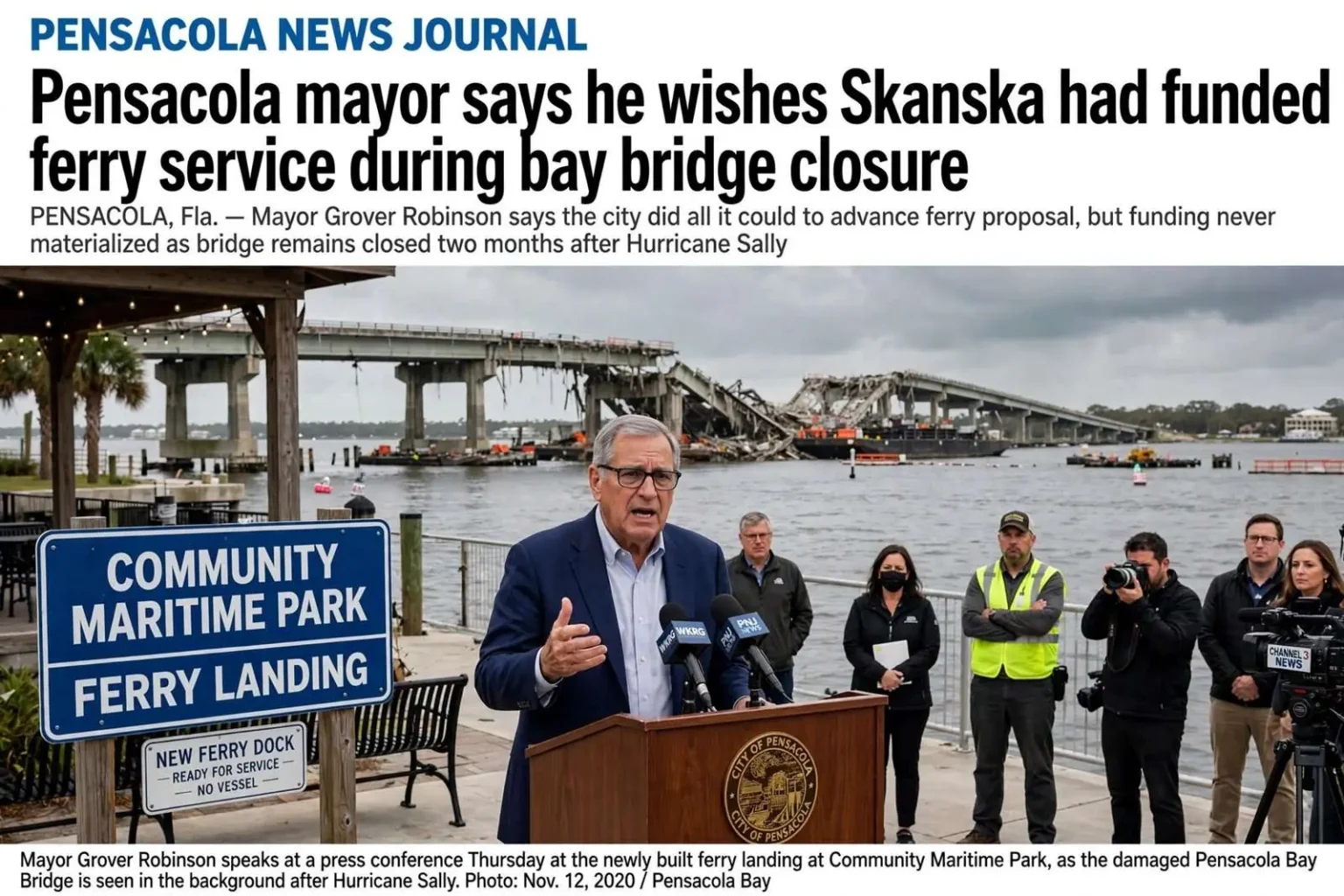
PENSACOLA, Fla. — A proposed ferry service across Pensacola Bay appears unlikely to move forward after two months of discussion, and Mayor Grover Robinson is pointing the finger at the bridge’s contractor. Robinson said the city has done everything it can to advance the idea, including adding a new landing for a ferry at Community Maritime Park, but the Florida Department of Transportation said it will not be able to fund the ferry.
Robinson said he believes Skanska should have stepped up to help pay for the ferry for residents affected by the closure of the Pensacola Bay Bridge. Skanska failed to secure barges that crashed into the bridge during Hurricane Sally, knocking the span out of service and severing the most direct link between Pensacola and Gulf Breeze. With the bridge closed, thousands of drivers have been using the Garcon Point Bridge to travel between Pensacola and Gulf Breeze and the beaches, adding miles and time to commutes that used to take minutes.
A city cut in two by the storm
The Pensacola Bay Bridge is not just another piece of infrastructure; it is the spine of daily life for the communities on either side of the bay. Gulf Breeze and Pensacola Beach sit on the barrier side of the water, and a large share of their residents work, shop and go to school in Pensacola itself. When the bridge closed after Sally, the ordinary geography of the region was suspended overnight, and a trip that meant a few minutes on the bridge became a long detour through the Garcon Point Bridge and its two-lane approach roads.
The added distance reshaped routines in ways residents felt every day. Commuters left home earlier to allow for the longer drive, emergency response times had to be recalculated, and businesses on both sides of the bay watched customers disappear from their counters. Traffic engineers rerouted thousands of vehicles a day onto roads never designed for that volume, and the communities along the detour route absorbed the noise, wear and congestion that came with them. The closure turned into one of the most consequential and longest-lasting effects of the hurricane in the Pensacola area.
The ferry idea
Against that backdrop, a passenger ferry across Pensacola Bay was pitched as a partial fix, a way to move residents between the city and the barrier communities while the bridge was rebuilt. Mayor Robinson and city staff pursued the idea for two months, and the city went beyond discussion: a new landing for a ferry was added at Community Maritime Park on the Pensacola waterfront, giving the service a ready terminus near downtown. The concept drew interest from residents facing long commutes and from business owners on both sides of the bay who wanted any relief they could get.
But a ferry is an expensive operation, requiring vessels, crews, insurance, fuel and dockside facilities, and the funding question never found an answer. The Florida Department of Transportation told the city it would not be able to fund the service, which effectively ended the proposal after two months of discussion. Without a funding source, the landing at Community Maritime Park stood ready for a boat that had no way to run, and the mayor turned his attention to who he believed should have paid.
Robinson points at the contractor
Mayor Robinson’s argument was straightforward: the bridge was closed because Skanska, the contractor, failed to secure barges that crashed into the span during the hurricane. In his view, the company should have stepped up to help pay for a ferry that existed only because of that failure. The sentiment found a ready audience among displaced commuters, who had spent months driving the Garcon Point detour and watching a project they had no part in disrupt their lives.
Contractor responsibility after a disaster is a genuinely complicated legal question. Construction contracts assign different risks to owners and contractors, insurance policies cover different categories of damage, and disputes over what happened during a hurricane and who pays for it are typically resolved through claims processes that can run for years after the storm itself. Mayors and residents do not have to wait for those processes to conclude to have an opinion, and Robinson’s public comments made clear where he thought the financial responsibility for the community’s disrupted lives belonged.
How Sally took the bridge down
Hurricane Sally came ashore in September 2020 as a slow-moving storm that punished the central Gulf Coast with hours of wind, storm surge and rain. The Pensacola Bay Bridge was already in the middle of a major reconstruction project, with Skanska serving as the contractor on the replacement span, and the storm put both the old and new structures at risk. Unsecured barges broke loose in the bay and slammed into the bridge, damaging spans and leaving the crossing unusable in both directions.
Images of barges wedged against the bridge circulated widely in the days after the storm and became the defining photograph of Sally’s impact on Pensacola. What the pictures could not show was how long the disruption would last. Bridge damage of that magnitude is not repaired quickly: engineers have to inspect every span, demolition has to be coordinated, and rebuilding proceeds under the same weather and supply constraints that follow any major hurricane. For a crossing that carries tens of thousands of vehicles a day, the closure rippled through every part of the regional economy.
Life on the Garcon Point detour
With the main crossing out, the Garcon Point Bridge became the region’s workaround, and thousands of drivers between Pensacola and Gulf Breeze and the beaches learned its rhythms. The route adds significant time to a trip that once crossed the bay directly, and the two-lane roads feeding the bridge were never intended to serve as the primary connection for an entire metro area. Congestion built at predictable hours, incidents on the detour route threatened to strand thousands of drivers, and the wear on local roads became a running complaint.
The detour also carried a cost for emergency services. Fire, ambulance and police agencies on both sides of the bay had to plan around the longer route, and the loss of a direct crossing changed response times in ways that are hard to communicate to the public. Schools, employers and delivery services all adjusted schedules, and for families split between Gulf Breeze and Pensacola, the bridge closure became the defining inconvenience of the months after the storm, outlasting power outages and cleanup in most neighborhoods.
What the ferry proposal revealed
The ferry debate, brief as it was, revealed something about how the region thinks about its water. Pensacola Bay has a long maritime history, and permanent ferry service has been proposed in the community before as an amenity rather than a necessity. What made the post-Sally version different was urgency: this was not a tourism enhancement but an attempt to restore a lost transportation link, and the fact that the city could not assemble funding for a temporary service showed how thin the region’s alternatives to the bridge really are.
Community Maritime Park’s new landing remains as a physical reminder of the episode. The park on the downtown waterfront was built as a public amenity, and a ferry dock there would have given it another role in daily life. Even without the service, the landing improves the city’s waterfront infrastructure and leaves open the possibility that a future operator could revisit the crossing, either as a commuter option or as part of the tourism traffic that already moves along the Gulf Coast’s waterways.
Waiting for the bridge
With the ferry option off the table, residents’ attention turned back to the bridge project itself and the question everyone in the region asked daily: when will it reopen? Reconstruction continued under the pressures that follow every major hurricane, with crews working around damaged spans while the region watched the progress. Transportation officials communicated timelines that shifted as engineering realities emerged, and the reopening became the milestone against which the community measured its recovery from Sally.
The episode left lessons that reach beyond Pensacola. Coastal bridges are singular points of failure for barrier communities across the Gulf, and Sally showed how quickly a single storm can sever one while alternatives are few and costly. The ferry proposal, the mayor’s criticism of the contractor and the months of Garcon Point detours all became part of the record of what a bridge closure means, and that record now informs how cities from Mobile to Panama City think about redundancy, contractor accountability and the value of the crossings their daily lives depend on.
The accountability question lingers
Whether Skanska bears financial responsibility for the ferry the city wanted, the detour costs the region absorbed or the bridge damage itself will be sorted out long after the public debate moves on. Large construction projects carry layers of insurance and contractual risk assignment, and hurricane liability involves questions about what a contractor of ordinary care would have secured before a forecast storm. What is already clear is the political lesson: residents and their mayors judge responsibility by lived experience, and the party they associate with a failure will hear about it publicly, whatever the eventual legal outcome.
The episode also showed the limits of what a city can do on its own when regional infrastructure fails. Pensacola could build a landing and promote a service, but it could not fund the operation without state or federal partners, and a bridge is state responsibility through and through. The gap between what a municipality needs during a disaster and what it can deliver by itself is a recurring theme on the Gulf Coast, and it is the reason regional planning agencies continue to study redundancy options for the crossings that tie the barrier communities to the mainland.
For now, the ferry idea joins the list of post-Sally proposals that made sense and ran out of money, and the residents of Gulf Breeze and Pensacola Beach continue to build their commutes around the crossings that exist. The landing at Community Maritime Park waits on the waterfront, the reconstruction work defines the region’s recovery, and the debate over who should have paid for a boat to carry stranded commuters home is part of the record of a community that spent a year learning exactly how much one bridge is worth.