Pensacola native Damarious Randall ejected from Browns game after illegal hit
Pensacola native and Browns safety Damarious Randall was ejected after a helmet-to-helmet hit on Steelers receiver Diontae Johnson and may be fined or.
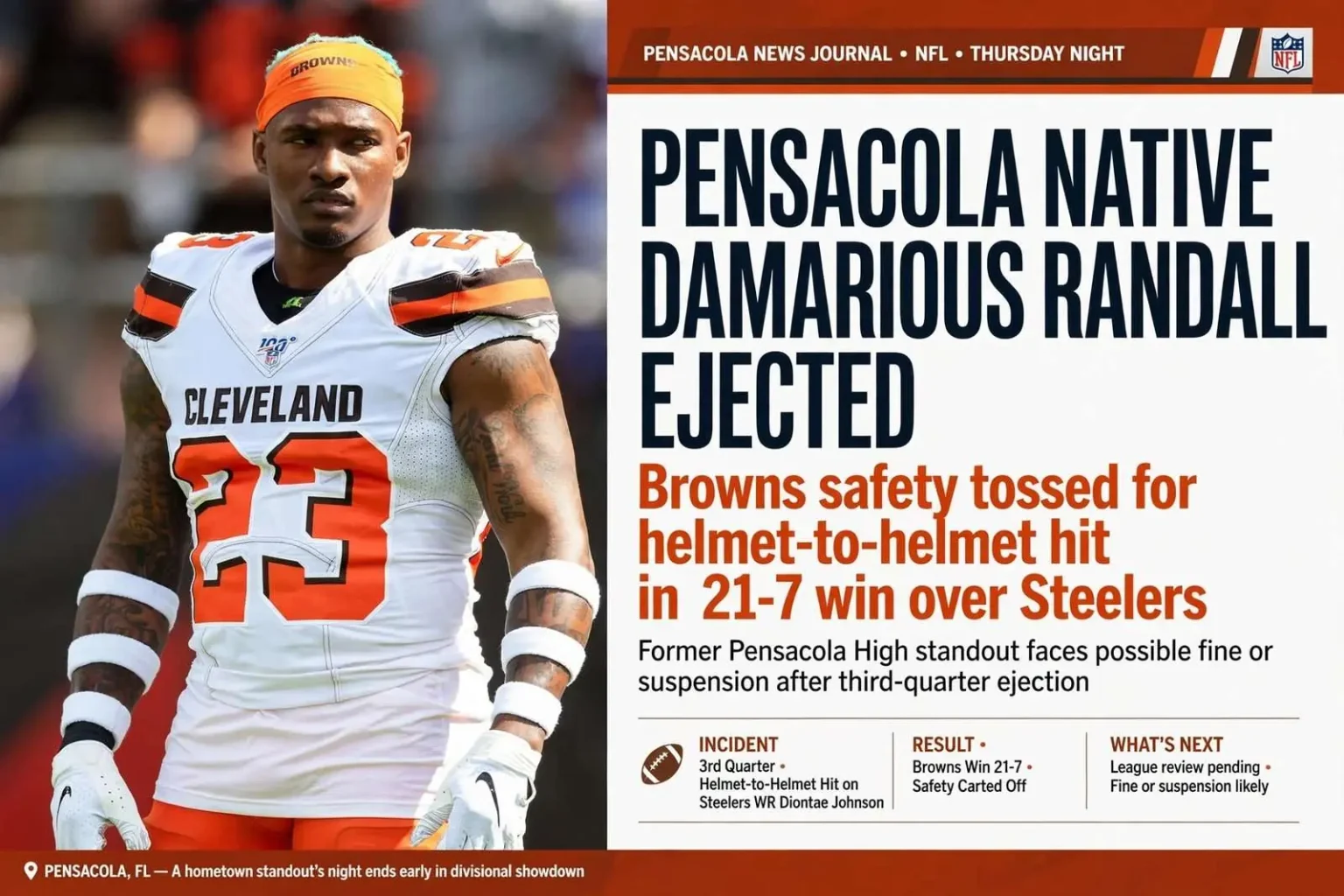
A Pensacola native and former Pensacola High School standout could face a fine or suspension after being ejected from a Thursday night NFL game. Cleveland Browns safety Damarious Randall was thrown out in the third quarter following a helmet-to-helmet hit on Pittsburgh Steelers rookie wide receiver Diontae Johnson. Johnson appeared to suffer a concussion and was taken to the locker room on a cart. The Browns won the contest 21-7. Randall, who played at Pensacola High and Arizona State, spent his first three NFL seasons with Green Bay before joining Cleveland.
The hit came in a game Cleveland dominated, which made the ejection the night’s defining image for the wrong reasons. With the Browns rolling toward a 21-7 victory over their AFC North rival, Randall delivered the helmet-to-helmet blow on Johnson over the middle, drawing the flag and the automatic disqualification that the league’s rules mandate for such contact. Johnson, the Steelers’ rookie receiver, appeared to suffer a concussion and left the field on a cart bound for the locker room.
For Randall, the ejection carried consequences beyond the rest of the night. Helmet-to-helmet ejections are followed by league review, and a fine — or, for repeat offenders, a suspension — typically lands in the days after the game. The NFL’s player-safety rules have for years treated forcible contact with the helmet as among the most serious in-game infractions, precisely because of the concussion risk that materialized on Johnson’s cart ride.
The Pensacola pipeline
Randall’s path from Pensacola to NFL primetime follows a well-worn Gulf Coast route. Pensacola High School’s football program has produced professional talent for decades, drawing from a city whose public fields have sent players to college rosters and draft boards across the country. Randall starred at Pensacola High before taking the junior-college route to Arizona State, where his play as a defensive back put him on the radar of NFL scouts looking for versatile, athletic cornerbacks.
Green Bay made that scouting matter, selecting Randall in the first round of the 2015 draft. He spent his first three NFL seasons with the Packers, showing the range and ball skills that made him a top-32 pick — and, in 2017, a playmaker with five interceptions. A change of coaching regimes in Green Bay made him expendable, and Cleveland acquired him in a trade, installing him at safety where his coverage instincts translated into the deeper, more physical role the Browns needed.
That path — Pensacola to junior college to a major program to a first-round pick — is the kind of story that resonates along the Panhandle, where high school football is a proving ground and where each NFL roster announcement renews the local pride of watching a hometown name on a Sunday broadcast. Randall’s ejection made national headlines for the hit; in Pensacola, the longer story remained the hometown kid who reached the league’s starting ranks.
The hit and the rulebook
The play that ended Randall’s night falls under the NFL’s most litigated safety provisions. League rules prohibit players from lowering their heads and using the helmet to initiate forcible contact, and from delivering forcible blows with the helmet against defenseless receivers. When such contact draws a flag, the officials are required to eject the offender on the spot — the “automatic disqualification” standard adopted after years of concussions the league was criticized for tolerating.
Johnson’s injury illustrated what the rule exists to prevent. The rookie appeared to suffer a concussion and was carted to the locker room, entering the league’s concussion protocol — the evaluation-and-clearance process that keeps players out until independent neurologists sign off. A rookie receiver’s season can hinge on such a hit, which is why the NFL’s enforcement has grown stricter with each rule revision, whatever frustration it draws from players and fans who grew up on a more permissive game.
For Randall, the aftergame arithmetic was straightforward. First offenses of the helmet-contact rules typically bring fines ranging into five figures, calibrated to the player’s salary; repeat violations escalate toward suspensions. The league reviews every ejection during the week that follows, and the discipline — if any — is announced before the next game. What the Thursday night broadcast made certain was the ejection itself; the financial consequences arrived, as they always do, in the league’s quiet Friday announcements.
The game around the ejection
Lost in the aftermath of the hit was the quality of the Browns’ performance. A 21-7 road win over Pittsburgh, in a Thursday night divisional rivalry, was the kind of statement Cleveland’s long-suffering fan base had waited years to see. The Browns’ defense controlled the Steelers’ offense for most of the night, and the victory carried extra weight in a division where every head-to-head result shapes the playoff race and the standing grudges.
The rivalry context amplified everything about the ejection. Browns-Steelers games are among the NFL’s most physical annually, and a hit that sent a Steelers rookie off on a cart guaranteed the moment would be replayed, debated and remembered in both cities. Pittsburgh’s sideline reacted to the injury; Cleveland’s to the loss of a starting safety in the second half of a game they were winning. The officials, for their part, had no discretion once the helmet-to-helmet contact was ruled forcible — the flag and the disqualification were the rulebook working as written.
Randall’s absence for the remainder of the contest also tested Cleveland’s depth in a way the final score obscured. Playing the fourth quarter of a rivalry game without a starting safety asks more of the backups and the scheme, and the Browns managed it well enough to close out the win. The coaching staff’s postgame posture reflected the league’s modern reality: no team defends the contact anymore, whatever it privately thinks of the officiating.
From Green Bay to Cleveland
Randall’s move from the Packers to the Browns was itself a story of how NFL careers bend. Drafted by Green Bay in the first round in 2015 out of Arizona State, he arrived as a cornerback with expectations appropriate to the selection. His three seasons there included the highs of 2017’s five-interception campaign and the lows of injuries and coaching changes, and when the Packers’ new front office reshaped the secondary, Cleveland traded for him and shifted him to safety.
The position change suited his skill set. Safety in the modern NFL asks a player to cover like a cornerback, tackle like a linebacker and read the field like a quarterback, and Randall’s college pedigree as a two-way athlete — he was also drafted by baseball — showed in the transition. By this season, he was a fixture in Cleveland’s back end, playing through a year in which the Browns’ defense had become the engine of their improvement.
That context is what made the ejection costly in more than dollars. A team building toward its first playoff appearance in years needed its starters on the field, and the league’s discipline schedule would determine whether the ejection cost him anything more. For a player whose contract year was approaching, every missed snap and every league fine carried weight that outlasted one Thursday night.
What it means back home
In Pensacola, Randall’s career has been followed the way Gulf Coast communities follow all their exported athletes — box scores checked on Sundays, highlights shared by the high school’s boosters, and each national mention recycled into local pride. A hometown player ejected on national television is not the headline Pensacola would choose, but the underlying fact remains: a Pensacola High graduate, first-round pick and starting NFL safety, playing in one of the league’s marquee divisional games.
His route — through junior college, through a position change, through a trade — is itself a lesson for the region’s current high school players, whose paths to professional football rarely run straight. Randall’s time at Arizona State after starting in junior college, and his reinvention as a safety in Cleveland, show the adaptability the modern league demands. The ejection, in that longer arc, is one rough Thursday in a career that has already exceeded what most of the game’s players ever reach.
As for the game’s ledger: the Browns won 21-7, Johnson entered the concussion protocol, and Randall’s case went to the league office for review with a fine or suspension possible. The archived account of the night preserves those facts — a Pensacola native at the center of one of the week’s biggest stories, for better and worse, in a game his team won.
Thursday nights and divisional stakes
Thursday night games compress everything the NFL sells into a short, loud package, and rivalry games on the stage draw the league’s biggest single-night audiences. The Browns-Steelers meeting was one of those — a matchup with decades of history, played on a weeknight when the whole football country is watching one game. That spotlight is a double-edged context for an incident like Randall’s hit: the same broadcast that showcased Cleveland’s dominance carried the ejection, the cart and the replay to every screen in the country within minutes.
The league’s review calendar turns quickly after such nights. The officiating department grades the crew’s calls, the football operations staff reviews any ejection under the playing-rules provisions, and the discipline decision — fine or suspension, with the amount tied to the player’s salary and history — is typically issued before the following Sunday. Players can appeal, and the appeals process has occasionally reduced discipline, but the starting point for forcible helmet contact is well established.
Teams, meanwhile, manage the week around the verdict. Cleveland’s coaches prepared their defensive packages not knowing until midweek whether their starting safety would be available for the next game, and the roster planning that follows an ejection is one of the small, unsung administrative burdens the modern rules place on coaching staffs. The salary-cap era makes every fine a bookkeeping event as well as a punishment.
The final accounting of the night, as the archived report preserves it, is the one that matters for the record: a Pensacola native ejected in the third quarter of a Thursday night game for a helmet-to-helmet hit, a rookie receiver carted off with an apparent concussion, a 21-7 Browns win, and a possible fine or suspension awaiting the league’s ruling. The rest — the replays, the debate, the discipline — followed in the days after, as it always does.