Pensacola Residents Can Weigh In on Next Police Chief During Virtual Forums This Week
Pensacola residents can weigh in on the next police chief during virtual forums this week. The city's national search kicks off in February.
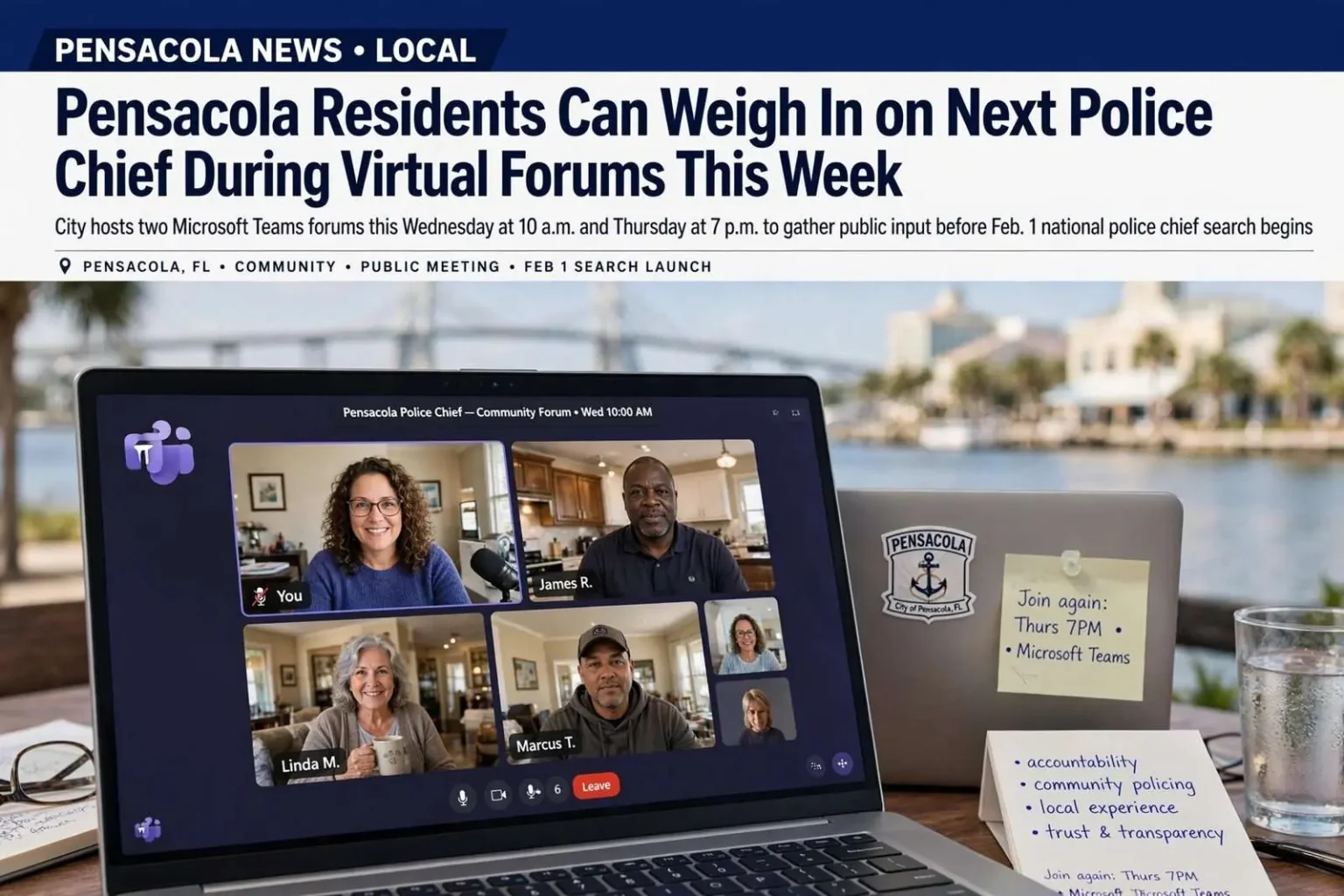
Pensacola residents have a chance to give their input on the search for the city’s next police chief during virtual community forums this week, part of a national recruitment effort the city has opened directly to public participation. The forums will be held via Microsoft Teams this Wednesday at 10 a.m. and Thursday at 7 p.m., giving residents two different windows — a morning session and an evening one — to weigh in on the qualities they want in the city’s next top law enforcement officer.
Gary Peterson is with the firm Public Sector Search and Consulting, Inc., which is leading the national search for a new police chief. He says despite the pandemic, the forums are seeing strong engagement. “There is a significant number of folks who will show up to these forums. It can range from 10 or 15 people to 40,” Peterson said.
The recruitment itself begins in earnest on February 1, with a social media campaign and outreach to candidates locally, regionally, and nationally. The forums this week precede that launch, positioning public input as the first building block of the search: before the city advertises the job, residents are defining what the job should demand.
“We think this is the right thing to do for our community to be sure that we identify the right candidate for us,” said Mayor Grover Robinson. “This focuses on finding the right person for our community and making sure we’ve checked everywhere across the country.”
Public input before the search begins
Structuring community forums ahead of the formal recruitment window is a deliberate sequencing choice. Candidates for a police chief position are typically evaluated against a profile — experience, leadership style, community policing philosophy, administrative track record — and the strongest profiles are built from what residents, officers, and city officials say they need. By gathering that input first, Pensacola ensures the February search is aimed at a target drawn by the community itself rather than by a generic national job description.
The two-session format acknowledges the realities of public participation. A single 10 a.m. Wednesday meeting excludes anyone who works days; a 7 p.m. Thursday session reaches the evening crowd but not shift workers on late duty. Offering both widens the base of voices, and Peterson’s reported turnout — from 10 or 15 people to 40 — suggests that even under pandemic conditions, residents were showing up in numbers that give the input genuine weight.
Virtual delivery, forced on local governments by the pandemic, has also proven its own value for processes like this. Microsoft Teams forums eliminate travel and childcare barriers, allow residents to participate from home, and — for a police chief search — may lower the intimidation factor that keeps some residents from speaking about policing in a packed council chamber. The pandemic format, born of necessity, has expanded who gets heard.
Why the chief search matters in Pensacola
The police chief of Pensacola leads the department responsible for law enforcement across the city — patrol, investigations, and the community relationships that determine how policing is experienced block by block. The position shapes everything from response times and crime strategy to how officers engage with neighborhoods, how the department hires and trains, and how the city’s policing aligns with its elected leadership’s priorities. A chief’s tenure colors the department’s culture for years beyond it.
National searches like this one have become standard for mid-sized cities, and for good reason. They widen the candidate pool beyond the ranks of the incumbent department, expose the city to leadership models from other regions, and signal to residents that the choice is being made on merit rather than familiarity. Peterson’s firm, Public Sector Search and Consulting, Inc., specializes in precisely this work — executive recruitment for government agencies — and its role places the Pensacola search inside a professional process used by cities nationwide.
The local-regional-national outreach Peterson described means internal candidates will compete alongside applicants from across the country. That competition benefits the city in two directions: it gives the best homegrown leaders a fair path to the top job, and it pressures every candidate — inside or outside — to articulate how they would lead a Gulf Coast city’s department at a moment when policing everywhere is under scrutiny.
The mayor’s mandate
Mayor Grover Robinson’s comments frame the search in terms of thoroughness and fit. “We think this is the right thing to do for our community to be sure that we identify the right candidate for us,” he said, and his second remark made the method explicit: “This focuses on finding the right person for our community and making sure we’ve checked everywhere across the country.”
The emphasis on checking “everywhere across the country” is both a promise and a standard. Residents judging the eventual hire will be able to ask whether the process lived up to it — whether the search genuinely reached national candidates, whether the community’s forum input shaped the selection, and whether the final choice reflects Pensacola rather than a resume’s convenience. Mayors inherit accountability for police chief selections like no other appointment, and Robinson’s public framing of the process sets the measure by which it will be judged.
The phrase “the right candidate for us” carries its own weight. Fit in a chief’s search is not merely professional qualification — every serious candidate will have decades of command experience — but alignment with what Pensacola’s residents say they want from their department. That is what the forums are designed to capture: the community’s own definition of “right,” recorded before a single resume arrives.
What residents are being asked
Chief-search forums typically solicit a consistent set of concerns: what residents expect from response times and crime reduction, how they want officers to engage with neighborhoods and young people, what accountability should look like when things go wrong, and what kind of communicator the city’s top officer should be. For a department serving a city of Pensacola’s size — a historic downtown, working-class neighborhoods, a military-connected population, and a tourism economy along the bay — those answers vary by community and are the raw material of the candidate profile.
The virtual format invites participation from exactly the residents whose voices are often thinnest in formal processes. Parents can log in after dinner; workers on day shifts can take a lunch-hour session; elderly residents can contribute without driving downtown at night. Peterson’s turnout figures — 10 or 15 people at the low end, 40 at the high — are modest by in-person event standards but substantial for a specialized executive search, and each participant’s comments feed directly into the recruitment documents the search firm will carry into the national market.
Residents unable to attend either session still have the broader lesson of the schedule: the city is collecting input on a rolling basis, and the February 1 launch of recruitment means the window for shaping the search is now — not after candidates are shortlisted, when the profile is already fixed.
The road from forums to finalist
The process that follows the forums will unfold in the standard rhythm of a professional executive search. Public input and city leadership’s direction are distilled into a candidate profile and job posting. The February 1 launch puts that posting before the market through the social media campaign and the local, regional, and national outreach Peterson described. Applications are screened, preliminary interviews narrow the field, and finalists — typically a small group — face public or semi-public scrutiny before a selection is made.
At each stage, the community’s fingerprints remain on the process. The profile the city advertises is built from what residents said in forums like this week’s; the questions asked of finalists are drawn from the same material; and the mayor’s standard — having checked “everywhere across the country” — is the benchmark against which the eventual announcement will be measured.
For Pensacola, the search for a police chief is among the most consequential personnel decisions a city makes, and the city has chosen to make its first step a public one. Two virtual forums — Wednesday at 10 a.m. and Thursday at 7 p.m. on Microsoft Teams — stand between the community and the recruitment that begins February 1. The residents who log in will shape the profile; the profile will shape the candidate pool; and the candidate chosen will shape policing in Pensacola for years to come.
The search firm’s role
Public Sector Search and Consulting, Inc. occupies a specialized niche in American local government: executive recruitment for police and fire leadership. Firms like it maintain networks of command-level officers across the country, understand the certification and credentialing landscape of each state, and know how to move a sitting deputy chief in one state toward an opening in another. That reach is what turns a city’s “national search” from a job posting into a genuine national canvass.
The firm’s work also carries the process’s credibility. A professional search firm screens applicants against the profile the community helped write, conducts background and reference work on the semifinalists, and presents the city with a field of candidates who meet the bar rather than whoever applied first. Peterson’s presence at the forums — the firm’s principal hearing the community directly rather than working from secondhand summaries — signals that the input is being collected at the source, by the people who will draft the recruitment documents.
For candidates, the firm serves the reverse function: it explains what Pensacola is looking for, tests their interest against the reality of the job and the city, and manages the confidentiality concerns of sitting chiefs and deputy chiefs who cannot apply openly while employed elsewhere. The best searches treat both sides of that market, and the forums are the community’s opening contribution to it.
Policing searches in a national moment
The timing of the search gives the forums additional weight. Policing in America is under sustained public examination, and cities selecting new chiefs are choosing not just an administrator but a philosophy — community engagement versus enforcement-first models, reform versus continuity, transparency versus the traditional reserve of the badge. Residents showing up to virtual forums across the country have been pressing those questions, and Pensacola’s engagement figures suggest local residents are no exception.
A national search is how a city answers those questions honestly. Limiting the pool to internal candidates folds the community’s expectations into whatever culture already exists; opening it nationally imports candidates shaped by other cities’ debates, other reforms, other approaches to the same tensions. Robinson’s insistence on checking “everywhere across the country” puts Pensacola in the latter camp, and the February 1 recruitment launch will test how widely the net actually casts.
The outcome will be measured on multiple clocks. The city needs a leader installed promptly to provide continuity for the department; the community needs a selection it regards as legitimate; and the eventual chief will need the trust of both the officers commanded and the residents served.
Two evenings, one invitation
For the week at hand, the practical message is simple. Pensacola residents who want a say in who leads their police department can join Wednesday’s forum at 10 a.m. or Thursday’s at 7 p.m., both via Microsoft Teams, and speak directly to the firm conducting the national search. The turnout so far — 10 to 40 residents per session, by Peterson’s account — shows the format working despite the pandemic that created it.
Those sessions feed a process with a defined next stage: recruitment beginning February 1, powered by a social media campaign and outreach across the local, regional, and national markets. Mayor Robinson’s stated goal — the right candidate for the community, with every corner of the country checked — depends on the first part of that sequence being done well, and the first part belongs to the residents.
The forums are Pensacola’s chance to define the job before the city defines the applicant. Whatever the community says this week about leadership, accountability, and policing will travel with the search from the posting to the finalists to the day the new chief is sworn in — and will remain the standard by which the city’s choice is judged ever after.