Performance Art Duo Princess Lands at Alabama Contemporary Art Center
Performance art duo Princess brings the multimedia tour 'Out There' to Alabama Contemporary Art Center on April 20 — animation, music and a quest for.
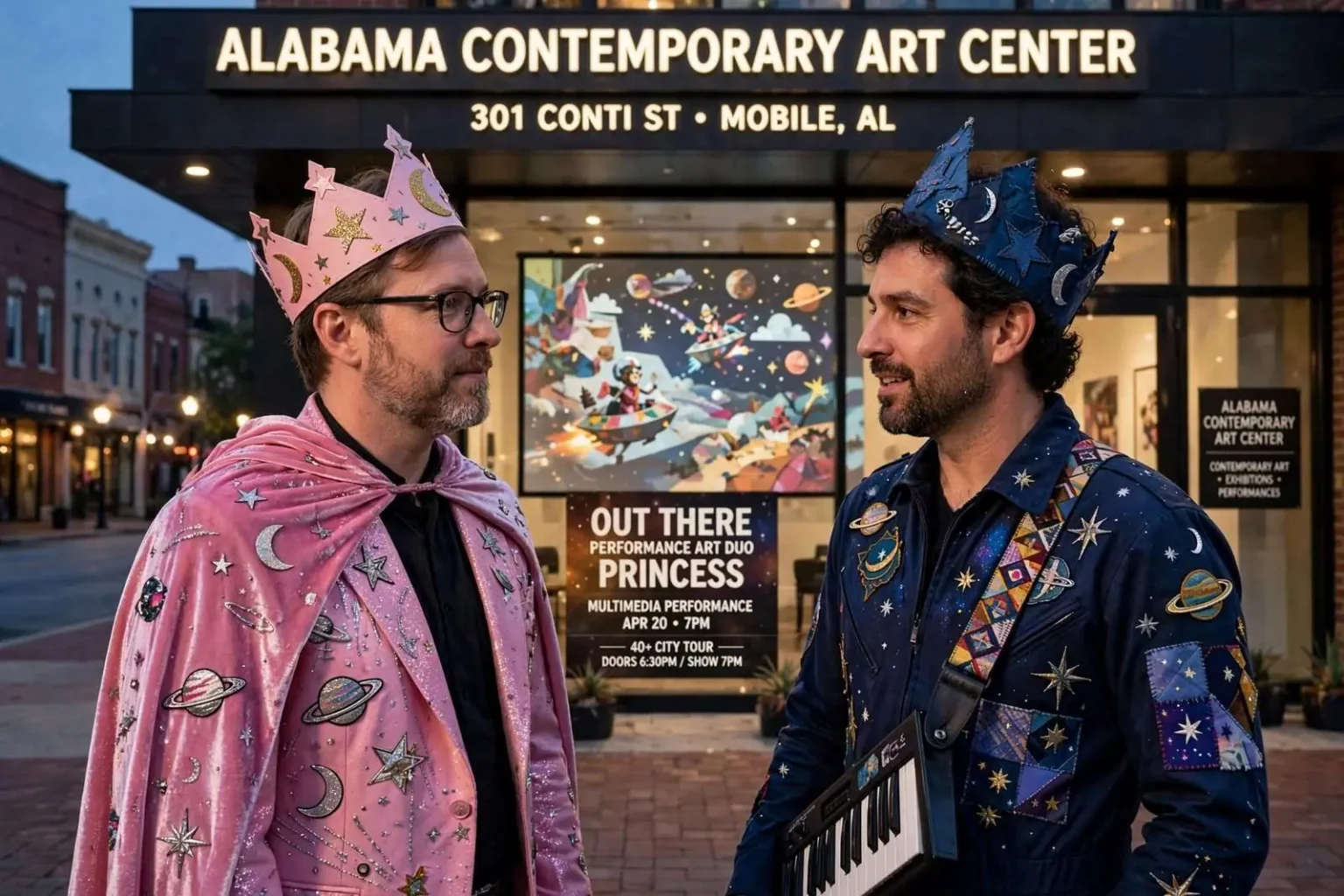
MOBILE, Ala. — Need to get away? You can leave the planet at Alabama Contemporary Art Center (ACAC) thanks to performance art duo Princess, whose multimedia piece “Out There” boards passengers at 301 Conti St. on April 20 at 7 p.m. as part of a 40-plus-city tour. The performance brings one of the more unusual touring acts in contemporary art to downtown Mobile, where the nonprofit art center has built its reputation on presenting work that falls outside the mainstream gallery experience.
Princess is Michael O’Neill and Alexis Gideon, who formed the project in 2004 in a Chicago DIY performance space before parting ways in 2006. A decade later, musical ideas shared long-distance — Gideon in Pittsburgh, O’Neill in Brooklyn — piled up, and their participation in the 2017 Women’s March gave the work a sharper purpose. “We wanted to make this music into something related to those issues as a way for us, as men, to process our feelings about what was going on,” O’Neill said.
That origin story places Princess squarely within the DIY tradition that produced much of America’s experimental performance scene. Chicago’s small-venue network — storefront spaces, lofts, and collectively run rooms where artists test material without institutional filters — has long served as a proving ground for projects that could never survive a commercial booking process. Princess spent its formative years in that world, and the duo’s blend of music, costume, and video still carries the do-it-yourself ethos of those early rooms.
The reunion itself is a study in how long-distance artistic partnerships work in the modern era. With Gideon composing in Pittsburgh and O’Neill working in Brooklyn, the pair accumulated material across years of correspondence and file-swapping before deciding the body of work had become a project worth finishing together — a process that ultimately produced “Out There” and sent the duo back on the road for the first time in a decade.
Leaving the Planet
“Out There” features the costumed pair performing 16 musical pieces as an animated tale plays on a large screen between them. The staging is deliberately simple in outline and dense in effect: two performers, one screen, and a story that unfolds in animation while the musicians supply its soundtrack live. Audiences are not watching a film with a live score so much as inhabiting an animated world that the two men on stage are constructing in real time.
The visuals blend personal and archival photography with video footage and stop-motion into a Technicolor quest for identity and cooperation, as a fictional version of the duo flees Earth seeking refuge from “toxic masculinity and misogyny.” The escape narrative gives the performance its title and its structure — a journey off-world that doubles as a search for a way of being men that the fictional travelers cannot find at home.
That premise puts “Out There” in conversation with a long tradition of science fiction used as social allegory, from the speculative fiction that smuggled political critique past censors to the space-age pop culture that O’Neill and Gideon clearly absorb and rework. The animated frame lets the duo address charged subject matter through characters and fantasy rather than lecture, which is part of what has allowed the piece to tour so widely without softening its content.
The soundtrack is rich with hooks, raps and rhythms, including a closing trio of songs made with the female group TEEN and musician JD Samson. The collaborations are central to the piece’s argument rather than decorative: O’Neill, who calls Princess a “queer band” expressing fluidity through costume, said letting women collaborators reshape their compositions was difficult but necessary — a practical admission that a work about escaping masculine self-regard had to let outside voices into the writing room itself.
TEEN, the Brooklyn-based band that joins the closing sequence, and JD Samson, a musician and performance artist long associated with queer and feminist pop projects, give the finale a collective energy that reframes everything the duo performs alone before it. The choice to hand the piece’s final stretch to women collaborators mirrors the narrative’s own turn — a story about two men learning they cannot complete their quest by themselves.
Reaction on the Road
Reaction on tour has been lively — plenty of conversation, and the occasional walkout during a hyper-phallic scene. O’Neill respects those choices. In an era when audiences expect to agree with the art they consume, a performance that provokes actual departures has become a rarity, and the duo treats the friction as part of the work’s function rather than a problem to be engineered away.
That willingness to unsettle fits the venue as much as the act. ACAC, located in the heart of downtown Mobile at 301 Conti Street, has positioned itself as a contemporary art institution unafraid of challenging work, and programming like “Out There” is the kind of booking the center exists to make. For Mobile audiences, a 40-plus-city national tour stopping at the art center represents access to a caliber of experimental performance that usually requires travel to New Orleans, Atlanta, or larger markets.
The touring model behind “Out There” is also worth noting for what it says about contemporary performance economics. A 40-plus-city run means the piece is built to travel light and play almost anywhere — a pair of performers, a screen, and projection — allowing a self-produced work to reach cities that national tours routinely skip. Mobile, in this case, lands the stop precisely because the project is structured to include it.
A First for Mobile
For his part, O’Neill is eager to reach Mobile for the first time: another frontier for a musician who has played in 49 states. The statistic is a touring résumé in miniature — years of dates in every corner of the country, with one state still unchecked — and it frames the Mobile performance as more than another date on the itinerary. Every artist collecting all 50 states has a moment when the map finally fills in, and this visit carries that weight for O’Neill.
For local audiences, the occasion is similarly rare. Performers of O’Neill’s mileage typically arrive in Mobile only when a national act passes through on an arena routing or a festival books a touring package. An intimate performance space on Conti Street, with the artist close enough to speak to the crowd, is a different kind of encounter — the format in which experimental work actually makes sense, and in which the audience’s reaction becomes part of the show.
The April 20 date at 7 p.m. gives the performance an evening slot in downtown Mobile’s cultural calendar, within easy reach of Dauphin Street’s restaurants and bars for anyone making a night of the visit. Downtown’s gallery and performance district has grown steadily as a destination for exactly this kind of event, and a touring multimedia piece landing at ACAC reinforces the neighborhood’s claim as the city’s home for contemporary art.
What audiences will find when the lights go down is a piece that resists tidy description: part concert, part animated film, part costume performance, and part argument about how men reckon with the culture they inherited. The duo fled Earth on screen years ago and has been finding audiences across the country ever since. In April, the journey lands at 301 Conti Street — and Mobile gets to decide for itself what to make of the passengers.
The tour’s reach also reflects the moment the work was built for. Since the 2017 Women’s March gave the project its direction, conversations about masculinity, gender, and accountability have only intensified in American cultural life, and “Out There” arrived as one of the few touring performance works engaging those questions from the inside — two men processing their own formation rather than commenting on it from a safe distance. Audiences in cities across the tour have found that honesty is part of what makes the piece land, even when individual scenes push them out of their comfort zones.
The craft behind the production deserves mention as well. Blending personal and archival photography with video footage and stop-motion animation is a labor-intensive approach — the kind of collage technique that takes years to assemble — and it shows in a piece whose visual texture shifts constantly between home-movie intimacy and constructed fantasy. For animators, filmmakers, and musicians in the Mobile area, seeing the full work performed live offers a rare working example of how many mediums can be layered into a single touring performance.
Princess’s history also mirrors the path of many experimental duos: a hot start in a DIY scene, a split, and a reunion that only worked because both artists had grown separately. Gideon’s own work in music and animation and O’Neill’s career as a performer and comedian each added tools to the collaboration during the years apart, and “Out There” is the document of two vocabularies recombined into one project. That the reunion produced a tour of more than 40 cities — rather than a one-off reunion show — suggests the partnership regained something essential the moment the material started flowing between Pittsburgh and Brooklyn.
For Mobile, the practical takeaway is that the April 20 performance at Alabama Contemporary Art Center is a one-night proposition on a long national route. Shows like this do not hold over, and the audience for experimental performance in the city is exactly the size that makes arriving early a sensible plan. Doors at 301 Conti Street, 7 p.m., with the costumed duo and their animated escape narrative ready for boarding — the first time this particular journey has passed through Alabama’s oldest city, and a chance for O’Neill to finally fill in state number 50.