Person shot during possible home invasion at Ferry Pass condominiums
The Escambia County Sheriff's Office is investigating a possible home invasion and shooting at Woodland Condominiums in Ferry Pass, Florida.
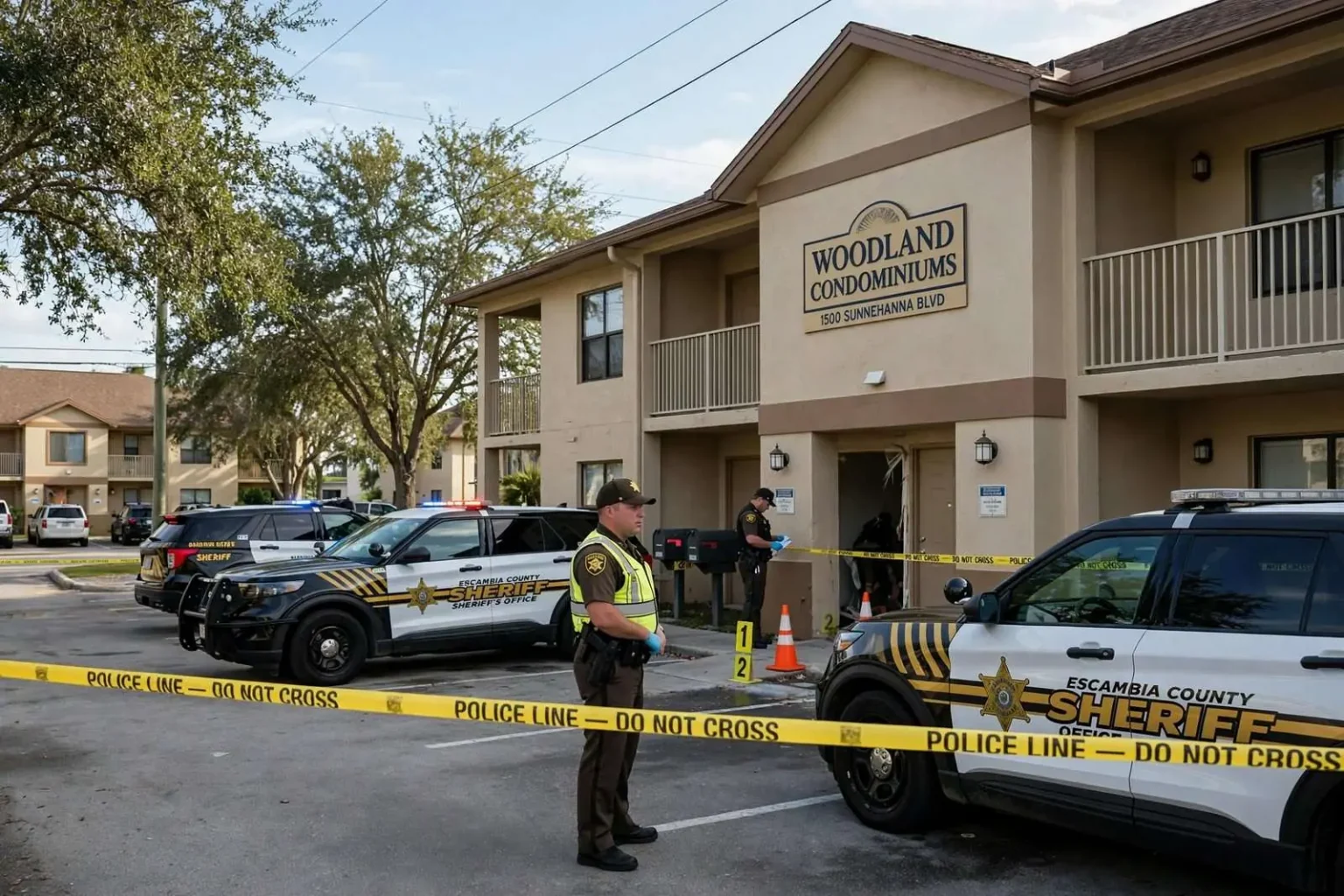
FERRY PASS, Fla. — The Escambia County Sheriff’s Office is investigating after someone was shot during a possible home invasion at the Woodland Condominiums, a complex at Sunnehanna Boulevard and Westchester Drive just off Nine Mile Road in the Ferry Pass area.
The call came in around 2 p.m. Monday, sending deputies and emergency crews to the condominium complex near one of the busiest corridors in central Escambia County. The shooting victim was taken by private vehicle to a local hospital rather than waiting for an ambulance, a decision that reflects the urgency those inside the unit felt as the situation unfolded.
What investigators believe happened
Sheriff’s office officials said someone shot the person they believe was trying to break into a home, and that an exchange of gunfire occurred during the home invasion. In other words, the agency’s early account described a homeowner or resident firing on an intruder, with shots coming from both sides before it ended.
The person who was shot is not cooperating with investigators, and their condition is unknown. That lack of cooperation is a familiar complication in cases where the wounded person may have been the one forcing entry. Without a statement from the person shot, deputies must reconstruct events from physical evidence — shell casings, damage to doors and windows, bullet strikes — and from witnesses in neighboring units who heard or saw pieces of the confrontation.
How deputies work the scene
Escambia County deputies handle incidents like this through a standard sequence. Patrol units secure the scene and render aid, detectives take over the unit where the shooting occurred, and crime-scene technicians document and collect evidence. In a possible home invasion, investigators pay particular attention to points of entry: whether a door or window shows forced entry, where each round landed, and what the pattern of gunfire says about the positions of the people involved.
Interviews with neighbors at Woodland Condominiums would have been central to the early investigation. Condominium complexes are dense living environments, and midday incidents rarely unfold without anyone hearing shouting, vehicles speeding away or the gunfire itself. Detectives also canvass for surveillance video, which has become one of the most valuable tools in cases like this; doorbell and complex cameras frequently capture the arrival and departure of everyone involved.
The legal landscape
Florida law is notably protective of residents who use force against intruders. The state’s self-defense statutes, including the provisions commonly known as the castle doctrine, presume that a person lawfully in a dwelling is justified in using force, including deadly force, against someone unlawfully and forcibly entering. Whether those protections apply turns on the specifics: who entered, whether the force used was proportionate to the threat, and what the evidence shows about who fired first.
That legal framework shapes how the sheriff’s office investigates and how prosecutors review the case. Detectives must establish the sequence of events precisely, because a finding of justifiable use of force ends the criminal inquiry, while evidence of unlawful conduct moves it toward charges. A wounded intruder who refuses to cooperate does not end the investigation; it simply shifts the burden onto physical evidence and witness statements. Until detectives complete that work, the agency typically describes the case in neutral terms, as it did here.
The Ferry Pass setting
Ferry Pass sits in the heart of Escambia County, between Pensacola’s city limits and the communities to the north, and Nine Mile Road is one of its principal arteries. The Woodland Condominiums complex lies just off that corridor in a densely developed area of apartments, condominiums and retail plazas serving the surrounding neighborhoods. Midday incidents in such settings draw quick attention precisely because so many people are home, commuting or running errands when they occur.
Residents of the complex experienced the standard disruption of a violent-crime investigation: patrol vehicles blocking access, detectives moving between units, and questions about who was involved and whether anyone remained at risk. Deputies typically increase visibility in an area after an incident like this while the investigation continues.
What comes next
The investigation will turn on the evidence gathered in the first days. If the person who was shot recovers and becomes willing to talk, their account will enter the record; if not, the case will stand on the physical and testimonial evidence already collected. The sheriff’s office has not released the identity of the person shot or of the person who fired, pending the investigation, and has not said whether any charges will be filed.
For now, the incident stands as the kind of case Florida’s self-defense laws were written around: a daytime confrontation at a home, an exchange of gunfire, and a wounded person whose refusal to cooperate leaves investigators working backward from the evidence. Deputies continue to ask anyone with information about the incident to come forward, as witness accounts from the complex could fill the gaps the victim’s silence has left.
Incidents of this kind also raise questions that echo across the Ferry Pass community whenever gunfire erupts in a residential complex. Home invasions are comparatively rare, but attempted break-ins and property crimes in densely packed apartment and condominium areas are a persistent concern, and residents often respond to a shooting like Monday’s by reviewing their own security — better locks, exterior lighting, cameras — and by pressing complex management for improvements. Deputies encourage exactly that kind of engagement, since a complex where neighbors watch out for one another generates the tips that solve cases.
The time of day mattered to the investigation as well. A 2 p.m. incident unfolds in full daylight, with residents home from work shifts, children arriving from school and traffic heavy on Nine Mile Road. Daylight means more potential witnesses and more cameras recording, but it also means the confrontation happened in front of a community that did not expect violence in the middle of the afternoon. Calls of this kind typically draw multiple 911 reports within minutes, and dispatchers triage the additional calls to build a picture of what happened before deputies even arrive.
When victims won’t talk
The wounded person’s refusal to cooperate deserves particular attention, because it changes the entire trajectory of the case. Investigators routinely encounter witnesses and victims who decline to speak — sometimes out of fear of retaliation, sometimes because the person was engaged in conduct they do not want to explain, and sometimes because the person’s account would implicate them in a crime. Detectives are trained to proceed regardless, building the case from what the scene itself says.
Physical evidence in a shooting scene is often rich. Casings mark where shooters stood. Trajectory and impact points show the direction of fire. Forced-entry damage tells investigators whether the intruder used a tool, kicked a door or broke a window, and how long the attempt lasted. Blood evidence charts the wounded person’s movement. Taken together, such evidence frequently allows detectives to reconstruct an exchange of gunfire with enough precision to determine whether the resident’s account — or the lack of one — is consistent with the scene.
The hospital variable
The decision to transport the victim by private vehicle also carries investigative weight. Bystanders who move a wounded person often do so to save time in a life-threatening injury, which is understandable and sometimes decisive for survival. But the transport also moves evidence, transfers blood and gunshot residue between people and vehicles, and delays medical documentation of the victim’s condition. Detectives later locate and examine the vehicle that made the drive, and hospital staff document the wounds in a medical record that becomes part of the case file.
The unknown condition of the person shot adds urgency for the sheriff’s office. If the wounds prove fatal, the case automatically escalates to a death investigation with homicide detectives and the State Attorney’s Office involved from the outset. If the person recovers, investigators will revisit attempts to interview them, since a person’s willingness to talk can change as circumstances change.
Deputies’ message to the public
The sheriff’s office uses cases like this to reinforce the same guidance it always gives: report suspicious activity immediately rather than after the fact, note descriptions of people and vehicles, and preserve any camera footage from the relevant window of time. In a complex like Woodland Condominiums, where dozens of units face common walkways and parking areas, the collective camera coverage of residents can reconstruct nearly every minute of an incident — but only if owners come forward before footage is overwritten.
For now, the Woodland Condominiums shooting remains under investigation, with the central question unchanged from the first hours: what actually happened between the person who was shot and the resident who fired. The evidence collected from the unit, the vehicles and the complex’s cameras will answer that question, and the eventual finding — whether justifiable force, charges, or an unresolved case — will rest on how completely that reconstruction comes together.
What the case illustrates in the meantime is the reality of midday violent crime in suburban Escambia County: it happens fast, it draws the whole neighborhood’s attention, and it leaves investigators working methodically through evidence while the community waits for answers about a shooting just off Nine Mile Road.