Phillips Feed Co.: A Family Feed Store Off Wolf Ridge Road Keeps Mobile’s Rural Traditions Alive
Phillips Feed Co. off Wolf Ridge Road in west Mobile supplies feed, seed, tack and hunting corn to generations of Mobile County customers.
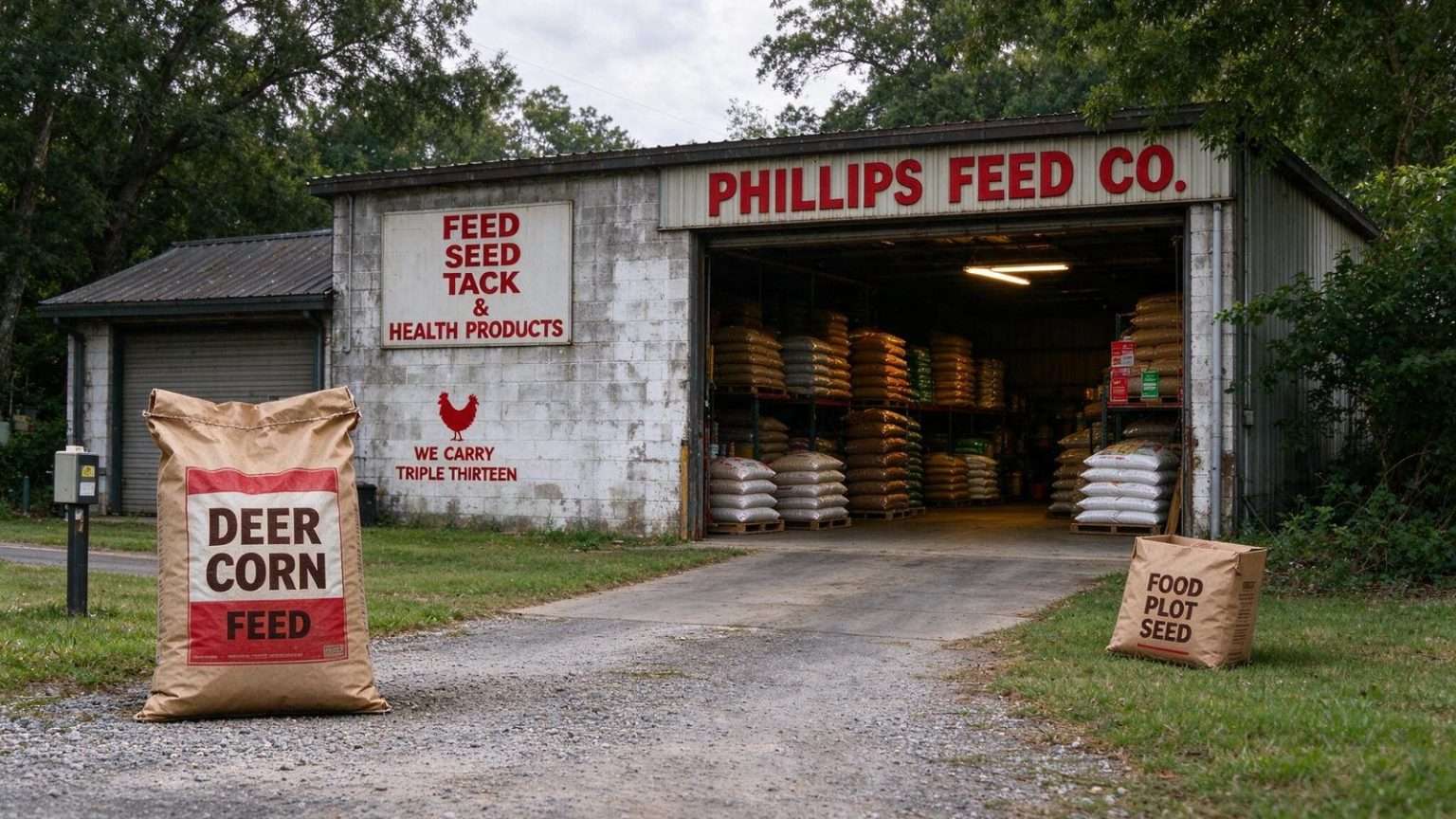
Tucked off Wolf Ridge Road at 2417 Feed Mill Road in west Mobile, Phillips Feed Co. is the kind of business that predates the subdivisions now crowding Mobile County’s rural edges — a family-run feed store where hunters, farmers, and backyard animal keepers have traded for decades.
The shop stocks a full range of livestock and agricultural supplies: feed for every manner of animal, a wide variety of seed, and basics in tack and animal health supplements.
Feed stores occupy a particular place in Alabama’s rural economy. They are part supply house, part gathering spot and part informal advisory service — the place where a chicken keeper with a sick flock, a cattle farmer pricing hay and a deer hunter planning a food plot all end up in the same aisle, trading knowledge along with their money. Phillips Feed Co. has played that role on Mobile’s western edge for years, through the changes that have reshaped the county around it.
Deer hunters know it as the place to buy corn for hunting plots, and the store’s fair prices have long been part of its draw. Food plots are a fall tradition across south Alabama, where hunters spend late summer and early fall planting and maintaining plots to draw deer through the season — a practice that turns a few bags of corn and seed into months of stand time in the woods.
Generations of Customers
The store’s customer base is multigenerational by design. Regulars describe children of longtime customers now buying triple-thirteen fertilizer and feed for their own animals — the same products their uncles and fathers loaded up decades ago.
Triple-thirteen — the 13-13-13 blend of nitrogen, phosphorus and potassium — is a workhorse fertilizer across the Gulf South, the balanced mix behind gardens, food plots and pastures for generations. Its presence on a feed store’s shelves is a marker of the store’s role: this is where working land gets tended, not a boutique garden center with a cafe.
That continuity is rarer than it once was. As subdivisions spread into former farmland across Mobile County, the customer base for agricultural supply shifts from commercial farms to a different kind of customer — hobby farmers, homesteaders, backyard poultry keepers and horse owners keeping a few acres. Stores that adapt while keeping their old-stock depth survive; stores that lose either side do not.
Customers consistently point to the same things: fair prices, deep knowledge of what they sell, and treatment that feels more like family than retail. In an era of big-box agriculture aisles, that last quality does the heaviest lifting — the difference between a clerk who scans a bag and a store owner who asks how the cattle are doing and what worked in the pasture this year.
The Wolf Ridge Countryside
Wolf Ridge Road runs through one of the parts of Mobile County where the rural past is still visible in the landscape — rolling land, old homesteads, horse pastures and wooded acreage between the developments pushing out from the city. The road’s name recalls the wilder country this once was, and the stretch around Feed Mill Road retains the feel of the farming communities that settled it.
West Mobile’s growth has been one of the county’s defining stories for decades, as residential development spread along Schillinger Road, Snow Road and the other arteries feeding toward the Mississippi line. With that growth has come the tension that defines Phillips Feed Co.’s world: acreage subdivided, farmland converted, and a customer base evolving from full-time farmers to rural residents who keep animals alongside their day jobs.
Yet the demand has not disappeared — it has changed shape. Modern homesteading interests, the backyard chicken boom and the enduring popularity of deer hunting in Alabama have all fed the kind of store Phillips runs. A customer buying chicks and feed in spring may return in fall for food plot seed and corn, then again in winter for supplements — a year-round relationship no national retailer replicates.
What’s on the Shelves
The store’s inventory maps the agricultural life of its customer base. Feed covers the full range of animals kept in Mobile County — poultry, cattle, horses, goats, rabbits, hogs, deer and dogs — in bags stacked to the ceiling of a warehouse that smells like the working countryside it serves.
Seed sits at the center of the seasonal calendar. Spring brings vegetable garden varieties and summer forages; fall brings the wheat, oats, clover and brassica mixes that food-plot hunters plant ahead of the season. Between those peaks, the store carries the animal health basics — dewormers, vaccines, supplements — and the tack and equipment that keep small farms functioning.
The corn trade deserves its own note. Deer corn moves in volume across south Alabama from late summer through winter, as hunters fill feeders and top-dress plots ahead of opening day, and a store that prices its corn fairly earns a loyal share of that traffic year after year.
That breadth matters because timing is everything in agriculture. A farmer who needs vaccine this week or seed before the rain cannot wait on a shipping window, and the feed store’s role as local inventory is part of what keeps it essential even as online retail expands into rural supply.
A Working Link to the County’s Roots
In a corridor of Mobile County where farmland is steadily giving way to development, Phillips Feed Co. remains a working link to the area’s agricultural roots. Mobile County was built on farming and timber before it was built on shipyards and aviation, and family farms — cattle, poultry, row crops and truck farms that fed the city — shaped the western and northern reaches of the county for generations.
Businesses like the feed store are among the last institutions from that era still functioning in their original role. Schools consolidate, farm bureaus evolve, but the feed store keeps answering the same seasonal questions it always has, from spring planting to fall plots to winter feeding. Its survival through the county’s transformation says as much about the depth of rural habit in Mobile as it does about the store itself.
The store also anchors a network of local relationships that agriculture runs on — the seed suppliers, feed mills, hay growers and livestock buyers whose commerce keeps small farms viable. A feed store that knows its customers knows who has hay for sale, who is butchering, who breeds livestock and who can repair a fence at short notice. That connective function never shows up on an inventory list, but it is part of what customers mean when they describe the store as family.
Why Family-Run Still Matters
The multigenerational customer base and the family-run operation mirror each other. Children who grew up loading feed with their fathers now run accounts of their own; the store’s knowledge base passes down the same way, from one set of hands to the next. Big-box competitors can match some prices on commodity bags, but they cannot match a store whose staff has watched a customer’s herd grow for twenty years.
That service model shows in the details. Advice on feed rations for a lactating goat, on when to plant clover, on treating a lame horse before the vet arrives — this is the expertise regulars cite alongside price. It is retail as a relationship rather than a transaction, and it is the reason rural supply stores outlast the chains that move into their markets.
The knowledge also cuts both ways. Customers bring the store information from their own pastures — what the deer are hitting, what the hay crop looks like, which feed their animals did best on — and that shared intelligence becomes part of the store’s institutional memory. A feed store’s aisles function as an informal county extension office, staffed by experience rather than bulletins.
For newcomers to west Mobile — the families settling subdivisions that were pastures a decade ago — the store often serves as an introduction to the area’s rural practicalities: who to call, what grows here, what the seasons demand. The store’s role in the community adapts to each generation of customers without changing its essential character.
Finding the Store
Phillips Feed Co. operates at 2417 Feed Mill Road off Wolf Ridge Road in west Mobile. Hunters stocking up before the season, farmers running their supply lists and new animal keepers with questions all head to the same unassuming warehouse off the country road.
The store can be reached at (251) 344-7712. For a county whose edges keep filling with rooftops, the phone number that answers is a small piece of continuity — the feed store still open, still stocking the same shelves and still treating its customers like the neighbors they are.