Pine Hill Haints’ Jamie Barrier and Sam Barret Bring the Hootenanny to Mobile’s 360 Jazz Cafe
Jamie Barrier and Sam Barret of the Pine Hill Haints played an intimate $5 hootenanny show at Mobile's 360 Jazz Cafe in February 2013.
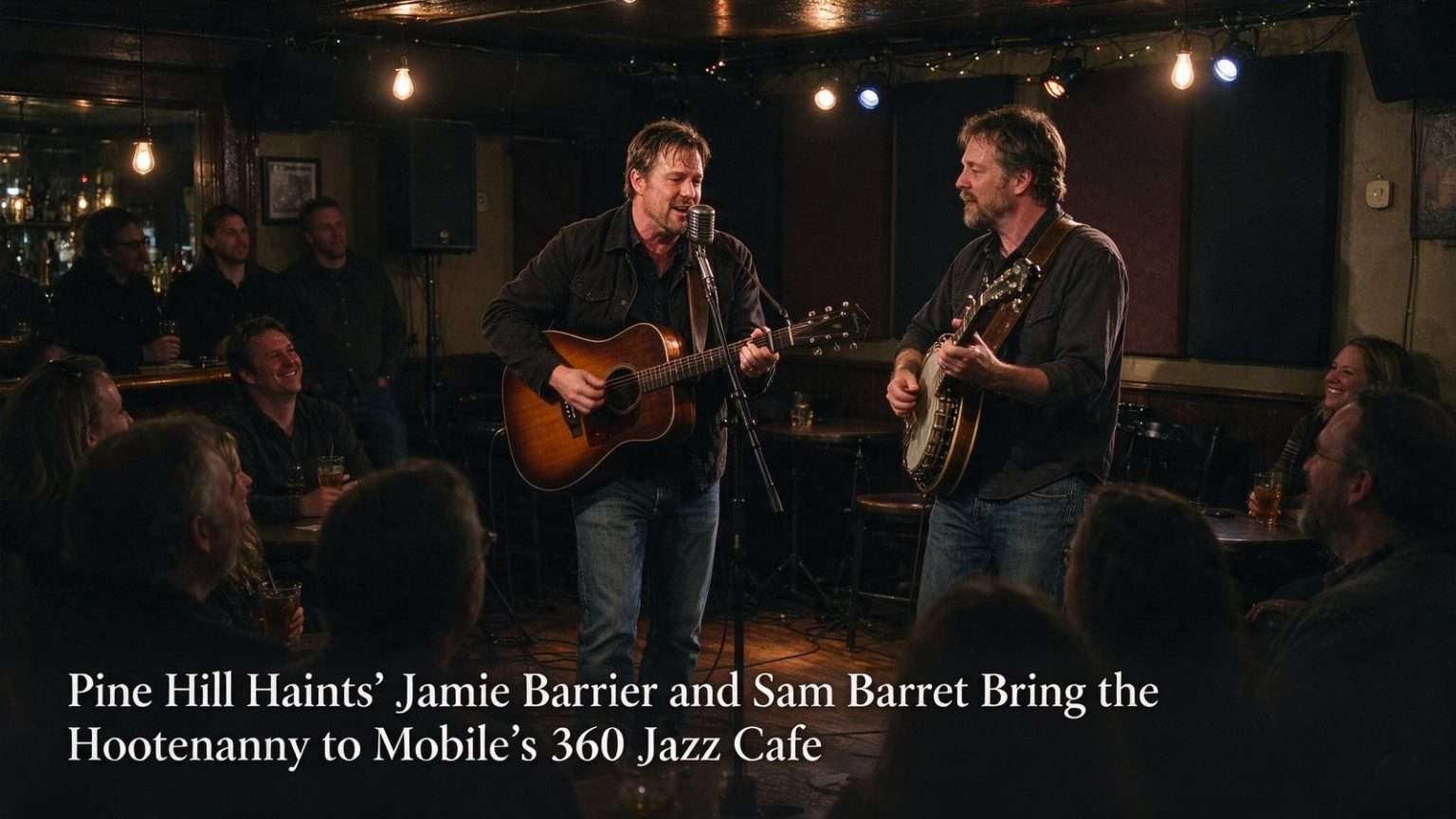
Two members of one of Mobile’s most beloved bands traded their full-band format for an intimate duo setting in early February 2013, as Pine Hill Haints frontman Jamie Barrier and “Serious” Sam Barret brought their hootenanny to the 360 Jazz Cafe on a Saturday night. The stripped-down date gave Port City fans a rare close-up encounter with the music of a band usually experienced in full, rambunctious form.
The Pine Hill Haints have long been seminal favorites around the Port City, known for their ghostly blend of graveyard folk, rockabilly and old-time music. The band’s sound — built on acoustic instruments, haunted Southern imagery and a raw, urgent delivery — has made it a cult act far beyond Mobile, with listeners across the country and overseas discovering the group’s growing catalog of recordings. But the Haints have always been, first and foremost, a Mobile band, born of the city’s bars, houses and late nights, and hometown shows carry a weight that touring dates elsewhere do not.
Stripping the material down to the duo of Barrier and Barret gave fans an unusually close-quarters way to hear songs that the full band typically plays with more forces behind them. In a room the size of the 360 Jazz Cafe, the exchange between performer and audience that defines the Haints’ live reputation becomes immediate: stories between songs, requests shouted from the bar, and the kind of informal atmosphere that a hootenanny — the old word for a gathering built around participatory folk music — was made for.
The Haints’ Place in Mobile Music
Over years of playing the Gulf Coast, the Pine Hill Haints built a reputation as one of the hardest-working and most distinctive acts in Alabama independent music. Their catalog draws on the well of Southern music — old-time ballads, gospel shapes, rockabilly energy and punk urgency — filtered through a sensibility that embraces the spooky and the mournful. The band’s themes of ghosts, rivers, graveyards and hard travel might sound grim on paper, but in performance the music lands as celebration, the kind of songs a room full of people can shout along with.
That combination has made the band a touchstone for Mobile’s independent scene. Younger musicians cite the Haints as proof that a band can stay rooted in its hometown, self-release its music and still reach an audience far beyond the state line. The group’s name itself, borrowed from the piney woods and the ghost stories of the Deep South, signals the band’s grounding in the region’s folklore rather than in any trend or scene.
Jamie Barrier, the band’s frontman and principal songwriter, is the constant at the center of it all — a singer whose voice and songwriting carry the band’s mix of menace and warmth. “Serious” Sam Barret, a longtime collaborator, brings instrumental firepower and vocal harmony to the full band, and in the duo format the two of them carry the repertoire between them, filling the space with whatever the room requires.
The Duo Format: A Hootenanny, Not a Concert
The word hootenanny dates to the folk revival of the mid-20th century, when it described informal gatherings where anyone might sing, and the term suited this booking precisely. A duo show by two members of a beloved band is not a scaled-down concert; it is a different kind of event, closer to a session than a set. Songs can stretch or shrink, stories take the place of full-band arrangements, and the audience sits close enough to hear the instruments’ raw sound without amplification doing the work.
For the material itself, the duo format is a revelation rather than a compromise. The Haints’ songs are built on strong melodic bones — the full band adds drums, strings and volume, but the songs survive, and in some ways thrive, when reduced to voices and a guitar or two. Longtime fans got to hear familiar songs in a new light, while newcomers got a low-threshold introduction to a band whose full shows can be an intense initiation.
The 360 Jazz Cafe Setting
Doors opened at 7 p.m. with music starting at 8, and early arrivals were encouraged to take advantage of the club’s food and drink menus. The 360 Jazz Cafe has made its name as one of Mobile’s more intimate listening rooms, a place where the audience comes to hear the music rather than to talk over it, and the venue’s kitchen and bar give patrons a reason to arrive early and settle in for the night.
The room’s scale is the point. Venues of this size — seating measured in dozens rather than hundreds — have become essential infrastructure for touring and local acts alike, offering artists an attentive crowd in exchange for a scaled-back show. For a duo format in particular, the economics and the acoustics both favor a small room, and the 360’s booking of the Barrier-Barret hootenanny fit the club’s identity as a home for jazz, folk and roots-adjacent music on Mobile’s nightlife map.
Cover was $5 at the door, dropping to $2 for 360 Jazz Cafe members. The modest door charge reflected the venue’s approach: keep shows affordable, reward the regulars who support the club through memberships, and build a dependable audience for acts that fly below the mainstream radar. For the price of a sandwich, Saturday-night attendees got two accomplished performers in a room built for listening.
Why Small Rooms Matter to a Scene
Show bookings like this one are the connective tissue of any city’s music scene. Big venues bring touring names; festivals bring crowds; but the small clubs are where a band’s relationship with its hometown actually lives — where songs get tried out, where musicians sit in with one another, and where the audience is close enough to become part of the show. Mobile’s independent music community has long depended on rooms of exactly this size, from the bars of Dauphin Street to the neighborhood venues scattered across the city.
The Pine Hill Haints’ willingness to play a duo date in a jazz cafe speaks to that ecosystem. A band with the Haints’ reputation could fill larger rooms on name value alone, but splitting into a hootenanny format for a Saturday night at the 360 keeps the band woven into the local fabric — visible, accessible and approachable in a way that arena acts never are. It also gave the venue a marquee-worthy booking without the overhead that a full-band show would have required.
For fans, the practical advice was straightforward: come early, eat, claim a seat and settle in. Doors at 7 p.m. and music at 8 left room for dinner from the club’s menu before the first note, and the $2 member cover meant that regulars had little reason to miss it.
An Unusually Close Quarters Experience
What made the night notable was not novelty for novelty’s sake but the chance to hear a beloved band’s material in unusually close quarters. The Pine Hill Haints’ records reward headphone listening — dense with texture, field-recording atmosphere and details that emerge over time — and a duo show in a small room recreates some of that intimacy in person. Every string noise, breath and spoken aside is part of the performance when the performer is ten feet away.
For a band whose mythology leans toward the ghostly and the distant — graveyard folk, after all — the 360 Jazz Cafe date inverted the usual distance. There was nothing spectral about a Saturday-night room full of neighbors singing along with Jamie Barrier and “Serious” Sam Barret. It was Mobile music at its most direct: hometown heroes, a small stage, a five-dollar cover and songs that the room already knew by heart.
The show capped one of the more appealing bookings of Mobile’s early-2013 club calendar, and it demonstrated once again why the Pine Hill Haints remain seminal favorites in the Port City — a band that can conjure ghosts from a big stage, and just as easily invite the whole town into the parlor for a hootenanny.
The Songs and the Sources Behind the Haints’ Sound
Part of what separates the Pine Hill Haints from other acts that borrow old-time textures is how deeply the band’s songwriting draws on the region’s actual musical inheritance. The Haints’ repertoire nods to the shapes of Southern traditional music — murder ballads, river songs, revival-meeting refrains — while treating those forms as living material rather than museum pieces. Songs arrive with the plainness of folk music and the momentum of punk, a combination that has earned the band devotees well outside Alabama and a standing reputation among listeners who track independent American music.
In a duo setting, those sources come through with unusual clarity. Without the full band’s percussion and strings, the audience hears the songs the way they might have been passed around a century ago: one voice carrying the melody, another adding harmony, an instrument keeping the time. For a catalog built on songs about rivers, storms, ghosts and hard roads, the sparser arrangement suits the subject matter, putting the stories at the center of the performance.
That is the quiet appeal of a hootenanny in the first place. The format asks the performers to be entertainers and hosts at once — introducing songs, bantering with the room and responding to what the audience wants — and it asks the audience to be more than spectators. On a Saturday night at the 360 Jazz Cafe, with the kitchen serving and the bar busy, the exchange between Jamie Barrier, “Serious” Sam Barret and the hometown crowd was the whole of the evening’s business, and for five dollars at the door it was among the better bargains on Mobile’s winter calendar.