
‘Plan B’ for tolling the Mobile River Bridge project would offer a tax credit
State Sen. Chris Elliott has pre-filed a 'Plan B' bill offering Alabama drivers a tax credit for tolls paid on the Mobile River Bridge project.
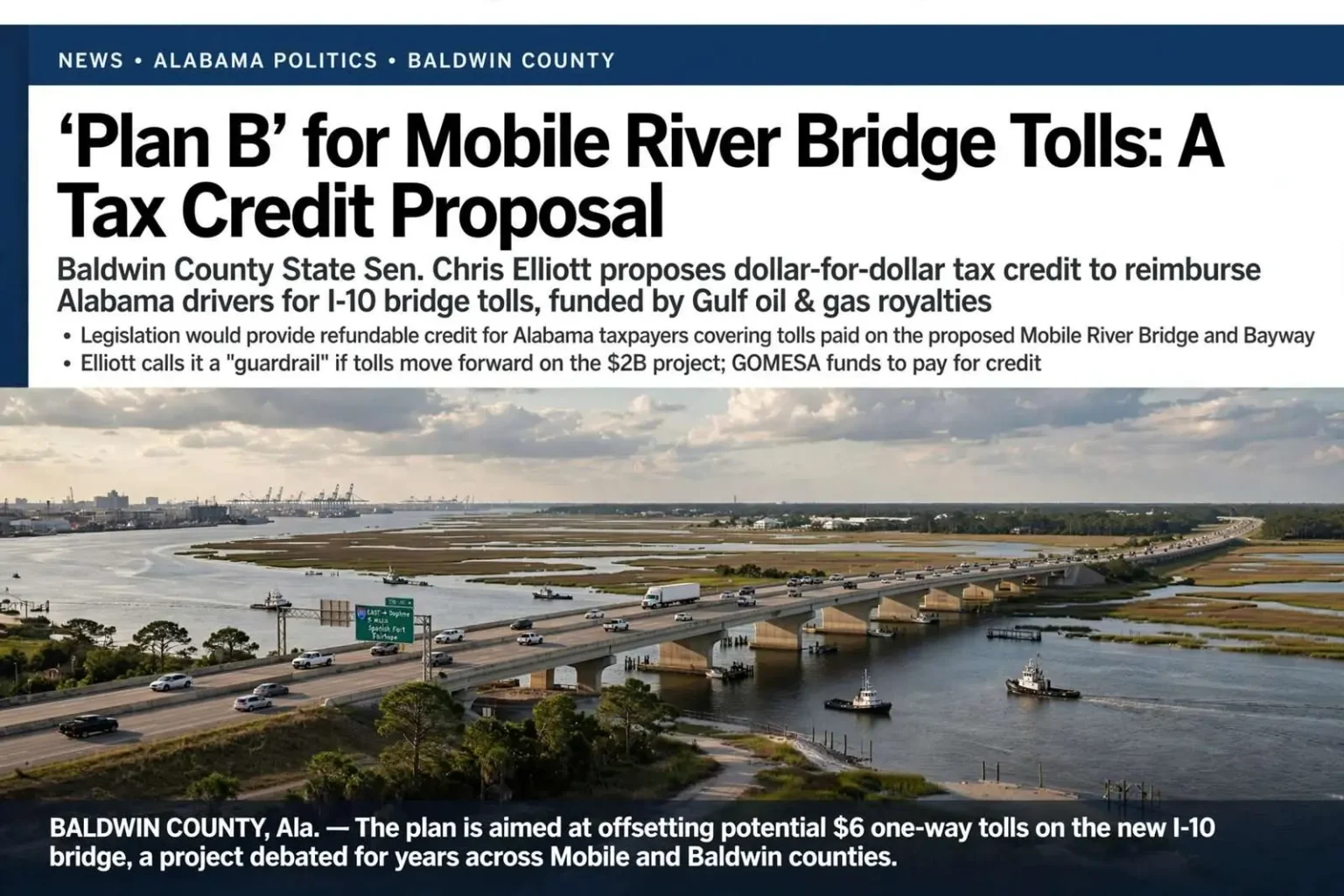
BALDWIN COUNTY, Ala. — State Sen. Chris Elliott is calling it a “Plan B.” If tolls are used to help fund the Mobile River Bridge project, what about a dollar-for-dollar credit on your Alabama tax return?
The legislation, pre-filed ahead of the coming legislative session, is aimed squarely at the most contentious element of the region’s biggest transportation project: the plan to finance the proposed Interstate 10 bridge across the Mobile River and the expanded Bayway by charging tolls to the drivers who use them. For years, the tolling question has divided residents of Baldwin and Mobile counties, and it has turned the bridge project — broadly popular in concept — into a political fight over who pays and how much.
“Six dollars, one way. Maybe $2.50, but six dollars is outrageous to me,” said Baldwin County resident Billy White, summing up the frustration many commuters have expressed as the toll figures circulated at public meetings.
Elliott’s answer is to let the state absorb the blow through the tax code. “This bill provides a dollar-for-dollar tax credit of any toll paid in this project. So, folks that are going to be impacted by this toll are made whole,” he said.
How the Credit Would Work
The mechanism matters. “It’s a credit, not a deduction, so it’s a dollar-for-dollar credit against taxes owed or a refund if the amount spent on tolls exceeded liability,” he said.
The distinction between a credit and a deduction is significant for the drivers the bill targets. A deduction reduces the income on which taxes are calculated, returning only a fraction of the expense depending on the taxpayer’s bracket. A credit subtracts directly from the tax bill itself, so every toll dollar paid comes back whole. And for commuters whose annual toll spending exceeds what they owe in state income tax, the bill as written would convert the excess into a refund — meaning regular users of the bridge and Bayway would, in effect, pay nothing to the state for the privilege.
For heavy commuters — Eastern Shore residents who cross Mobile Bay daily for work, school, medical appointments, or trade — the arithmetic is the whole point. A round trip under a $6 one-way toll could add up to thousands of dollars a year, and the credit would neutralize that cost on the state level, shifting the burden back to the project’s financing structure rather than the drivers’ wallets.
Why Elliott Hopes It’s Never Used
He hopes it is never needed and that the Alabama Department of Transportation will come up with a different plan to fund the $2 billion project. “If they choose to move forward we wanted to have a ‘plan B’ and that’s what this is,” he said.
That framing is essential to understanding the legislation’s intent. Elliott is not endorsing tolls; he is building a guardrail in case they arrive. The bill functions as leverage in the ongoing debate over the project’s financing — a signal to transportation officials and the public that Baldwin County’s legislative delegation will not let the toll burden simply fall on its constituents without a countermeasure. If ALDOT produces a funding plan that avoids tolls entirely, the bill simply never comes into play.
The Mobile River Bridge and Bayway project has been decades in the making. The existing route between Mobile and the Eastern Shore funnels interstate traffic through the George Wallace Tunnel under the Mobile River and along the elevated Bayway spanning the bay — bottlenecks that produce some of the state’s worst congestion and that have no practical room to expand as built. A new bridge, rising high enough to replace the tunnel bottleneck, has been the long-standing fix, but its multi-billion-dollar price tag has always forced the question of how to pay for it, and tolling emerged from the planning process as the primary answer.
GOMESA Money as the Funding Source
To pay for the tax credit, Elliott has also pre-filed a bill directing how royalties from offshore oil and gas wells — or “GOMESA” money — can be spent. That money would fund the credit.
GOMESA — the Gulf of Mexico Energy Security Act — sends a share of federal offshore drilling royalties to the Gulf Coast states and their local governments, with Alabama receiving tens of millions of dollars in some years. The revenue was conceived with coastal purposes in mind: conservation, infrastructure, and hurricane protection among them. Directing that money toward shielding drivers from tolls ties the state’s offshore energy windfall to its most visible coastal infrastructure problem, and it gives the tax credit a dedicated funding stream rather than leaving it to compete with the rest of the state budget.
The arrangement also sets up a policy conversation about priorities, since GOMESA dollars arrive with allocations already claimed by coastal governments and various programs. Steering a slice of that money into toll relief would require the legislature to rank the bridge issue above other uses of the revenue.
The Politics of the Toll Fight
The tolling plan has generated sustained opposition across the two counties since the figures were made public, with public meetings drawing crowds of residents who questioned both the amounts and the fairness of the approach. Critics argue that tolls on the new bridge and the Bayway would effectively tax the daily commute between Baldwin and Mobile counties, hitting working families, small businesses, and logistics companies hardest. Supporters of tolling counter that the users of the new capacity should pay for it, and that federal and state funds alone cannot cover a project of this scale.
Into that fight, Elliott’s legislation introduces a middle path: build the project, collect the tolls if that is the financing decision, but return the money to Alabama taxpayers through the income tax. The approach leaves ALDOT’s financing structure intact while neutralizing the cost to the state’s own residents — and, not incidentally, preserves the toll revenue stream that out-of-state and through travelers would continue to pay into without any credit coming back.
That last detail is part of the political appeal. A substantial share of the traffic crossing Mobile Bay on I-10 originates outside the region — commercial freight and vacationers bound for the beaches — and tolls paid by those drivers would still flow to the project. Only the state’s own taxpayers would be made whole under the bill.
What Comes Next
The bills now head into the legislative session, where they will compete with the rest of the state’s budget and policy agenda. Their fate is intertwined with the project’s own timeline: financing decisions on the Mobile River Bridge and Bayway, federal approvals, and construction planning all continue in parallel, and any movement by ALDOT toward an alternative funding plan would change the calculus immediately.
For Baldwin County commuters, the legislation represents the first concrete mechanism proposed to blunt the toll’s impact, and its progress in Montgomery will be watched closely on both sides of the bay. Whether the “Plan B” ever becomes necessary depends on decisions still ahead — but for now, the message from Baldwin County’s delegation is that if tolls come, the state’s drivers will not carry the cost alone.
Residents who want to follow the issue can track the bills as they move through committees, weigh in at ALDOT’s public comment opportunities, and watch the project’s financing discussions as the $2 billion plan advances toward construction.
The Project Behind the Politics
Understanding the stakes requires understanding the roadway itself. Interstate 10 is the Gulf Coast’s main east-west artery, and every vehicle traveling it between Florida and the Mississippi line must cross Mobile Bay. Today that crossing means descending into the George Wallace Tunnel beneath the Mobile River — a structure built in the early 1970s with two narrow lanes in each direction and clearance limits that bar tall trucks and hazardous cargo, which detour for miles around the city as a result. The Bayway, the elevated causeway spanning the bay on the eastern approach, adds its own congestion, crash delays, and weather closures to the mix.
The proposed fix is a new bridge rising high over the river — tall enough for port traffic to pass beneath without tunnels — paired with a rebuilt, wider Bayway. The estimated cost has hovered around $2 billion, a figure far beyond what annual state and federal road allocations can absorb in the region, which is what pushed planners toward tolling as the core of the financing plan. The project has cleared years of environmental review and planning, but the money question remains the decisive one.
For residents of Spanish Fort, Daphne, Fairhope, and the rest of the Eastern Shore, the route is not an abstraction; it is the daily connection to jobs, hospitals, the airport, and half the region’s commerce. That is why the toll debate has been loudest in Baldwin County — the drivers with no alternative route have the most to lose from a $6 crossing they cannot avoid.
A Test Case for the State
The outcome of the Mobile River Bridge financing debate is being watched beyond the Gulf Coast as well. Alabama has built few new tolled facilities, and how the state handles its largest proposed project in decades — the mix of state, federal, toll, and possible legislative interventions — will shape how future mega-projects get funded. Elliott’s tax-credit approach, if enacted, would itself become a model other regions facing toll proposals might pursue, effectively letting the state general fund or earmarked royalties absorb costs that tolling was designed to recover.
That possibility is exactly what supporters of toll-free financing hope for and what fiscal conservatives in the legislature will scrutinize: a dollar-for-dollar credit on a $2 billion project’s toll revenue could represent a substantial ongoing obligation, funded here by GOMESA royalties whose other claimants will defend their share. The session’s committee debates will test whether the coalition of coastal legislators can hold together around the plan.
Either way, the legislation has already changed the conversation. The choice ahead is no longer framed as tolls or nothing, but as tolls with relief for Alabama drivers, or an alternative financing plan yet to be produced — a shift Baldwin County’s delegation intends to keep in place until the bridge question is finally settled.


