
Police Identify Man Fatally Shot in Birdville Community
Mobile police identified Michael E. Carmichael, 50, as the man shot and killed on Heron Drive in the Birdville community.
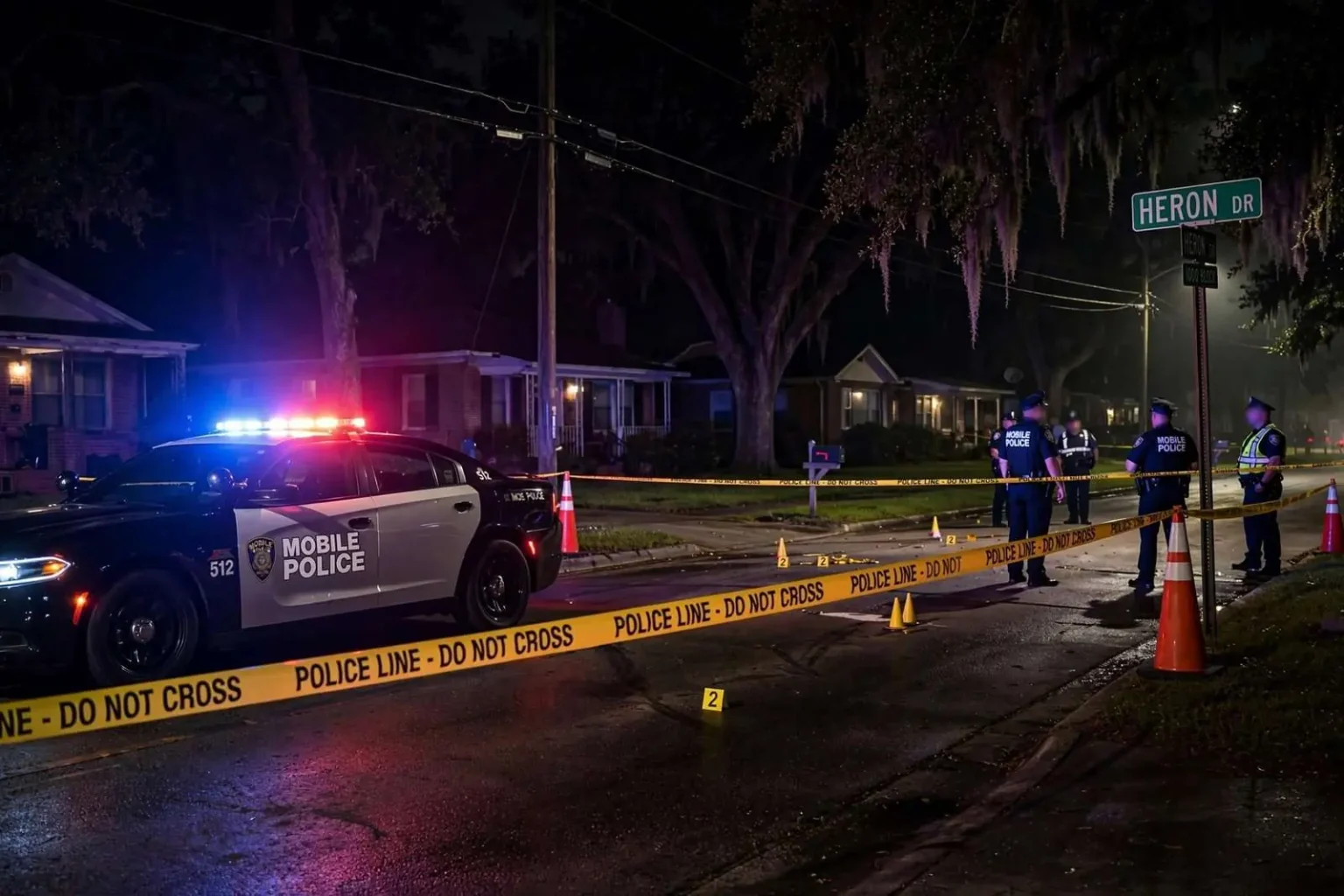
Mobile police have identified the man found shot to death in the Birdville community early Wednesday morning as Michael E. Carmichael, 50.
Officers were called to the scene around 12:17 a.m. and discovered Carmichael lying in the road on Heron Drive with a gunshot wound. He was pronounced dead at the scene, police said.
The department withheld Carmichael’s name initially while investigators worked to notify next of kin, a step police departments routinely take before releasing a homicide victim’s identity publicly. With the family notified, detectives moved forward with the release of the name as the investigation continued.
Police said the investigation remained active, and no arrests had been announced. Detectives have not said whether they believe the shooter and victim knew each other, and no suspect description was released in the hours after the discovery.
Anyone with information about the shooting is asked to contact Mobile police at 251-208-7211.
An Early Morning Discovery on Heron Drive
Heron Drive sits in the Birdville community, an older residential neighborhood in northwest Mobile along the Moffett Road corridor. The area is made up largely of single-family homes, church congregations and small businesses that have served residents for generations, and many people there know one another by name. A fatal shooting in the middle of the road in such a setting is a rare and jarring event for the surrounding blocks.
According to the timeline police provided, the call came in shortly after midnight. That hour matters in investigations like this one, because overnight streets tend to be nearly empty and there are fewer potential witnesses than there would be during the day. First responders arriving around that time would have secured the roadway, rendered aid where possible and confirmed that nothing could be done to save the victim before turning the location over to investigators.
When a person is pronounced dead at a scene in Mobile County, the investigation typically involves several agencies working in sequence. Patrol officers secure the perimeter and interview anyone nearby. Evidence technicians photograph the roadway, collect shell casings or other physical material, and document the scene for investigators who may not arrive until later. The Alabama Department of Forensic Sciences handles the examination that will formally establish the cause and manner of death.
How a Mobile Homicide Investigation Proceeds
In cases like this one, the Mobile Police Department’s investigators take the lead once patrol units secure the scene. Detectives typically begin by canvassing the immediate area, knocking on doors and checking whether any homes or businesses along Heron Drive and the surrounding streets have surveillance cameras that might have recorded something in the minutes before and after the shooting. Doorbell cameras have become an increasingly important tool in cases where there are no eyewitnesses.
Detectives also work to reconstruct the victim’s last known hours — where he was, who he was with and how he came to be lying in the roadway. That work involves interviews with family members, friends and anyone who had recent contact with the victim. In many shootings, the answer to what happened comes not from a single dramatic breakthrough but from dozens of small statements that gradually line up with the physical evidence.
The department has not announced a motive, and investigators generally avoid speculating publicly in the early stages of a case. Arrests in Mobile homicide investigations sometimes come within days and sometimes take weeks or months, depending on the quality of witness cooperation and forensic results. Until an arrest is made, the case remains open and active.
Why Police Hold Back a Name
The decision to withhold a victim’s name for a time is not secrecy for its own sake — it is a widely followed practice among law enforcement agencies. Before a name is made public, investigators want to be certain that next of kin have been located and informed, so that a family member does not learn of a death from a news report or a social media post. Notification is usually made in person by an officer or a chaplain, and in some cases it takes hours or longer to reach relatives.
The delay also serves practical investigative purposes. In the first hours after a homicide, detectives may want to speak with family members before the details of the case circulate widely, so that their recollections are fresh and undisturbed. Once a name is public, neighbors and acquaintances begin talking among themselves, and the account that investigators hear can be shaped by rumors rather than direct observation.
For the Carmichael family, the notification process means the grieving began before the community knew who had died. Family members of homicide victims are frequently asked to help investigators by providing background on the victim’s recent life, his associations and any conflicts or concerns he may have mentioned. That cooperation often proves essential, particularly in cases where there are no eyewitnesses.
The Birdville Community Context
Birdville is one of Mobile’s older communities, with roots stretching back generations in the northwest part of the city. Neighborhoods in this part of Mobile developed along well-traveled corridors like Moffett Road, with side streets such as Heron Drive connecting residents to schools, churches and businesses nearby. Many families have lived in the area for decades, and community institutions there tend to be closely tied to neighborhood life.
Mobile, like cities across Alabama and the nation, has contended with gun violence that touches communities of every size. Each fatal shooting leaves behind a family coping with sudden loss and a neighborhood coping with fear and uncertainty. Police leaders in Mobile have repeatedly emphasized that solving homicide cases depends heavily on residents coming forward, and community organizations in the city have worked for years to encourage witness cooperation.
The overnight hours present particular challenges for investigators. Fewer witnesses are awake, lighting is limited and any surveillance video captured in darkness can be harder to use. That makes early tips from residents who may have heard something — a vehicle, a voice, an argument — especially valuable in cases like the one on Heron Drive.
The Role of the Public in Solving Cases
Police are asking anyone with information about the shooting to call 251-208-7211. Investigators stress that even details that seem unimportant to the caller — a car seen speeding away, a person walking through the area, a sound heard around the time of the shooting — can help fill in the timeline detectives are assembling.
In Mobile, tips from the public have historically played a decisive role in homicide investigations, from identifying vehicles to naming suspects. Residents sometimes hesitate to get involved out of concern about coming forward, and agencies address that concern by allowing people to share information through channels that do not require identifying themselves. What matters to detectives is the information itself, not the identity of the person providing it.
The first days of a homicide investigation are widely considered the most important. Memories are fresh, physical evidence has not degraded, and surveillance footage can still be retrieved before it is overwritten. That is why authorities renew their appeal for information so quickly after a killing and why they urge anyone who was in the area of Heron Drive early Wednesday to come forward, even if they are unsure whether what they saw or heard matters.
What Comes Next in the Case
As the investigation moves forward, several standard steps lie ahead. The victim’s body will be examined by the Alabama Department of Forensic Sciences, which will document the specific circumstances of the gunshot wound and produce a report that becomes part of the case file. Detectives will continue processing evidence collected from the scene, and lab work on any material recovered can take additional time.
If investigators identify a suspect, the case will be presented to the Mobile County District Attorney’s Office, which decides whether the evidence supports formal charges. A person charged with murder would then make an initial court appearance, where a judge would address bond and schedule further proceedings. That process can unfold over many months, and prosecutors typically continue gathering evidence even after an arrest is made.
Until then, the case remains in the hands of Mobile police detectives, who have not given a timeline for resolving it. Homicide cases in the city are never closed until they are solved, and investigators regularly return to old cases as new information surfaces. Someone who comes forward months from now can still help bring the case to a resolution.
The Toll on the Neighborhood
For people who live along Heron Drive and throughout Birdville, the days after a fatal shooting bring a familiar set of worries. Parents think about children waiting for school buses a few streets away. Longtime residents recall when such events felt unimaginable on their block. Churches and neighborhood groups often respond by organizing gatherings where residents can talk about safety and, increasingly, by encouraging neighbors to watch out for one another.
The physical scene also tells a story that residents witness directly. A stretch of roadway cordoned off with tape, investigators in protective gear working under portable lights, a coroner’s vehicle — all of it leaves a mark on the people who live nearby. Community advocates in Mobile have long argued that the aftermath of violence deserves as much attention as the investigation itself, from victim services for the family to support for neighbors affected by what they saw.
Police have not indicated whether residents should take any special precautions, and no general threat to the area was announced. The absence of a suspect description means detectives are still developing information about who may have been involved.
How to Help
The appeal for information remains open. Anyone who was in the Birdville community or near Heron Drive in the early morning hours of Wednesday, anyone who may have seen a person or vehicle leaving the area quickly, and anyone who has heard discussion of the shooting since it occurred is asked to contact Mobile police at 251-208-7211.
Investigators will follow up on every lead they receive. Tips are reviewed and compared against the evidence already gathered, and even a fragment of information can confirm or rule out a line of inquiry. For the family of Michael E. Carmichael, the hope shared by investigators and neighbors alike is that someone who knows what happened will decide to speak.
The Mobile Police Department has not said when additional updates will be released. Arrests and charges, when they come in cases like this one, are typically announced publicly, and any development will mark the next step in answering the question the Birdville community has been asking since sirens filled the streets around Heron Drive in the early hours of Wednesday morning.