Police weigh command post at Mobile sports bar as parking lot crowds draw complaints
Mobile police say they are close to setting up a command post at The Stadium Sports Bar and Grill after complaints about parking lot crowds and a weekend.
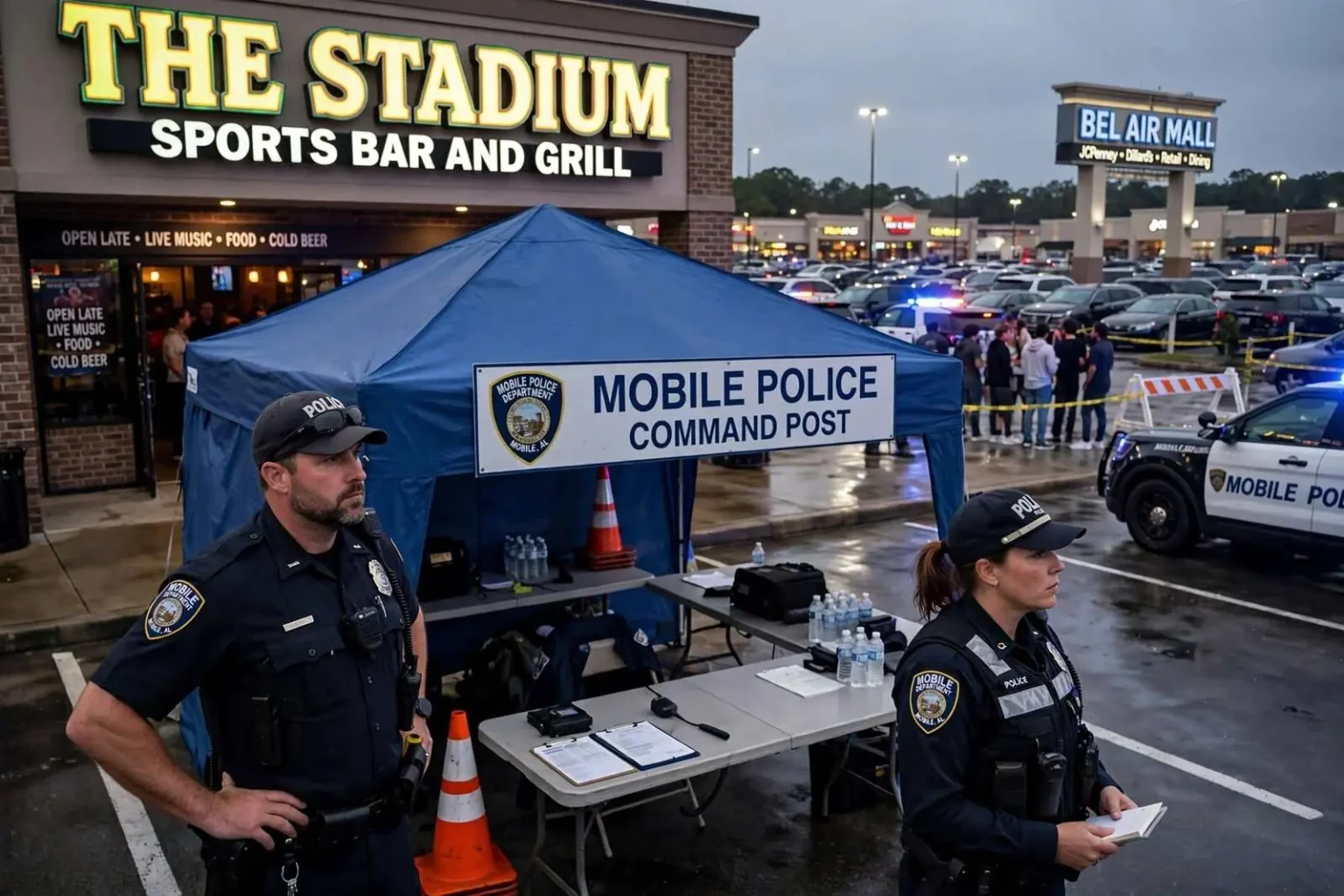
Repeated complaints about crowds spilling out of a Mobile sports bar and filling the surrounding parking lot have put the business on the Mobile Police Department’s radar, and the chief says a permanent police presence at the site is not far off. The Stadium Sports Bar and Grill, located across from Bel Air Mall, has drawn concerns about capacity overflow since it opened in August, and the department says weekend crowds have produced recurring trouble, including a fight captured on video in August and a shooting over one weekend.
Weekend Shooting
According to police, a woman was shot on a Saturday night by a man who was handling a gun carelessly. Investigators described that shooting as accidental, but said it came alongside numerous other reports of criminal activity connected to the area around the business. A bullet fired carelessly in a crowded parking lot has no regard for who it strikes, and the incident transformed a pattern of nuisance complaints into a public safety issue the city could not ignore.
Police said calls tied to the location have included suspicious activity, property damage, repeated noise complaints and citations for loitering. For August and September, police identified three reports filed by people who were involved in disputes with others at The Stadium but who contacted police only after leaving the property. One additional report was filed at the location involving leaving the scene of an accident.
That accounting matters for how the problem is understood. The calls that reach police represent a fraction of the disturbances that occur, since many disputes end without anyone dialing 911 — and disputes reported after the fact by people who drove away are among the hardest for officers to resolve. The paper trail suggests a volume of conflict well beyond what the official log captures.
Complaints Predate the Current Location
The complaints are not new to the ownership. Similar issues were raised when the business operated at its previous Azalea Road location under the name Halftime. The pattern following the business from one site to another is a significant detail for city officials weighing enforcement options: it suggests the problem is tied to how the venue operates rather than to any particular parking lot or neighborhood.
Mobile City Councilman Joel Daves raised the matter publicly in June, saying constituents had contacted him repeatedly. “I have received a number of complaints. His customers need to be inside and we don’t need 2 or 300 people congregating outside the business all hours of the night,” Daves said.
Daves’s district includes the Bel Air area, one of the city’s busiest commercial corridors, where the mall and surrounding businesses anchor thousands of jobs and a steady flow of evening traffic. A property whose weekend nights generate hundreds of loiterers puts pressure on neighboring businesses, many of which operate early the next morning and depend on their own customers feeling safe in the lots they share.
Chief: Most of the Crowd Aren’t Customers
Police Chief Lawrence Battiste said the department has been working with the owner of The Stadium to curb the overflow, and noted that the core of the problem sits outside the building rather than inside it. In the chief’s assessment, most of the crowd gathering in the parking lot are not customers of the bar at all — they are drawn by the scene itself, the music, the crowds, and the social gravity of a busy weekend night, and they arrive without ever paying a cover charge or buying a drink.
That distinction complicates the enforcement picture. A business can control who comes through its doors by checking IDs, counting patrons, and hiring security, but it has far less authority over a public parking lot where non-customers gather. Private property rules give owners the right to have trespassers removed, but clearing a lot of hundreds of people repeatedly, weekend after weekend, requires manpower the owner does not have — which is why the conversation has turned to a police presence.
The parking lot itself is part of the commercial ecosystem around Bel Air Mall. Large lots shared among businesses create exactly this kind of jurisdictional gray zone: the bar’s patrons, the neighboring stores’ overflow, and the general weekend crowd all blend into one gathering that no single party controls. Retailers across the country have wrestled with the same dynamic, and the usual fixes — posted hours, controlled access, off-duty officers, private security — all carry costs someone must absorb.
What a Permanent Presence Would Mean
The chief’s statement that a permanent police presence is “not far off” signals a shift from responding to calls toward deterring them. A visible, consistent police detail changes the calculus for the young crowds that gather: fights, careless gunfire, and noise violations become far riskier when officers are standing at the edge of the lot. For the neighboring businesses, it offers something they have requested for months — a predictable answer rather than a squad car that arrives after the trouble starts.
Permanent details are typically funded in one of several ways: the department absorbs the cost as a public safety priority, the business reimburses the city for off-duty coverage, or a combination spreads the burden. Each approach has precedent in Mobile, and the choice will likely depend on how long the problems persist. Cities generally prefer voluntary compliance — capacity limits, earlier closing, effective security — over standing enforcement, which is expensive and tends to relocate rather than eliminate a problem.
The owner’s cooperation, as described by the chief, will be central to whatever arrangement emerges. Venues that confront this kind of pattern successfully usually end up doing several things at once: hiring licensed security, enforcing occupancy limits, controlling access to their lots during operating hours, and communicating directly with police about expected crowds. A business that works the problem honestly gives the city every reason to work with it; one that treats the parking lot as someone else’s problem invites the stricter path.
The Council’s Role
Daves’s public comments in June put the issue on the city’s formal agenda, and council members in Mobile have a number of tools short of shutdown to work with: requesting police district attention, pressing the city administration on enforcement, and — in persistent cases — supporting liquor license reviews or nuisance abatement proceedings. None of those steps has been taken yet, and the tone from both the council and the police department has been one of pressing the owner to fix the problems before escalating.
The distinction between a business that generates trouble and a business that attracts a crowd it cannot control will matter if the issue returns to the council. State and city licensing processes focus on conditions at the licensed premises, and the fact that most incidents occur in the parking lot rather than the bar complicates any attempt to hold the license accountable. It also explains why police have focused on cooperative measures first.
What Neighbors Experience
For residents and business owners around the Bel Air corridor, the weekend scenes have practical consequences beyond noise. Congested lots block access to neighboring stores, discouraged customers take their evening business elsewhere, and incidents — even ones that end without serious injury — shape perceptions of safety in a district the city has spent years trying to strengthen. Bel Air Mall and the surrounding commercial properties represent one of Mobile’s most important retail centers, and the city treats threats to its viability seriously.
The August shooting crystallized those concerns. Whatever the intent of the man handling the gun, the outcome — a wounded woman, in a crowded parking lot, across from the city’s largest mall — demonstrated the stakes of letting a gathering crowd problem go unaddressed. Accidental or not, the shooting was entirely preventable, and it moved the conversation from noise complaints to consequences.
The Weeks Ahead
The department’s next steps will show how Mobile intends to balance business interests, public safety, and the rights of the crowds themselves. A permanent presence at the site would put the city in the parking lot every weekend night, an unusual commitment that signals both the seriousness of the problem and the limits of what the owner has accomplished so far. Battiste’s emphasis on continued work with the owner suggests the city still prefers partnership to punishment.
For The Stadium, the path forward is narrow but clear. Keep the customers inside, control the lot, staff the doors, and give police no reason to make the presence permanent in any form other than a good working relationship. The business has a location other operators would envy — across from Bel Air Mall, in the heart of the city’s evening traffic — but that location comes with expectations, and the fall season will test whether the operation can meet them without the city doing the work for it.