
Portable Toilets Set Up for Mardi Gras Burn in Bienville Square
At least six portable toilets placed in Bienville Square for Mardi Gras caught fire Monday morning, pushing black smoke over downtown Mobile.
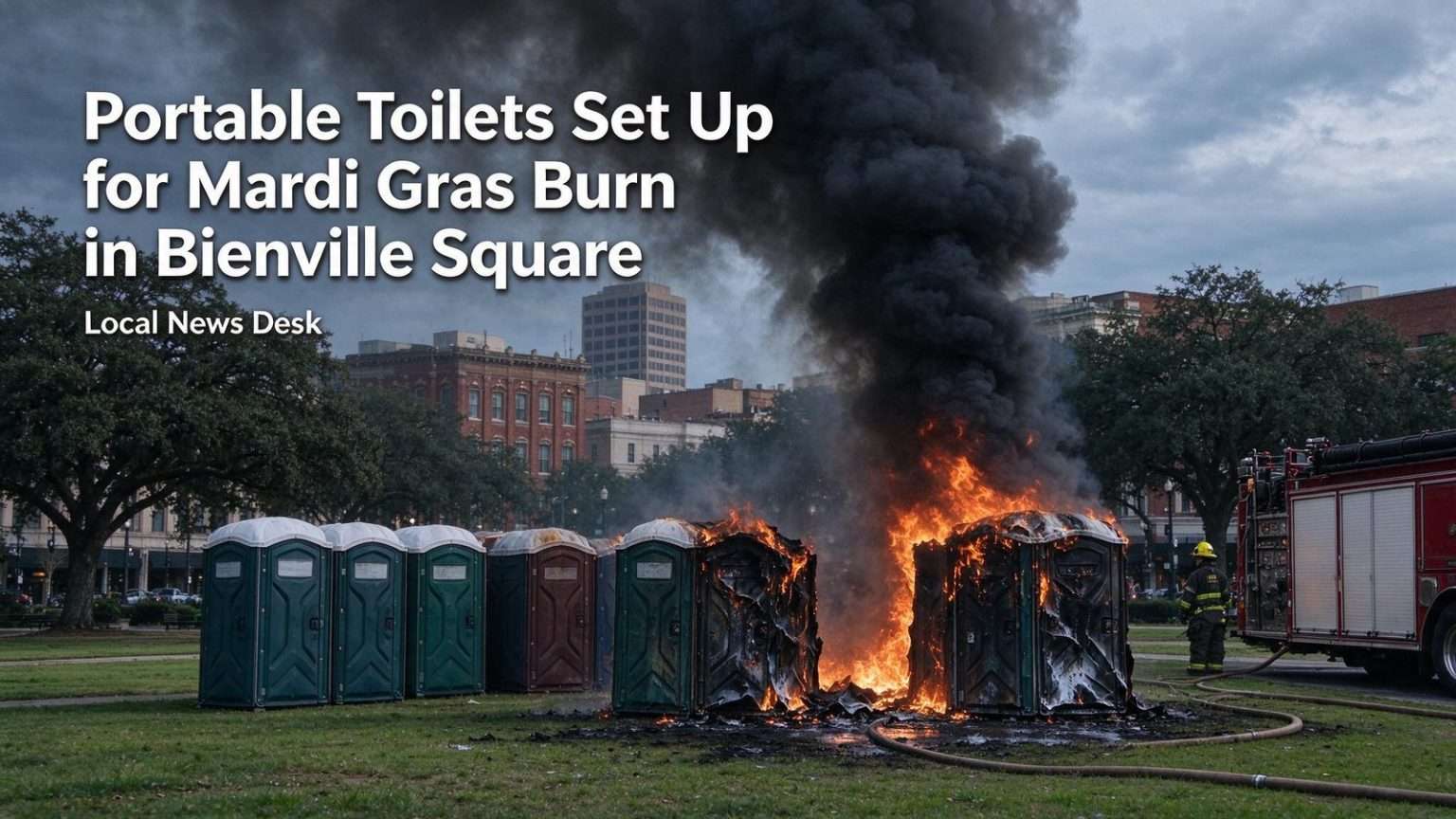
MOBILE — At least six portable toilets caught fire in Bienville Square early Monday morning, sending a column of black smoke over downtown Mobile, according to Mobile Fire-Rescue. The units had been placed at the square to handle the crowds drawn downtown by Mardi Gras parades and celebrations.
The fire broke out just before 8 a.m. The thick, dark smoke was heavy enough to be seen well beyond the square and was captured by a camera mounted at the Maritime Museum, giving the incident a visual record that spread quickly even before officials had sorted out what had happened.
Fire officials did not immediately say what caused the toilets to ignite, and no injuries were reported in connection with the fire. Portable restroom units of the type deployed for festivals are fiberglass and polyethylene constructions whose contents and construction can burn hot and smoky once a fire takes hold, which is why a cluster of them can produce a smoke column visible across a downtown skyline even in an incident involving no structures.
Bienville Square sits in the middle of Mobile’s downtown parade district, a few blocks from the routes used through carnival season. Temporary restrooms are a standard fixture there during Mardi Gras, when tens of thousands of people move through the area over several weeks, and the units staged around the square are as much a part of the carnival landscape as the barricades, bleachers, and food vendors that fill the blocks around the routes.
The timing of the blaze, in the heart of the carnival calendar, meant the destruction of facilities the city was counting on for the crowds still to come. Crews responding just before 8 a.m. faced an unusual scene for a downtown morning: burning plastic restroom units in a historic park framed by live oaks, with the residue of the fire spreading across a lawn that would need to be usable for parade-day crowds.
Bienville Square and Mobile’s Parade District
Bienville Square is one of Mobile’s oldest public parks, a green block in the heart of downtown named for Jean-Baptiste Le Moyne, sieur de Bienville, the French colonial founder of the city. The square has served for generations as a gathering place for concerts, civic events, and the everyday lunch crowds of the surrounding business district, and during carnival it becomes a staging and overflow area in the middle of the parade footprint.
The square’s location puts it within walking distance of the streets that carry Mobile’s parades, which wind through the downtown grid past historic churches, office towers, and the columns of old commercial buildings. During the carnival season, which builds from weeks of smaller balls and parades to the final crescendo around Mardi Gras itself, the blocks around Bienville Square fill with families staking out viewing spots, vendors selling food and trinkets, and the infrastructure that supports them all.
That infrastructure includes the portable restrooms whose burning drew the fire crews out Monday morning. Crowds of the size Mobile hosts during carnival season require sanitation planning on a scale the permanent facilities cannot approach, and cities across the Gulf Coast lease banks of portable units each year, placing them along parade routes and in the parks and lots that anchor the celebration. The loss of several units at once, mid-season, is the kind of logistical wrinkle festival organizers have to solve quickly, since replacement units have to be sourced and placed before the next major parade night.
The park itself can be vulnerable during such incidents. The heat from multiple burning units can scorch turf and damage the roots of mature trees, and Mobile’s downtown squares are shaded largely by century-old live oaks that the city protects carefully. An incident confined to temporary equipment can still leave a lasting mark on a historic green space, which is one reason fire crews work to contain these blazes aggressively despite the absence of structures.
Mobile’s Mardi Gras: The Nation’s Oldest Carnival
Mobile’s carnival celebration predates the better-known New Orleans version, tracing its organized beginnings to the early 18th century and to the city’s French colonial founding. The modern season is run by the city’s mystic societies, the private organizations that stage parades, balls, and revelry across a schedule that stretches from weeks before Fat Tuesday itself through the final nights of the season. Claiming the title of America’s original Mardi Gras is a point of civic pride in Mobile, and the celebration is woven into the identity of the city in a way few festivals anywhere can match.
The scale of the season is easy to underestimate. Dozens of parades roll through downtown over the course of the carnival calendar, each drawing crowds that range from neighborhood-sized gatherings to sea-of-people nights along the main routes. Moon Pies, Throws, marching bands, and the flotsam of beads pile up along the streets, and the city’s crews work around the clock in the season’s final stretch to keep the routes clean and safe between processions.
With that scale comes the perpetual management of crowds, and the sanitation network around downtown is a serious piece of the season’s logistics. Portable restrooms, trash receptacles, barricades, and bleacher seating all have to be placed, serviced, and cleaned across weeks of near-continuous use. Incidents that knock out part of that network, like Monday morning’s fire, ripple into the planning for the parades that follow.
Fires involving portable restrooms during carnival season are a recognized nuisance across Gulf Coast carnival cities, to the point that public works officials and festival organizers treat the units as seasonal fire risks to be monitored. Whether Monday’s fire was the result of a deliberately set flame, discarded smoking material, or some accidental source was not immediately determined, and investigators had not announced a cause in the hours after the blaze.
How Mobile Fire-Rescue Handles Downtown Incidents
A fire in Bienville Square puts responders in one of downtown’s most constrained environments. The blocks around the square mix historic structures, dense street grids, and, during carnival season, barricaded streets and staged equipment that narrow access for fire apparatus. Mobile Fire-Rescue crews responding to the square had to reach and extinguish burning units in a park setting while making sure the fire did not extend to trees, nearby structures, or the crowd infrastructure scattered through the area.
The heavy black smoke that carried across downtown came from the burning plastics and chemicals that make up the units and their contents. Smoke plumes of that character are the signature of structural and plastic fires, and their visibility across a skyline often turns routine equipment fires into highly visible events, particularly when, as here, a museum camera and downtown cameras captured the column rising over the park.
No injuries were reported, which fire officials would count among the positives of the morning. Portable restroom fires pose their greatest risk when they occur in crowds or when units are occupied, and a pre-8 a.m. fire in an empty square avoided both scenarios. The danger to responders and the public was chiefly the smoke and the fire itself, both of which were contained to the immediate area.
The cause determination, whenever it comes, will decide whether the case is closed as accidental or referred for investigation as arson. Deliberate fires in carnival infrastructure have been a recurring headache for Gulf Coast festival cities, and agencies treat any suspicious blaze in parade infrastructure as a matter worth pursuing, both for the cost of the equipment and for the signal it sends heading into the busiest nights of the season.
What the Fire Means for the Rest of the Season
The practical consequences of losing at least six units mid-season are logistical more than anything else. Sanitation vendors serving downtown carnival events maintain inventory precisely because units are damaged, tipped, or destroyed every season, and replacement stock is generally available in the region. The faster questions are placement and timing: where the replacements go, and whether they can be delivered and serviced without disrupting the setup for the next parade night.
The square itself needed attention as well. Once the burned units were removed, crews were left with scorched ground and the residue of a plastics fire to clear before the lawn could again hold the families and folding chairs that fill Bienville Square on parade days. Mobile’s public services workers are accustomed to the post-carnival cleanup routine, but a fire scene inside a historic park is a different sort of cleanup from the usual Monday-morning bead collection along the routes.
For downtown businesses, the episode was a brief disruption in the middle of the most important weeks of the year. Carnival season drives the annual rhythm of the bars, restaurants, and shops around the square, and anything that threatens the crowd experience downtown is taken seriously by the merchants who depend on it. A fire that produced no injuries and damaged only equipment still lands in the middle of that high-stakes stretch, and business owners along the routes were watching to make sure the response and the cleanup did not cost them parade-night crowds.
The fire also served as a reminder of the hidden work behind the celebration. The Mobile carnival that residents experience is the visible layer of parades and balls; underneath it sits a municipal operation — police details, fire coverage, sanitation, street cleaning, and vendor management — that runs for weeks to keep the event safe. A column of black smoke over Bienville Square, captured on a museum camera and seen across downtown, was a visible symptom of that machinery being tested mid-season.
Mobile Fire-Rescue had not announced a cause as of the latest information available, and the agency’s findings would determine whether the blaze goes into the record as an accident or as a deliberately set fire during one of the busiest weeks of the city’s year. What was already clear was the resilience of the setup: the square’s role in the parade district is fixed by geography and tradition, the crowds keep coming as long as the parades roll, and the portable restrooms, whatever their vulnerabilities, will be back in place along the routes as long as tens of thousands of Mobilians spend their carnival season downtown.


