
Prescribed Burn Revives Longleaf Pine Preserve at Mobile Botanical Gardens
A March 11 prescribed burn has brought fresh growth to the longleaf pine preserve at Mobile Botanical Gardens, while the garden has moved its annual Plantasia plant sale online with curbside pickup.
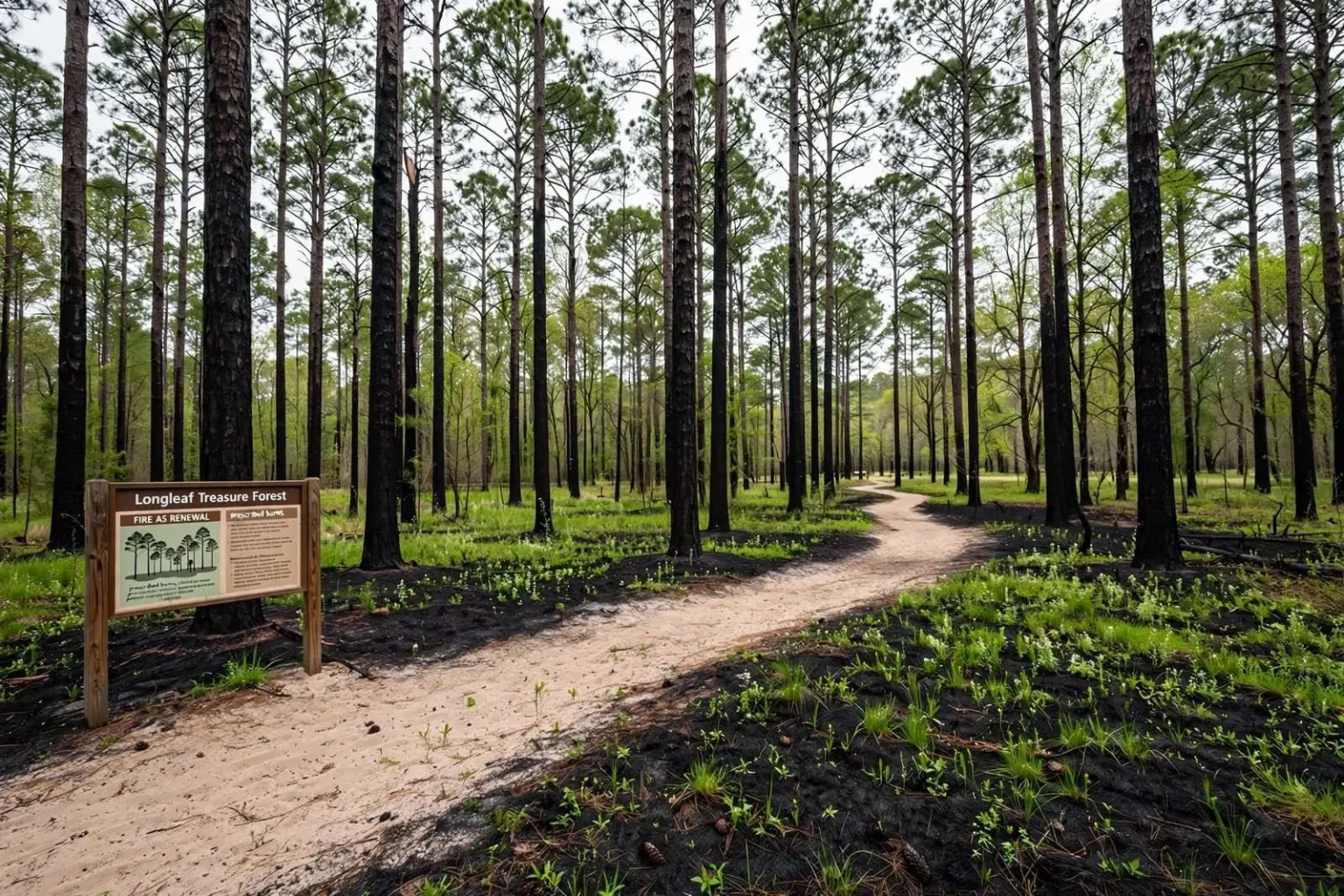
A stretch of sandy trails winding beneath towering longleaf pines at Mobile Botanical Gardens is showing fresh green growth this spring, the result of a prescribed burn carried out in the garden’s longleaf preserve on March 11. The controlled fire, conducted just before COVID-19 restrictions began reshaping daily life across the region, was the product of a partnership between Mobile Botanical Gardens, the Alabama Forestry Commission, the Longleaf Alliance, The Nature Conservancy and the city of Mobile.
The burn brought together agencies that rarely share a project — a nonprofit garden, a state forestry agency, a national conservation organization, a scientific alliance devoted to a single ecosystem, and the city itself — each contributing expertise to a task that looks like destruction but functions as renewal. Weeks later, the blackened ground of the preserve is producing exactly what fire managers expected: a flush of new growth across the forest floor.
Fire as an Ancient Management Tool
Longleaf pine forests once dominated much of the South Atlantic and Gulf Coastal Plain, sustained for thousands of years by lightning-sparked wildfires that periodically swept through the understory. That natural cycle cleared out competing vegetation, opened the canopy to sunlight and encouraged the germination of native wildflowers and grasses. Today, land managers replicate that process through carefully planned prescribed burns, since development and fire suppression have eliminated most of the naturally occurring fires that once maintained the ecosystem.
The longleaf ecosystem is among the most fire-dependent in North America. The pines begin life in a grass stage that survives fire, and mature trees tolerate blazes that would kill oaks and other hardwoods. Regular fire suppresses the hardwood competition that would shade out the pines, sustains the wiregrass groundcover that carries fire through the forest, and creates the open, park-like structure that defines a healthy longleaf woods.
The losses from a century of fire suppression have been steep. Longleaf pine once covered tens of millions of acres across the Southeast; fragments remain, and organizations such as the Longleaf Alliance work to restore the ecosystem through prescribed fire and replanting. Mobile Botanical Gardens’ preserve is a local piece of that larger effort — a remnant of the sandhill longleaf community that once covered much of what is now the city’s western reaches.
Prescribed burns are planned with the same rigor applied to any controlled operation. Burn windows depend on humidity, wind direction, and the moisture of the fuel on the ground, and the Alabama Forestry Commission — the state agency that regulates and assists with prescribed burning — brings both regulatory oversight and hands-on expertise. The March 11 date fell within the season when Gulf Coast land managers typically burn, ahead of the nesting season for ground-dwelling wildlife and before the summer growth surge.
Green Snow on the Sandhills
At the botanical garden’s Longleaf Treasure Forest, the burn has already transformed the landscape. Much of the ground beyond the trails is blackened with charcoal, but new shoots are pushing up through the soot in what garden staff describe as a carpet of “green snow” spreading across the sandy hillsides. The fire-adapted longleaf ecosystem depends on this kind of periodic burning to thrive, supporting everything from the high pine canopy down to the gopher tortoise burrows that riddle the forest floor.
The weeks after a burn are when the ecosystem’s resilience is most visible. Seeds and bulbs that lay dormant in the soil respond to the suddenly unobstructed sunlight, and grasses that evolved alongside millennia of fire return first, greening the charred ground. Visitors walking the preserve’s trails this spring can watch the cycle in fast motion — a demonstration, in miniature, of the process that maintained these forests long before anyone managed them.
Gopher tortoises, the architects of the burrows that honeycomb the preserve’s sandy soils, are among the burn’s beneficiaries. The tortoise is a keystone species of the longleaf ecosystem; its burrows shelter hundreds of other animals, from snakes to frogs to insects, and the open, herbaceous groundcover that fire maintains provides the low-growing plants tortoises eat. A landscape without fire gradually closes in, and the tortoises disappear with it.
A Free Refuge Open to All
The preserve remains open to visitors from dawn to dusk daily, free of charge, with no scheduled programming or admission gate. Sandy footpaths loop through the pines, past benches positioned at scenic overlooks and storyboards posted at trailheads that explain the site’s ecology and history. Garden officials have encouraged residents to use the forest as a quiet, socially distant escape during the pandemic, noting that visitors can walk the trails for the first time or the hundredth time and still find something new.
The storyboards at the trailheads do quiet educational work, explaining to first-time visitors why a freshly burned forest is a healthy one — knowledge far from universal in a region where fire has long been seen as purely destructive. A walk through the Longleaf Treasure Forest a few weeks after a burn offers the counterargument in living color: charred trunks over a carpet of new growth, tortoise burrows freshly cleared, and the canopy more open to the sky than it has been in years.
Visiting the Preserve
The longleaf forest sits on the left side of the property as visitors enter the Mobile Botanical Gardens grounds at 5151 Museum Drive. The garden occupies a tract in the Spring Hill area of Mobile, and its grounds combine cultivated display gardens with the wilder longleaf preserve, letting visitors move within a few hundred yards from formal plantings to a functioning fire-maintained ecosystem.
Visitors this spring will find the contrast at its most striking. The display gardens showcase camellias and azaleas in their seasons, while the preserve shows the working landscape of the Coastal Plain — the sandy soils, the towering pines, and the groundcover regenerating after the March burn. The trails are sandy and mostly flat, suitable for casual walkers, with benches placed where the woods open to views worth a pause.
Wildlife watching adds another layer. In addition to gopher tortoises, the open longleaf woods host woodpeckers, songbirds and the small animals that share the burrow system, and the post-burn flush of wildflowers and grasses draws pollinators through the warmer months. Each visit through the growing season shows a different stage of the forest’s recovery.
Plantas Goes Online for 2020
Mobile Botanical Gardens has also adjusted how it is running its annual spring plant sale this year because of the pandemic. The Plantasia Spring Plant Sale, normally an in-person shopping event, has moved online for 2020. Shoppers can browse the available inventory at MBGrebloomshop.com, place an order and have garden staff select and bag the best available plants before arranging a curbside pickup at the garden, allowing customers to avoid close contact while still supporting the nonprofit and stocking up on plants for the growing season.
Plantasia is the garden’s signature fundraiser, and the sale’s plant inventory — heavy on the native and Gulf Coast-adapted species that thrive in local yards — draws gardeners from across the region each spring. The online pivot preserved both the revenue the nonprofit depends on and the spring planting season itself, with staff hand-selecting the best of each order the way a knowledgeable friend might shop for you.
Garden leaders say the longleaf preserve and the plant sale together reflect an effort to keep the community connected to nature even as other public gathering spaces have closed. With no ticket booth, no set showtimes and no crowds to navigate, the forest offers an outdoor option for residents looking to get outside safely, while the retooled plant sale gives home gardeners a way to keep their own yards blooming through the spring.
Together, the March burn and the reimagined sale capture the garden’s double identity — a working conservation site where ancient ecological processes are deliberately maintained, and a community institution adapting to keep its services flowing in a changed season. The pines burned in March are already answering with new growth; the sale goes on, one curbside bag at a time; and the trails at 5151 Museum Drive remain open, dawn to dusk, to anyone who wants to watch a forest renew itself.
How a Burn Is Planned and Carried Out
A prescribed burn is never a casual affair. Weeks before the March 11 operation, the partners mapped the preserve’s burn units, established fire lines along the trails and property edges, and waited on a forecast that offered the right combination of humidity, wind and fuel moisture. On the day of the burn, crews from the partner agencies light and manage the fire in sections, holding it within its planned boundaries and monitoring smoke as it drifts away from neighborhoods.
The Alabama Forestry Commission’s role is central in Alabama, where state law governs prescribed burning and requires certified burn managers. The agency’s participation gives projects like this one both legal standing and the field experience of crews who burn thousands of acres across the state each year. The Longleaf Alliance and The Nature Conservancy contribute the ecological science — how often to burn, how hot, and what the forest should look like afterward — while the city and the garden provide the land and the public mission.
The timing of the March 11 burn, just ahead of the COVID-19 restrictions that followed, turned out to be fortunate. Fire operations depend on crews working closely together, and the restrictions that soon suspended public gatherings would also have complicated a multi-agency burn. Instead, the fire was carried out as planned, and the preserve entered the pandemic spring already transformed — blackened, open, and on schedule to green.
A Season of Renewal at the Garden
For Mobile Botanical Gardens, the spring of 2020 paired the oldest of land management tools with the newest of retail workarounds. The burn followed a cycle that predates the city by millennia; the online plant sale responded to a disruption measured in weeks. Both served the same purpose — keeping the Gulf Coast’s plant life, wild and cultivated, in front of the community that supports it.
Visitors who walk the longleaf preserve this season will see the burn’s full effect: an open canopy, a greening floor, and a forest doing what its species have done for thousands of years after every lightning strike. The free trails, the storyboards and the benches remain as they were, and the garden invites residents to watch the recovery unfold — one shoot of green snow at a time.


