Prichard Cancels Christmas Parade, Keeps Tree Lighting With Safety Measures
Prichard canceled its Dec. 5 Christmas Parade due to COVID-19 but will hold a socially distanced tree lighting ceremony on Dec. 4.
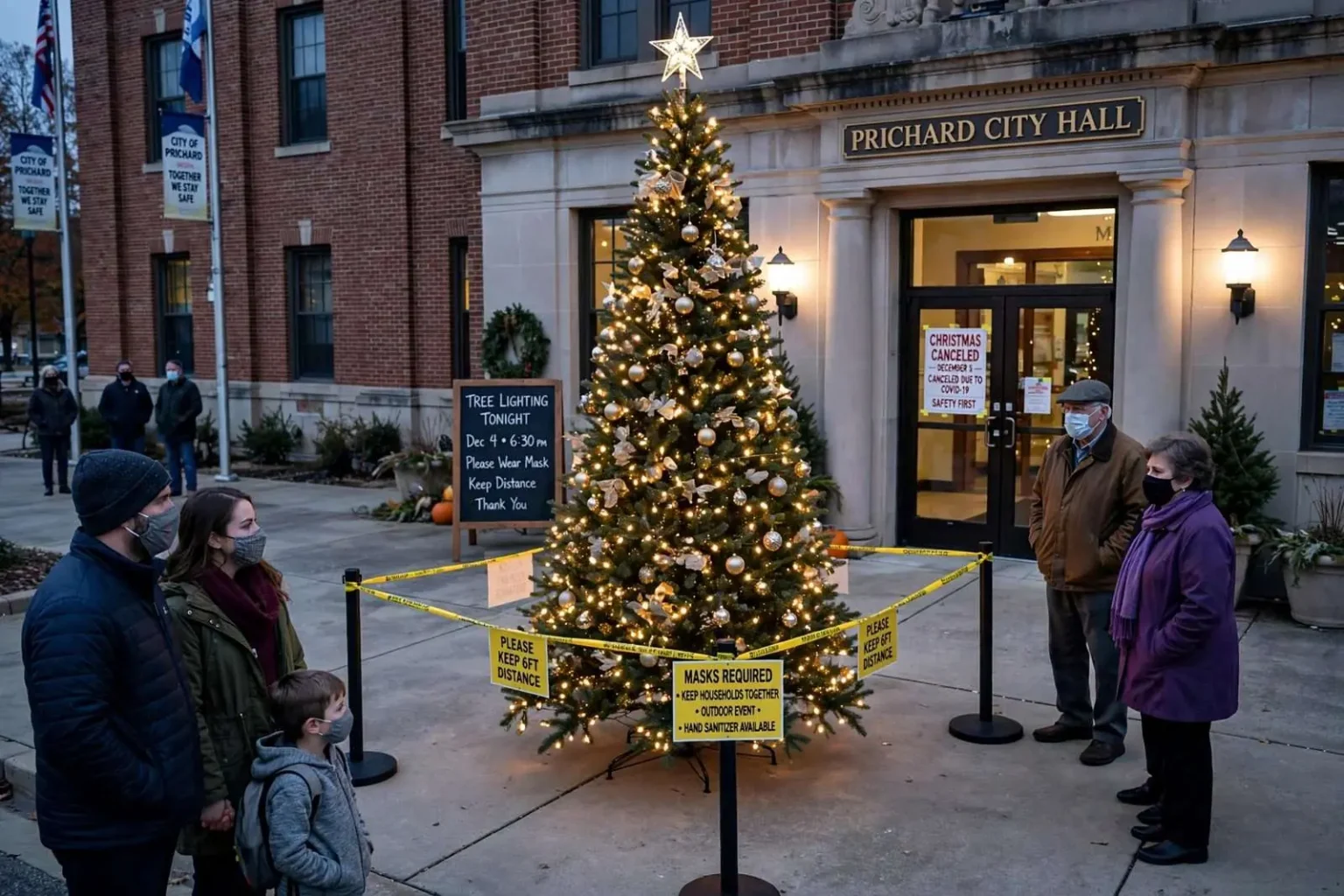
PRICHARD, Ala. — The City of Prichard has canceled its annual Christmas Parade, originally set for Saturday, Dec. 5, 2020, citing the rising statistics around COVID-19 cases as the pandemic surged across Mobile County and the state. The decision, announced by city officials just days before the event was to roll through the community, removed one of the city’s most beloved holiday traditions from the calendar but stopped short of shutting down the season entirely, with the city’s tree lighting ceremony still set to go forward.
“The leadership team is acting out of an abundance of caution regarding the statistics about the incidence COVID-19,” the city said in its announcement. The statement captured the careful balancing act municipal leaders across Alabama were performing that December, weighing the public’s desire for normalcy and tradition against a worsening public health picture that saw cases, hospitalizations, and positivity rates climbing week over week. In Prichard, where city government had spent months adjusting operations to the pandemic, officials concluded that drawing a large crowd along a parade route posed a risk they were not willing to take.
The cancellation came during one of the most difficult stretches of the pandemic for the Gulf Coast region. Fall and winter of 2020 brought a sustained nationwide surge in coronavirus infections, and Alabama was among the states where the upward climb showed no sign of easing. Public health officials had spent weeks urging residents to avoid large gatherings, wear masks, and maintain distance from people outside their households — guidance that applied directly to holiday events designed to draw crowds into close quarters along the street.
Tree lighting goes on, with precautions
While the parade was called off, the city made clear that the holiday season would not pass without observance. The tree lighting ceremony will still take place on Friday, Dec. 4 at 6:30 p.m., with attendees encouraged to practice social distancing. The distinction between the two events reflected the kind of risk-based decision-making that defined the pandemic era: a parade stretches for blocks and holds crowds along a route for an hour or more, while a tree lighting can be managed as a shorter, more compact gathering where spacing is easier to maintain.
City officials encouraged anyone planning to attend the tree lighting to keep household groups together, spread out from others, and take the precautions that had become routine across the region. Outdoor events were generally considered lower risk than indoor ones, and the evening ceremony in the open air allowed the city to preserve a moment of community celebration while honoring public health guidance. Masks were widely recommended at public gatherings at the time, and cities across Mobile County had adopted varying requirements for employees and visitors to public buildings.
For residents, the split decision — cancel the parade, keep the lighting — was a familiar pattern by late 2020. Communities across the country had spent the fall modifying, postponing, or canceling signature events, from football games to festivals to Memorial Day and Veterans Day observances. Some cities moved celebrations online; others trimmed them down to invite-only or drive-through formats. Prichard’s choice to keep a modified celebration intact reflected a desire to maintain the symbols of the season even when the crowd-drawing traditions could not safely proceed.
What the parade means to Prichard
The annual Christmas Parade holds a special place in the civic life of Prichard, a city of roughly 20,000 residents in Mobile County. Each December the parade draws families from across the city and neighboring communities, who line the route to see floats, marching units, and — for the youngest spectators — the arrival of Santa Claus. The event is one of the city’s signature public gatherings, a point of pride for local schools, churches, and community organizations that spend weeks preparing entries, and its absence from the calendar leaves a noticeable gap in the holiday season.
Prichard, situated just north of Mobile, is a community with a rich history in the manufacturing and industrial growth of the Gulf Coast, and its municipal government takes an active role in civic programming throughout the year. Holiday events are among the city’s most visible contributions to that calendar, planned by city staff in coordination with community partners. The decision to cancel the parade involved not just public health considerations but also the practical reality of staging an event: organizers, volunteers, and participants would all have been exposed to one another in the lead-up, multiplying the points of potential spread.
City leaders said the parade cancellation was made with an eye toward the health of the community as a whole, particularly older residents and those with underlying conditions who face the greatest danger from the virus. Public health officials throughout the pandemic emphasized that decisions affecting large gatherings were among the most consequential that local governments could make, because a single event could seed infections across an entire community.
The tree lighting on Dec. 4 offered Prichard families a chance to mark the season together, even in a year when so much had been set aside. As the pandemic stretched into its ninth month, the simple act of gathering — carefully, at a distance — carried a significance that went beyond the ceremony itself, a reminder that the community’s traditions could bend to the circumstances of the moment without breaking entirely.
Across the Gulf Coast, the 2020 holiday season tested how communities observe traditions under public health constraints. Mobile’s Christmas parade and other longstanding regional celebrations faced similar reckonings, with each municipality weighing crowd sizes, outdoor versus indoor settings, and the trajectory of case counts in the days before each event. Some events proceeded with modifications, others were canceled outright, and residents became accustomed to checking for updates as late as the day before a scheduled gathering.
The pandemic’s grip on Alabama tightened through December 2020. Hospital systems across the state reported rising admissions, and the state’s daily case counts climbed toward the highest levels recorded to that point in the pandemic. Mobile County, the state’s second most populous, saw sustained growth in confirmed cases through the fall, and local officials repeatedly pointed to community spread rather than isolated outbreaks as the driving force. In that environment, the calculation for outdoor public events became increasingly difficult, even for gatherings that in ordinary years would proceed without a second thought.
Guidance shaping the decisions
Public health guidance at the time identified large gatherings — particularly those where people from multiple households congregate closely for extended periods — as significant venues for transmission. The guidance encouraged outdoor events over indoor ones, smaller crowds over larger ones, spacing between household groups, mask use, and short durations. Event organizers who could not meet those parameters were advised to postpone or cancel. Prichard’s announcement tracked closely with that framework: the parade, which would have packed spectators along a route, failed the risk test, while the tree lighting, an outdoor and comparatively compact ceremony, could proceed with distancing.
City governments in the region also had to consider their own employees and volunteers in these decisions. Municipal staff would have set up barricades, coordinated participants, and managed crowds before and after a parade, and exposing them to heightened risk in the middle of a surge weighed against the benefits of holding the event. Insurance and liability considerations added further layers to the decision-making, as cities sought to protect themselves while fulfilling their duty of care to the public.
For the organizations that had prepared parade entries — school bands, church groups, dance studios, civic clubs, and businesses — the cancellation meant shelving work that had often been underway for months. Community members sympathetic to the decision nonetheless lamented the loss of the annual moment, particularly for children who look forward to the parade each year. City officials expressed hope that the tradition would return the following year, when conditions allowed a full celebration.
Looking toward the season ahead
As Dec. 4 approached, attention in Prichard turned to the tree lighting and what a safely held ceremony would look like. Attendees were encouraged to arrive with spacing in mind, keep to their household groups, and take personal precautions consistent with the guidance in effect at the time. The ceremony, like all public events in that season of the pandemic, carried a contingency character — subject to weather, to the public health picture, and to the cooperation of the community in observing the recommended precautions.
The city’s announcement closed with a commitment to continue monitoring conditions and to communicate any further changes promptly, as it had done throughout the pandemic. Residents were pointed to the city’s official channels for updates on the ceremony and other municipal operations, and city staff encouraged anyone with questions about the status of holiday programming to check for the latest information before making plans.
For a city that has weathered economic and demographic change across its history, the 2020 holiday season joined a long line of challenges met with adaptation. The parade would wait. The tree would be lit. And the community of Prichard, like so many across Alabama and the Gulf Coast, demonstrated that even in a pandemic year, the season’s meaning could be preserved — carefully, cautiously, and together, at an appropriate distance.