
Prichard Mayor Carletta Davis Proposes FY 2026-27 Budget With Raises and Cheaper Health Coverage
Prichard Mayor Carletta Davis has proposed a FY 2026-27 budget with raises for public works employees, police, firefighters and the city clerk, plus a health plan cutting deductibles from $2,500 to about $200.
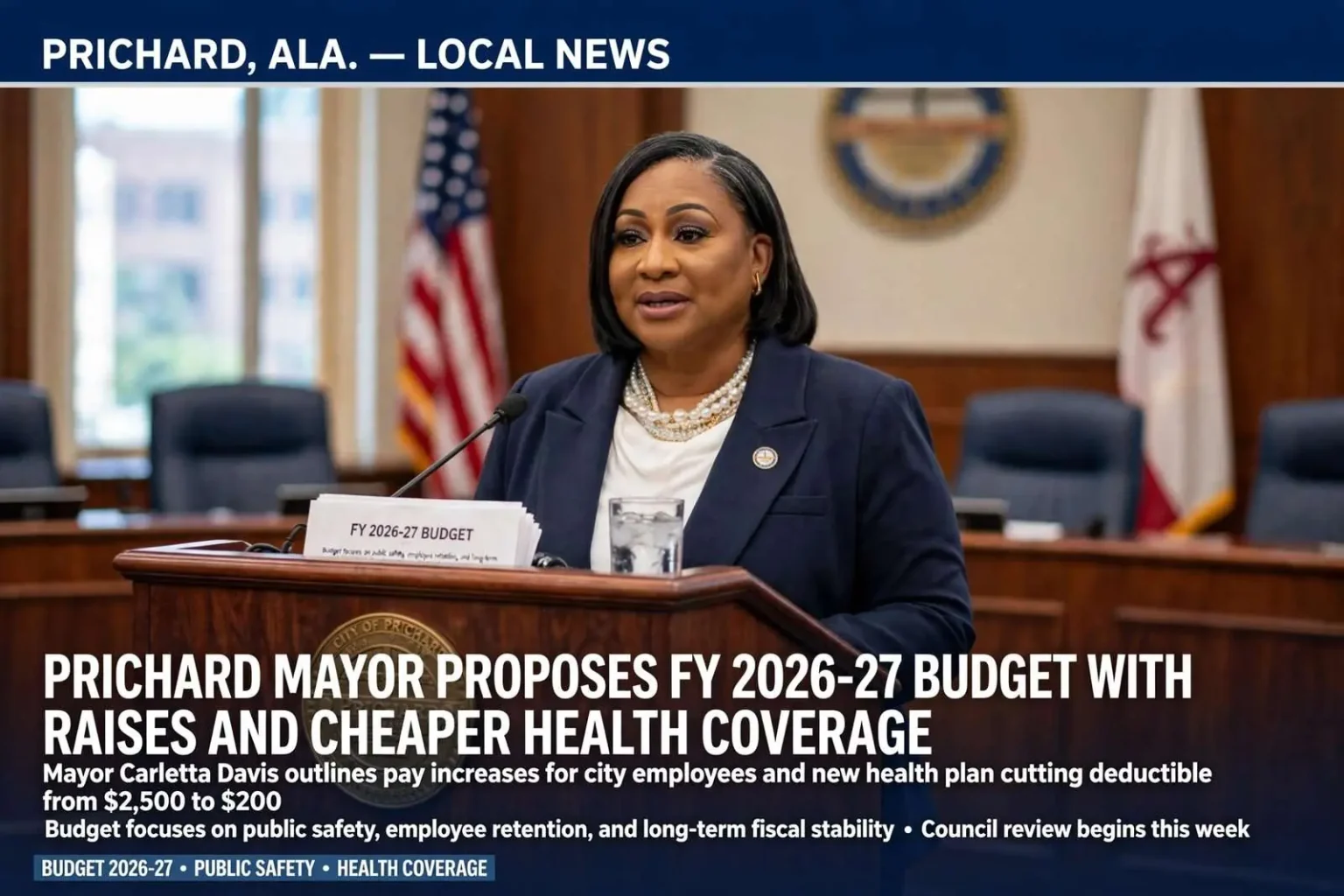
PRICHARD, Ala. — Mayor Carletta Davis presented her administration’s proposed Fiscal Year 2026-27 General Fund budget to the Prichard City Council this week, built around three priorities: paying employees more, strengthening public safety and putting the city on firmer long-term footing.
The proposal, now under council review, includes salary increases for public works employees, police officers, firefighters and the city clerk. Davis has framed the raises as a competitiveness issue rather than a gesture — Prichard has struggled to attract and retain qualified staff, and the administration argues that pay is the most direct lever available.
Municipal governments across Alabama have faced the same squeeze in recent years: a tight labor market that pulls certified workers toward better-paying neighboring cities, and revenue structures that make it hard for smaller municipalities to compete. When a public works crew loses an equipment operator to a city across the county line, the vacancy does not just slow a project — it forces remaining staff onto overtime, raises costs and degrades service for residents. The administration’s argument is that every unfilled position costs the city more than the raise it would take to fill.
For a city of Prichard’s size, the payroll is also the budget. Salaries and benefits for police, fire, public works and administrative staff consume the overwhelming majority of most general fund budgets in small Alabama cities, which means compensation decisions are not one line item among many — they are the budget. Any meaningful increase in pay must be balanced somewhere else in the proposal, and the council’s review process is where those trade-offs get negotiated in public.
Prichard’s fiscal history gives the long-term footing priority particular weight. The city weathered a nationally watched municipal bankruptcy in the years after the recession, a chapter that reshaped how its budgets are built and scrutinized, and administrations since have operated under the discipline of rebuilding reserves and avoiding the short-term borrowing that once strained the city’s finances. A budget that commits to recurring costs like raises carries obligations that last beyond any single fiscal year, which is why the administration has paired its compensation proposals with an explicit emphasis on putting the city’s finances on ground that will hold.
The budget cycle itself now moves into its most consequential weeks. Under state law, Alabama municipalities operate on fiscal years that begin Oct. 1, and councils must pass a balanced spending plan before the new year starts. The proposal will be examined in work sessions and public hearings, where council members question department heads about needs and residents weigh in on priorities. What Davis presented this week is the opening position of that negotiation, not its conclusion.
A Dramatic Change to Employee Health Coverage
Perhaps the most consequential item for city workers is a shift to a new health insurance plan through the Local Government Health Insurance Program. Under the new plan, the annual deductible is expected to fall from approximately $2,500 to roughly $200.
The Local Government Health Insurance Program is the state-administered pool that allows Alabama municipalities, county governments and public agencies to buy coverage together rather than negotiating alone in the private market. Participation spreads risk across thousands of public employees, which stabilizes premiums and gives smaller cities access to plan designs and provider networks they could never sustain on their own. For a city of Prichard’s budget size, the move from a standalone arrangement into the program can be the difference between offering real coverage and watching employees go uninsured or rely on a spouse’s plan.
The deductible arithmetic translates directly into household reality. For an employee earning a municipal salary, that is a change measured in real household terms: a single significant medical event under the old plan could consume a substantial share of annual take-home pay. Under a plan with a $200 deductible, the same hospital admission is absorbed at a fraction of the out-of-pocket cost, and families are far likelier to seek preventive care instead of delaying treatment until an emergency forces the issue. Emergency-room care is the most expensive care in the system, and plans with low deductibles shift behavior toward the cheaper kind.
Benefits of this kind also function as raises that do not appear on a pay stub. A reduction of more than $2,000 in potential annual out-of-pocket exposure is worth real money to every covered household, and for employees with chronic conditions or young children, it may matter more than a salary increment. Compensation packages are judged as a whole by the workers considering whether to stay — and the administration’s competitiveness argument applies to health coverage as much as to wages.
The administration is also working to establish a retirement option for city employees, including the possibility of a 401(k) plan. Prichard has not historically offered a robust retirement benefit, and adding one would address a longstanding gap in the city’s compensation package.
Public safety staffing has its own retirement dimension. Police officers and firefighters in Alabama typically participate in the Employees’ Retirement System, which covers most municipal employees statewide, but recruitment incentives and supplemental plans have become common tools for departments competing for certified officers. Whether Prichard’s proposed 401(k) option would sit alongside existing retirement coverage or fill a gap for particular categories of workers is among the details the council will sort through as the proposal moves forward.
The absence of a retirement benefit has consequences that compound over years. Municipal workers without a retirement plan face Social Security alone as the foundation of their old-age income, and younger workers who might otherwise build careers in city service have a financial incentive to leave for employers that offer matching contributions. A defined-contribution plan such as a 401(k) — in which employees and the city contribute to individual accounts — is the most common path for municipalities seeking to add retirement benefits without committing to the open-ended obligations of a traditional pension. The details, including employer matching rates and vesting schedules, would determine both the benefit’s value to workers and its cost to the city.
Public Safety in a Difficult Year
The budget’s public safety emphasis arrives during an extraordinary period for the city. The Mobile County Sheriff’s Office has handled most police calls in Prichard since June, following a federal corruption investigation that led to the arrest of multiple Prichard Police Department officers, including former Chief Walter Knight. Rebuilding the department is a stated goal of the administration, and personnel costs sit at the center of that effort.
Contract coverage by a county sheriff’s office is an arrangement Alabama municipalities fall back on when their own departments cannot function, and it carries costs and frictions of its own. Deputies patrolling a city they do not police every day answer calls and respond to emergencies, but the daily, relationship-driven work of community policing — knowing the neighborhoods, the repeat addresses, the school resource relationships — depends on officers who belong to the city. The longer the interim arrangement lasts, the stronger the argument for investing in the recruitment needed to restore a homegrown force.
Rebuilding a police department from a corrupted foundation is slow, expensive work. Recruitment in the current market means competing on salary, signing incentives and benefits against every other agency in the region, and background vetting must be rigorous enough to restore public confidence that the department has been cleaned out. Officers who stayed through the upheaval carry the burden of the interim period, and their retention matters as much as new hiring. Every element of that recovery runs through the budget the council is now reviewing.
The relationship between the city and the Sheriff’s Office during the interim has practical daily consequences residents feel directly. Response times, investigative follow-through and the visibility of patrols in neighborhoods all depend on how coverage is staffed and coordinated, and city officials have had to balance gratitude for the county’s help against the urgency of standing the city’s own department back up. The salary increases proposed for police officers are aimed squarely at that balance: every certified officer the city can hire and hold is a step toward ending the interim arrangement on the city’s own terms.
What Comes Next
Davis thanked the Finance Department for its work assembling the proposal, and the administration has emphasized that the budget’s priorities — pay, health coverage, retirement and public safety — are aimed at the same underlying problem: making city employment stable enough to build a career on. The council’s work sessions in the coming weeks will test each element against the revenue available, and amendments are likely before a final vote.
For Prichard residents, the stakes are practical. The quality of street repairs, the speed of police and fire response, and the stability of the workforce that delivers city services all trace back to the spending plan now on the council’s table. A city that cannot keep its employees cannot keep its promises, and the 2026-27 budget is the administration’s attempt to change that equation — one salary, one deductible and one hire at a time.

