
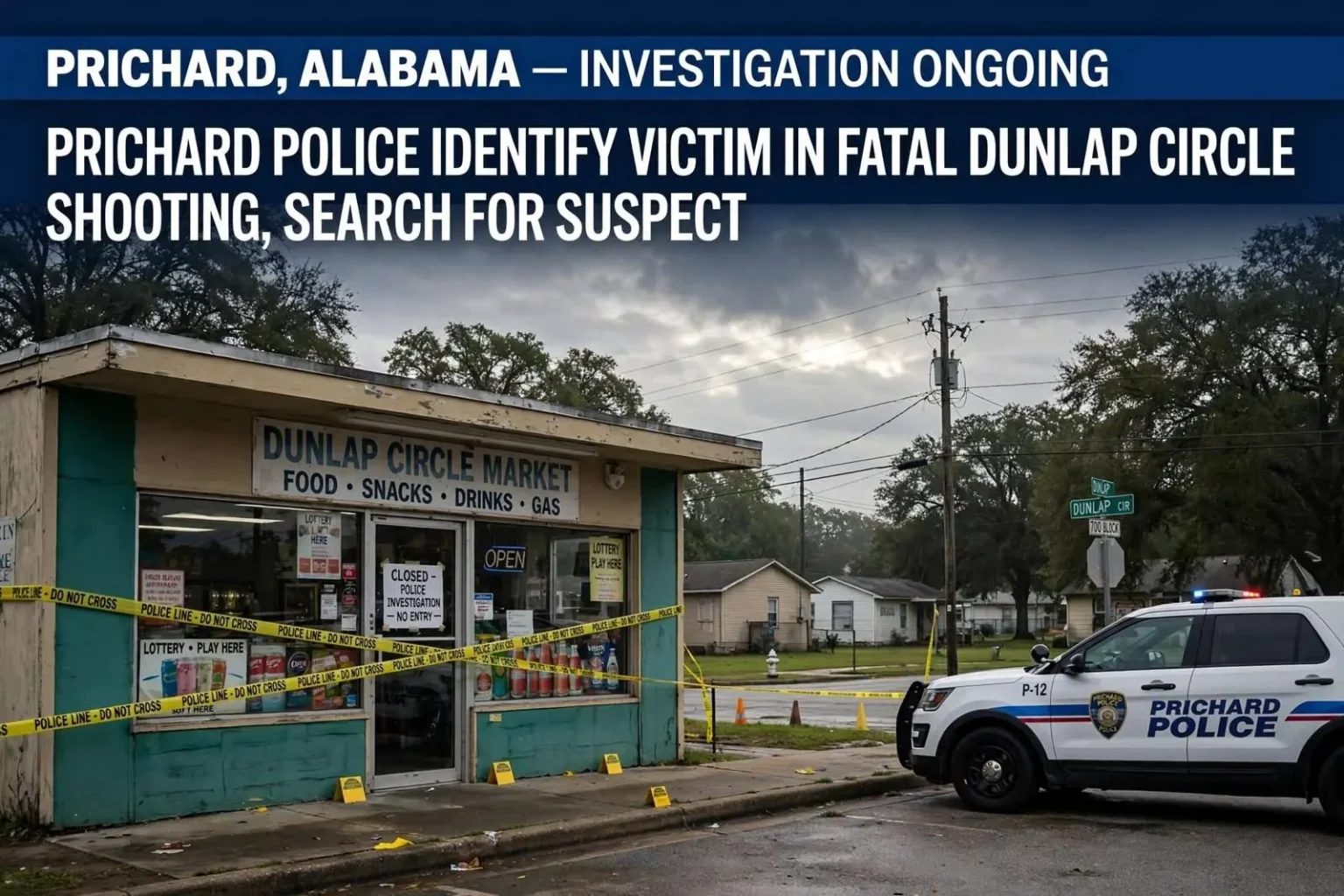
Prichard police are searching for a suspect after a man was shot and killed at a convenience store in the city’s 700 block of Dunlap Circle.
Officers were dispatched around 9 a.m. to a shots-fired call at 931 Dunlap Circle. While en route, they were redirected to the Central Fire Station on Turner Road, where a wounded man had been dropped off.
Altercation Escalated to Gunfire
Investigators determined the victim, identified as George Earnest Paige III, became involved in a verbal altercation with another man inside the store before being shot. Police named Xavier Kiyoshi Davis as the shooter and said he left the scene before officers arrived.
Paige was taken to USA Hospital, where he died from his injuries.
The morning sequence — shots fired inside a neighborhood store, a wounded man ferried by vehicle to the nearest fire station, and a suspect already gone by the time officers arrived — compressed into minutes a set of challenges that homicide investigators spend careers untangling. The decision to drive a shooting victim to a fire station rather than wait for an ambulance is a common one in desperate moments, and Prichard’s Central Fire Station on Turner Road sits close enough to the Dunlap Circle area that it has become an improvised destination in emergencies. Fire personnel trained as first responders began care immediately and handed the victim to arriving EMS for the transport to USA Hospital, the University of South Alabama’s trauma center, which handles the most serious penetrating injuries in the Mobile area.
The Scene on Dunlap Circle
Dunlap Circle sits in a residential section of Prichard, a city of roughly 20,000 people just north of Mobile’s Chickasaw boundary. Convenience stores in Prichard’s neighborhoods function as informal town squares — places where people gather in the morning on the way to work, where the clerk knows the regulars, and where an argument between two men can draw a small audience before anyone realizes how it will end. Investigators spent the day after the shooting canvassing that audience: everyone who was inside the store, everyone who was in the parking lot, and everyone who saw a vehicle leave in a hurry.
Forensic teams processed the store for shell casings, physical evidence, and camera footage, while detectives worked to establish where Davis went after the shooting. Prichard police, a department that operates with fewer resources than its larger neighbors in Mobile County, routinely leans on regional partners for major-case support, including the Mobile County District Attorney’s office investigators and, when needed, federal partners who can assist with tracking a fugitive who may cross city or county lines.
Police said a motive had not been established and that Davis was being sought for questioning — a phrase that carries legal weight. At that stage, Davis was named as a suspect in the shooting, but investigators had not announced charges, and the search was for a man they needed to hear from, not merely to find.
Prichard’s Long Fight With Violent Crime
The killing landed in a city that has battled violent crime for decades. Prichard, once a thriving industrial city along the Mobile city line, has struggled for years with economic decline, a shrinking tax base, and homicide rates that regularly rank among the highest per capita in Alabama. Its police department operates on a lean budget, and every homicide — particularly one that begins as a daytime argument in a neighborhood store — consumes resources the city struggles to spare.
City officials have tried a series of responses over the years: increased patrols in known trouble spots, cooperation with county and federal task forces, and community outreach aimed at breaking the cycle of disputes escalating into gunfire. The pattern in many of the city’s homicides is depressingly consistent — arguments that begin over money, respect, or personal grievances, and end within seconds when one party produces a gun. That is why investigators put such weight on the verbal altercation at the center of this case: identifying what the two men said to each other, and who witnessed it, often explains everything that followed.
Residents of the Dunlap Circle area know the stakes well. Prichard community groups and churches have organized vigils, anti-violence walks, and mentoring programs, arguing that the city’s young men need alternatives before an argument becomes a case number. Whether those efforts bend the city’s trajectory remains an open question, but each homicide renews both the grief and the resolve in neighborhoods that have seen too many of them.
How the Hunt for a Suspect Proceeds
The search for Davis moved along several tracks typical of Mobile County homicide work. Detectives sought warrants and alerts once they identified him, checked locations connected to his family and acquaintances, and watched for any sign he had left the area. Mobile’s position on the Interstate 10 and 65 corridors means a suspect can be in Mississippi or Florida within an hour, which is why Gulf Coast law enforcement agencies share fugitive alerts quickly across jurisdictional lines.
Prosecutors, meanwhile, begin reviewing the file as soon as it starts to build. The Mobile County District Attorney’s office will ultimately decide what charges are presented — capital murder, murder, or lesser degrees, depending on the evidence about how the shooting unfolded. In Alabama, a killing during certain predicate felonies or in specific circumstances can elevate the charge, but a shooting that grows out of a mutual argument typically presents as a murder case that turns on witness accounts and forensic reconstruction.
What the Police Are Asking
Anyone with information about his whereabouts or the case is asked to contact the Prichard Police Department Criminal Investigation Division at (251) 452-2211.
Investigators stressed that even partial information matters: a sighting of Davis in the hours after the shooting, a description of the vehicle he left in, or knowledge of where he might be staying all shorten the search. Callers who want to remain anonymous can route tips through Mobile-area Crime Stoppers channels, which pass information to detectives without collecting names.
For George Earnest Paige III’s family, the investigation’s progress is the only part of this story that can still change. Their loss began the moment a morning argument inside a neighborhood store turned lethal; whether the case ends with an arrest, a trial, and an answer depends on the witnesses who were there and the ones who have not called yet.
The Fire Station as a Lifeline
The reroute to the Central Fire Station deserves explanation for readers unfamiliar with how it works. In many American cities, fire stations have become de facto emergency intake points: when someone is shot or badly hurt and panic takes over, a driver’s instinct is often to get to a building with lights on and trained people inside rather than to wait the minutes an ambulance takes. Firefighters and paramedics, who keep medical equipment on their apparatus, can begin bleeding control and airway management the moment a vehicle pulls in, converting a chaotic drive into an organized handoff.
Prichard’s fire department, like others across Mobile County, trains for exactly these arrivals, and the roughly 9 a.m. timing of the Dunlap Circle call meant stations were fully staffed with the day shift. The distance from a neighborhood store to a trauma center like USA Hospital is measured in more than miles — it is measured in decisions, and the decision to drive to Turner Road gave the victim his only chance at survival. That he did not make it speaks to the severity of the wounds, not to the response.
When the Suspect Leaves Before Help Arrives
The interval between a shooting and an officer’s arrival is where many cases are won or lost. Davis left the store before the first patrol car reached Dunlap Circle, which means the detective’s work starts from an empty room: a store interior, casings on the floor, a cashier’s account, and whatever the cameras recorded. Every minute of that footage becomes critical — when the argument started, where the men stood, whether the shooter carried the gun in or retrieved it from somewhere, and which direction the vehicle went when it left.
That footage, combined with witness interviews over the following days, is what turns a name into a case. Identifying a suspect quickly, as Prichard police did here, is the first step; finding him, building the file, and getting it before a grand jury is the work of the weeks that follow. Families of victims in Mobile County often describe this middle period as the hardest — after the name is public but before anyone is in custody, when each day ends with the same question.
The Community’s Role
Homicide clearances in cities like Prichard depend heavily on witnesses choosing to talk, and investigators know it. Detectives will return to Dunlap Circle repeatedly in the days ahead, not because they lack leads but because people who declined to talk on the first knock often reconsider after time passes. Anonymous tip channels exist precisely for the neighbors who know something but fear being seen as the source.
The department’s Criminal Investigation Division handles the follow-up, and its number — (251) 452-2211 — now circulates in the news releases and social media posts that accompany the case. Every call that reaches that line gets logged, run down, and added to the file, and detectives consistently say the tip that breaks a case like this is rarely dramatic: it is a person who saw a car, heard a name, or noticed who stopped coming around the store after that morning.
The investigation remains open. Until Xavier Kiyoshi Davis is located, the case file on Dunlap Circle will keep growing — witness statements, forensic results, camera stills — waiting for the arrest that lets it become something a prosecutor can carry into a courtroom. For now, Prichard’s police are asking the same question they ask in every unsolved killing: who knows something, and who is willing to say it.


