
Prichard Races the Clock to Rebuild Its Police Force and Pass a New Budget
Prichard has hired consulting firm POLIHIRE to help rebuild its police department and find a new chief, all while racing an October 1 budget deadline.
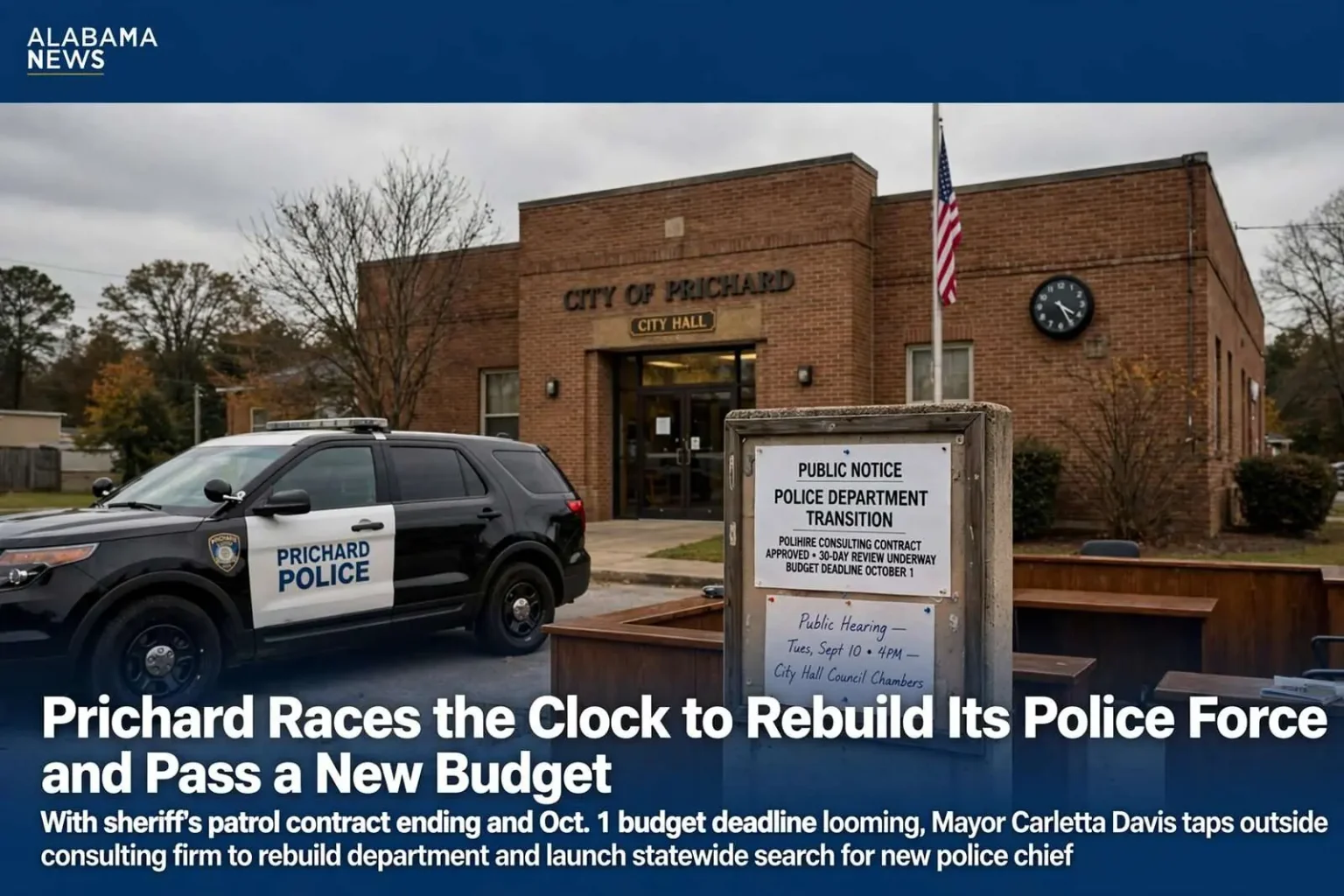
Time is running short for Prichard to decide what comes next for its police department — and how the city will keep law enforcement on the streets in the meantime. A contract allowing Mobile County Sheriff’s deputies to help patrol Prichard is nearing its deadline, piling even more pressure on city leaders to get a plan in place.
City officials are moving forward, and moving quickly. During Thursday’s council meeting, members approved a contract with POLIHIRE, bringing in outside help as the city works to rebuild its police department. Mayor Carletta Davis said the firm will begin working with the city within the next week, but the search for new leadership may already be underway.
“So what the contract is for is specifically to help to formulate the standard for hiring, and then also for the chief to help to find the chief of police,” Davis said.
A statewide search for leadership
Davis said she is already fielding calls from people interested in becoming Prichard’s next police chief, and that the search will reach well beyond the city for someone with the experience to take on the job.
“I really would like for someone to come into Prichard that has a lot of experience with and insight into how to rebuild a department. That’s going to take a special person, and so I don’t think that it would be someone that maybe would be local,” Davis said.
The consulting contract comes as the city continues working through what to do with the officers who remain on Prichard’s police force. Those officers will remain on paid administrative leave for 30 days, and Davis said that time will be used to take a closer look at exactly who is on the force and determine who could have a role moving forward.
“Given all that we’ve gone through with the police force, I think at this point, this administration needs to get a handle on who is actually on the force,” Davis said. “And we’re going to do that with the help of the consultant.”
While the city works to rebuild, Davis said the past will not be ignored.
“We had some bad actors on our force, but we also had some very dedicated people to the force and to this city,” Davis said. “And so we are going to honor that and take that in consideration as we go forward.”
A tight budget deadline adds pressure
That could mean some of the department’s remaining officers get a seat at the table as the city decides what the future of policing in Prichard looks like, but there isn’t much time. Prichard must have its new budget approved by October 1, which leaves just weeks to work through the police department, staffing, finances and the rest of the city’s priorities.
Davis said the deadline is tight, but she is confident the city can handle it.
“There is a tight deadline, and we are laser focused. I don’t want the citizens to feel like we can’t chew gum and walk at the same time because we certainly can,” Davis said.
Residents will get a chance to weigh in before the budget is finalized. A public hearing is scheduled for Tuesday, September 10 at 4 p.m., giving taxpayers a direct voice in how the city balances public safety with its other obligations before the fiscal year begins.
Rebuilding a Police Department: A Familiar Challenge for Small Cities
Prichard is far from the only small city in Alabama or across the country to face the task of rebuilding a police department nearly from scratch after leadership turnover or a loss of confidence in its existing force. Municipal police departments in cities with populations under 30,000 generally operate with lean staffing and thin budgets to begin with, which means that even a modest wave of departures, disciplinary actions or vacancies can leave a department unable to fully staff patrol shifts. When that happens, cities typically turn to one of a small number of options: mutual aid or contract policing from a neighboring agency, hiring interim leadership from outside the department, bringing in outside consultants to overhaul hiring and training standards, or some combination of all three. Prichard’s approach — leaning on Mobile County Sheriff’s deputies for patrol coverage while simultaneously bringing in an outside firm to help rebuild hiring standards and recruit new leadership — follows a pattern other municipalities have used when trying to reset a department’s culture and operations at the same time rather than sequentially.
Consulting firms that specialize in law enforcement staffing typically focus on a narrow set of tasks: developing or revising hiring standards, screening and vetting candidates, and sometimes conducting national searches for a new police chief. That kind of search casts a wider net than a city could typically manage on its own, particularly for a department attempting to recover from a period of turmoil, since experienced candidates capable of leading a department-wide rebuild are often already employed elsewhere and have to be actively recruited rather than simply responding to a job posting. Mayor Davis’s comment that Prichard’s next chief may need to come from outside the city reflects a common view among municipal leaders handling this kind of transition: that an outside perspective can make it easier to implement new standards without the complications that can come from promoting someone who was already part of the department’s existing structure.
How Alabama Cities Build and Approve a Budget
Alabama municipalities generally operate on a fiscal year that begins October 1, which means city councils across the state are working through budget season at the same time every year, weighing public safety costs against every other municipal obligation, from garbage collection to road paving to utility operations. State law requires that a proposed municipal budget be made available for public inspection and that residents have an opportunity to comment before a final budget is adopted, which is why a public hearing — like the one scheduled in Prichard for September 10 — is a standard, legally required step in the process rather than a discretionary one. For a city in the middle of a major departmental restructuring, the budget process becomes more complicated because personnel costs are often the single largest line item, and decisions about how many officers to hire, what salaries to offer to attract qualified candidates, and how much to spend on consultants or transitional support all have to be finalized before the fiscal year begins.
Contract Policing Between Local Agencies
Interlocal agreements that allow a county sheriff’s office to patrol inside a municipality’s limits are a common tool in Alabama when a city’s own police department cannot fully staff its patrol duties, whether because of budget shortfalls, staffing shortages or, as in Prichard’s case, a broader restructuring effort. These agreements are typically time-limited and can be renewed, extended or allowed to expire depending on how quickly the host city is able to stand its own department back up. Sheriff’s offices that take on this kind of coverage are generally reimbursed by the city for at least part of the added cost, and the arrangements are meant to be a bridge rather than a permanent substitute for a city’s own police force. For residents, the practical effect is that patrol cars and officers responding to calls may carry a different agency’s markings during the transition period, even though the underlying expectation — coverage of calls for service and basic patrol functions within city limits — remains largely the same as it would be under the city’s own department.
What Administrative Leave Means During a Departmental Overhaul
Placing an entire remaining police force on paid administrative leave while a department is restructured is an unusual step, but not an unprecedented one for agencies working through significant institutional problems. Administrative leave differs from suspension in that it is generally not considered a disciplinary action on its own — officers continue to be paid and remain employees of the department, but they are removed from active duty while an employer conducts a review. For a police department, that review typically includes checking each officer’s certification status with the state’s law enforcement standards agency, examining personnel files for any pending or unresolved disciplinary issues, and assessing training records to determine who meets current standards for returning to patrol. Municipal leaders who have gone through similar processes elsewhere have said the approach allows a city to make individualized decisions about which officers should return to duty, which may need additional training, and which should not return at all, rather than making a single blanket decision about the entire force.
The 30-day window Mayor Davis described is consistent with how other departments have approached this kind of review, since it gives incoming consultants and city leadership enough time to examine each officer’s record without requiring the city to leave itself entirely dependent on outside law enforcement for patrol coverage indefinitely. How quickly a city can transition officers back to active duty, or begin recruiting new ones, often depends on how thorough the underlying problems were and how much documentation exists on each individual officer, which is part of why cities in this position frequently bring in outside consultants rather than relying solely on internal staff who may have been part of the same command structure during the period under review.