Q&A: Mobile-Bred Author CJ Hatch on His Debut Novel ‘Hurricane Ron’
Mobile-bred author CJ Hatch discusses his debut Southern novel Hurricane Ron, his Gulf Coast roots, his path from TV news to fiction, and the planned.
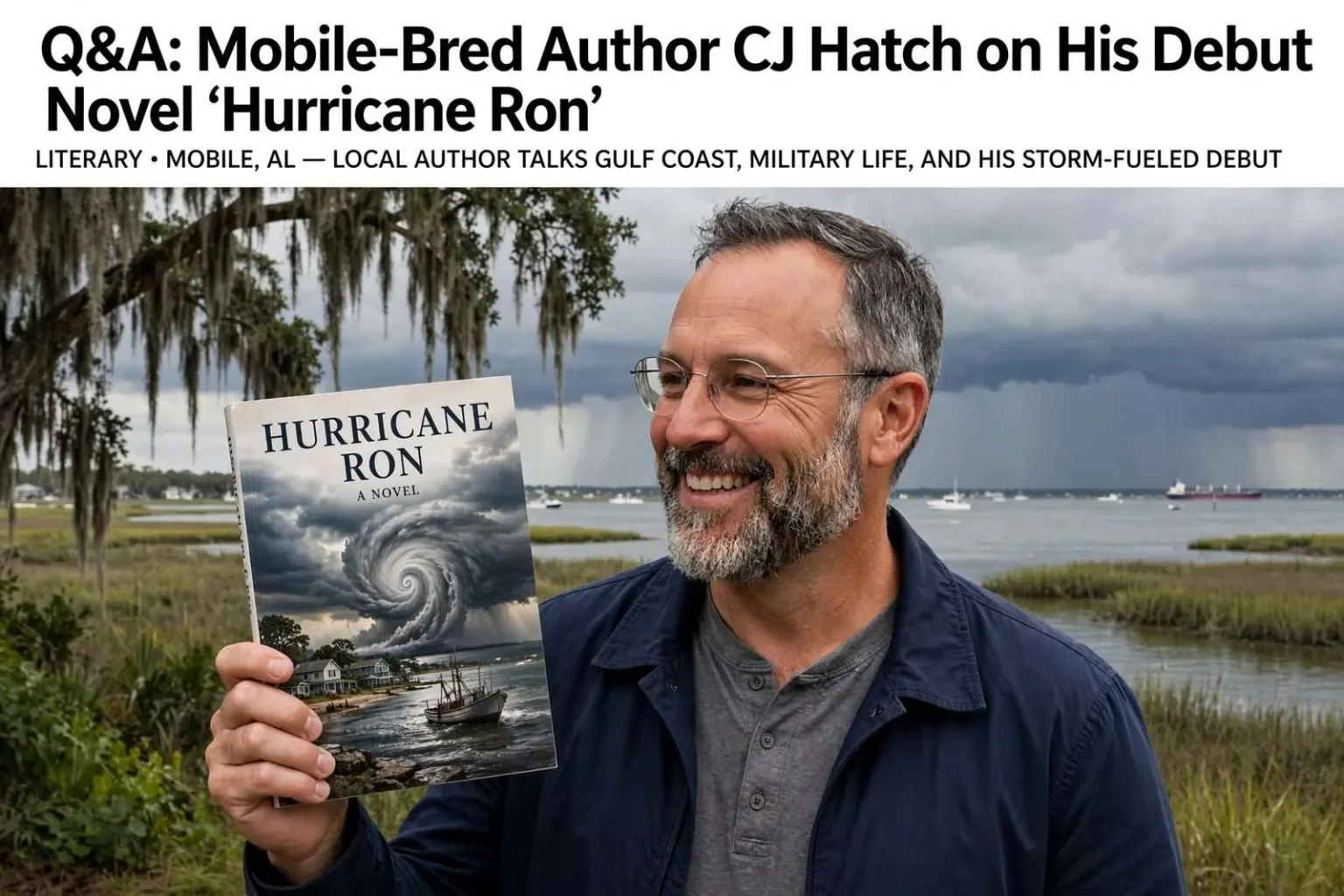
CJ Hatch may not have been born in Mobile, but he is effectively a native of the place. His debut novel, Hurricane Ron, follows a well-meaning title character who wreaks havoc across the lives he touches, all while dark clouds gather on the horizon. Tightly plotted and carefully constructed, it is a page-turner that few first-time novelists manage. We spoke with Hatch about the book, how it came together, and what comes next.
Growing Up Around Mobile Bay
Hatch’s father, a Coast Guard master chief, was assigned to the Mobile Aviation Training Center in 1970, when Hatch was about two and a half. The family of eight drove down from Massachusetts in a school bus converted into a camper, living in it for the first six months. He was then raised near the intersection of Dawes and Cottage Hill roads, attended Baker Elementary, Corpus Christi, McGill-Toolen, and graduated from Shaw High School.
It is a Mobile upbringing in miniature: military families, West Mobile neighborhoods, Catholic schools, and the rhythms of a city organized around the Bay and the port. After a false start at the University of South Alabama, he signed with the Air Force for eight years. Returning home, he used his military training as a broadcast specialist to land a job as a Northwest Florida beat reporter at WPMI-TV, later earning a communications degree at South and working for the City of Mobile.
He still visits Mobile regularly. His mother and two brothers live there, one brother is buried there, and his father’s and sister’s ashes were scattered off Dauphin Island. For a writer whose first novel is steeped in Gulf Coast atmosphere, the connection is not an abstraction — it is family history written into the geography itself.
Literary Influences
Hatch credited his love of reading across genres, with a strong nod to Southern authors such as Winston Groom, Robert McCammon, Faulkner, and Pat Conroy, alongside more commercial writers like Clive Cussler. The blend shows in the book: the character-driven warmth of the Southern tradition sits alongside the propulsive plotting of adventure fiction.
He described his protagonist, Ron McKee, as an almost Irving-esque counterbalance of insecurity and angst to Cussler’s cocksure heroes. Where the adventure hero strides through danger untouched, Ron means well and stumbles anyway, leaving turbulence in his wake while the storm clouds gather on the horizon. The result is a title character readers can root for and wince at in the same chapter.
“This novel really wrote itself and I was just along for the ride just like the readers,” Hatch said of his process, describing characters who took on their own motivations once created. It is a familiar claim among novelists, but in Hatch’s case the finished book bears it out — the plot moves with the confidence of a story that knew where it was going even when its author was discovering it chapter by chapter.
From Journalism to Fiction
Hatch said his years in broadcasting and journalism shaped the discipline behind his fiction. Reporting for WPMI-TV across Northwest Florida meant deadlines, tight writing, and constant contact with the kind of Gulf Coast characters — officials, fishermen, business owners, ordinary people caught in extraordinary weeks — who later populated his novel. A broadcast specialist’s training in the Air Force taught him to write clean and think in scenes, skills that transferred directly to the page.
The movement from television news to city government work gave him another vantage point on the place he calls home. Working for the City of Mobile meant seeing the machinery of the town from the inside — the budgets, the agencies, the personalities — and that institutional texture finds its way into a novel whose setting feels lived-in rather than researched.
The eight years in the Air Force, meanwhile, gave the book something else: an appreciation for people whose competence is quiet and whose disasters are often comic. Hatch’s view of human nature — affectionate, amused, forgiving of well-intentioned blundering — runs through every chapter. Ron McKee is not a hero or an antihero; he is what most people are, a bundle of good intentions and imperfect execution, and the novel’s warmth flows from that recognition.
The Storm on the Horizon
Without giving away the plot, the novel’s structure builds toward the storm that its title promises. Hurricane Ron works both as a name and a metaphor: the man is the storm, and the people around him are the coastline. Hatch keeps the tone light even as the consequences accumulate, in the tradition of Southern storytellers who know that comedy and catastrophe are often the same event viewed from different distances.
Readers from Mobile will recognize the terrain. The novel’s Gulf Coast — the water, the weather, the food, the accent, the easy mingling of sincerity and mischief — could only have been written by someone who absorbed it growing up near Dawes and Cottage Hill roads. For a city that has produced its share of writers but rarely gets the literary attention of Charleston or New Orleans, Hatch’s debut is another entry in the case that Mobile Bay is one of the most underwritten settings in American fiction.
The Q&A format suits a writer like Hatch, whose conversational style — part storyteller, part stand-up observer — comes through as clearly in interviews as on the page. Talking about the book, he circles happily between anecdotes about growing up in a Coast Guard household and craft talk about structure and character, treating both as two halves of the same apprenticeship. That ease reflects a life spent communicating: eight years in uniform, years in front of a television camera, and more still in public service taught him how to hold an audience, and the novel shows the same control of pacing.
Mobile readers, meanwhile, get the pleasure of seeing familiar landmarks through a novelist’s eye. The city’s literary shelf has grown over the years — Winston Groom’s fortunes, the outdoor writing that flows from the Delta, the memoirs and novels that treat the Gulf Coast as more than scenery — and Hurricane Ron takes its place naturally among them.
Advice for First-Time Novelists
Asked what he would tell aspiring writers, Hatch’s own path offers the answer. He did not come to fiction through an MFA program or a literary apprenticeship; he came to it after a career in broadcasting, government work, and decades of reading across every genre on the shelf. The book was written the way many first novels are — in the hours around a working life, fueled by the conviction that a story worth telling was worth finishing.
His process emphasized momentum over perfection. Characters took on lives of their own, and he followed them rather than forcing the outline. The discipline learned in newsrooms — file the story, meet the deadline, cut what doesn’t work — kept the manuscript moving forward when the writing got hard. For first-time novelists paralyzed by the size of the task, that combination of momentum and discipline is the transferable lesson: write the next scene, then the one after it, and trust the story to find its shape.
What Comes Next
Hatch remains connected to the city that raised him, and his visits home keep the well of material full. His family’s history here — a Coast Guard father, a mother and brothers still in Mobile, a brother buried in the city’s soil, and ashes scattered off Dauphin Island — means the Gulf Coast is not a setting he chose but an inheritance he carries. Whatever he writes next is likely to draw on the same deep local well.
For now, Hurricane Ron stands as the debut of a writer who took the long way around — from a converted school bus in 1970 to West Mobile schools, the Air Force, television news, and finally fiction. The novel’s blend of Southern literary warmth and commercial propulsion marks him as a writer to watch, and Mobile readers will find in its pages a home they recognize: a place where well-meaning people make magnificent messes, where storms — literal and figurative — are always gathering, and where the story always comes back to the water.
Hurricane Ron is available through booksellers and online retailers, and the author continues to appear at readings and events connected to the book. For a first-time novelist whose story began in a school bus camper on the way to Mobile, the ride, by his own account, is just getting started.
Asked about the response so far, Hatch has been characteristically modest, directing attention away from himself and toward the readers who have taken Ron McKee to heart. It fits the pattern of a man whose career — military service, local news, city government — has been about serving an audience rather than performing for one. The novelist’s reward, he suggests, is simply that people keep reading.