
Rare Meteor Outburst Possible Over the Gulf Coast Thursday Night
The alpha Monocerotids meteor outburst peaked overnight with several meteors per minute possible — here's when and where Gulf Coast skywatchers should look.
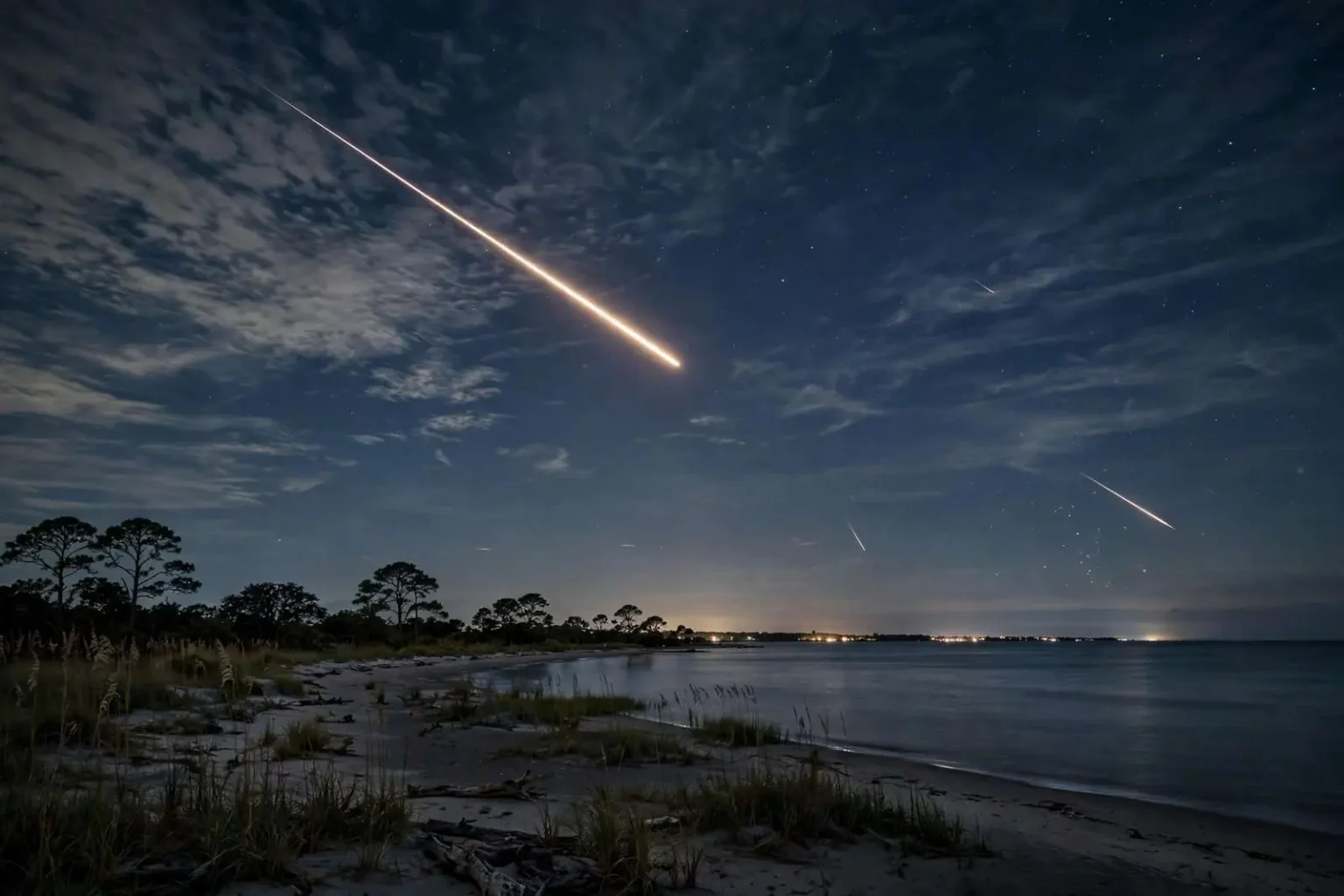
Skywatchers along the Gulf Coast had a shot at a rare celestial treat: a brief but potentially vivid outburst from the alpha Monocerotid meteor shower, expected to peak the night of November 21-22. Unlike the dependable annual showers that return each year on schedule, the alpha Monocerotids are famous among meteor watchers for their unpredictability — most years the display is quiet, but occasionally Earth plows through a dense clump of comet debris and produces a burst of meteors that can rival a major shower in minutes.
According to a prediction from researchers Peter Jenniskens and Esko Lyytinen published with the SETI Institute and NASA Ames Research Center, Earth was set to pass through debris from an unknown comet, producing a short outburst lasting roughly 15 to 40 minutes. At its height, observers could see several meteors per minute. That is a striking rate for a shower most people have never heard of, and it explains why amateur meteor observers across the country planned their Thursday night around the forecast.
The Science Behind the Prediction
Meteor showers happen when Earth crosses the trail of dust and grit left behind by a comet as it orbits the sun. The particles hit the upper atmosphere at tremendous speed and burn up in streaks of light. Most established showers — the Perseids of August, the Geminids of December — are tied to known parent bodies and repeat every year in predictable numbers. The alpha Monocerotids are different: their parent comet has never been identified, and the dust trail the shower travels through is encountered only rarely.
Jenniskens, a meteor astronomer affiliated with the SETI Institute and NASA’s Ames Research Center in California, has built a career on predicting exactly this kind of event, combining orbital calculations with historical records of past outbursts. Lyytinen, a Finnish meteor researcher known for modeling comet dust trails, developed the calculation pointing to the brief window on the night of November 21-22. Their published forecast gave Gulf Coast observers something rare: an appointment with a meteor shower that most skywatchers never see at all.
The rarity is the draw. Because the dense part of the debris trail is narrow, the outburst would last only minutes to half an hour — not the hours-long displays familiar from the big annual showers. Observers had to be outside, watching, at the right time, or they would miss it entirely and wait years for the trail to swing back across Earth’s path.
When and Where to Look
The best window opened around 10:50 p.m. CST Thursday, with the shower becoming visible low in the east-southeastern sky. The meteors appear to radiate from the constellation Monoceros, the unicorn, a faint patch of sky that lies just east of the brilliant star Sirius and north of Sirius’s neighbors in Canis Major — which means Gulf Coast viewers had the advantage of a southern latitude, putting the radiant higher in the sky than for observers farther north.
There was one catch for local viewers: high clouds streaming in from the west threatened to obstruct parts of the show. Gulf Coast weather in late November often features fast-moving cloud decks aloft even when the air near the ground is calm, and a thin veil of cirrus is enough to dim the fainter meteors. Anyone willing to brave the late hour and find a dark view toward the southeastern horizon had the best chance of catching the fleeting display.
Experienced meteor watchers recommend the same preparation for any such event: get away from city lights, give the eyes twenty minutes or more to adapt to the dark, and settle into a reclining chair or blanket with a wide view of the sky. The alpha Monocerotids tend to be fast meteors, streaking across the sky in a second or less, so patience and a broad field of view matter more than a telescope. Binoculars and telescopes, in fact, hinder meteor watching — the display belongs to the naked eye.
A History of Surprise Outbursts
The alpha Monocerotids earned their reputation in 1995, when a brief outburst caught observers in Europe by surprise and produced a burst of bright meteors over a span of less than an hour. Historical records going back decades document earlier flare-ups from the same shower, including mid-20th century displays that sent meteor rates soaring for a matter of minutes. Each event shared the same signature: sudden onset, high rates and a swift end as Earth passed through a narrow ribbon of debris.
That history is what made the Jenniskens-Lyytinen forecast exciting to the meteor-watching community. Predicting an outburst from a shower with an unknown parent comet requires inferring the debris trail’s location from the timing of past displays, and the researchers’ models suggested the trail would be encountered head-on this time. If the prediction held, the outburst would join a short list of anticipated meteor storms — events where scientists knew in advance that the sky was about to put on a show.
Professional researchers had a stake in the outcome as well. Outbursts provide a chance to study fresh comet dust, and teams planned to observe the shower from locations with clear skies, gathering data on the meteors’ speed, brightness and trajectories. Each such observation helps refine the models of where comet debris trails drift, improving future predictions.
Late November Skies on the Gulf Coast
The timing put the display against a familiar late-autumn sky. By 10:50 p.m., the bright constellations of winter were climbing in the east — Orion, Taurus and the brilliant Sirius — with the faint Monoceros between them. For Gulf Coast viewers, moonlight and weather are always the deciding factors for meteor watching, and the advancing high clouds made the southeast horizon the only reliable window.
The coast’s flat terrain and dark beaches and fields make the region better meteor country than most urbanized areas, provided observers get away from the glow of Mobile, Pensacola and the beach resort strips. Rural Baldwin County, the delta south of the city and the open pine lands of south Alabama all offer darker skies within a short drive, and a 15-to-40-minute outburst is short enough that even a quick trip to a dark spot could pay off.
Timing mattered as much as location. Because the predicted peak was so brief, an observer who stepped outside at 10:20 or 11:30 might have seen nothing, while a neighbor watching from 10:40 to 11:10 caught the whole show. Meteor enthusiasts prepared for that reality by planning to watch the entire window, keeping warm and letting their eyes stay adapted to the darkness.
The Value of the Show
Even when an outburst fizzles, events like this one serve a purpose for the astronomy community: they draw new people outside to look up. Local astronomy clubs across the Gulf Coast use predicted events to introduce the hobby to newcomers, and a clear November night offers plenty besides meteors — the Pleiades star cluster, the planets of the evening sky and the Milky Way’s winter edge among them.
For those who saw it, a meteor outburst is a reminder of how much happens overhead that no one notices. Every day, tons of interplanetary dust fall through the atmosphere, most of it invisible, most of it unnoticed. A few nights a year — and on rare, predicted occasions like the alpha Monocerotid window of November 21-22 — the debris announces itself, several meteors per minute, low in the southeastern sky over the Gulf, for anyone willing to stand outside and wait.
How Observers Prepared
In the days before the event, meteor-watching groups circulated the prediction widely, and amateur astronomers mapped out their viewing plans accordingly. The advice circulating among observers was consistent: find a dark site with an unobstructed view toward the east-southeast, arrive well before the 10:50 p.m. target so eyes could fully adapt, and stay through at least the following half hour. Because the shower’s radiant sits low during the predicted window, observers closer to the Gulf’s southern horizon — along the coast, on the bay, or in open fields — had a geometry advantage over viewers hemmed in by tree lines and buildings.
Others planned to contribute scientifically. Amateur meteor observers have long supported professional research by logging what they see — counting meteors per interval, noting brightness and color, and reporting the results to international meteor organizations. Those ground-based counts, gathered from backyards across the country, are what allow researchers to confirm whether a predicted outburst occurred and to measure its actual strength, feeding the next generation of dust-trail models.
What Makes an Outburst Worth Watching
Regular annual showers deliver steady entertainment — a few meteors every few minutes through the hours after midnight. An outburst is a different experience entirely: rates jump several-fold in a matter of minutes, and seasoned watchers describe the sensation as watching the sky come alive. Several meteors per minute, if the forecast held, would put the alpha Monocerotid burst in the range of the finest nights the major showers produce, compressed into a fraction of the time.
The brevity cuts both ways. An observer could watch an entire major shower’s peak over two or three hours and see dozens of meteors; the alpha Monocerotid window demanded attention for only about half an hour but offered no second chance until the debris trail next aligns with Earth’s orbit — an alignment that can take years to return. That scarcity is precisely what turned a Thursday night in late November into an event worth losing sleep over for Gulf Coast skywatchers, clouds permitting.