Remains of Korean War Soldier PFC Joseph ‘Dile’ Chancery Return Home to Escambia County After 75 Years
The remains of PFC Joseph Chancery, missing since the 1950 Battle of Chosin Reservoir, will be escorted from Pensacola to Mobile before burial in Escambia County.
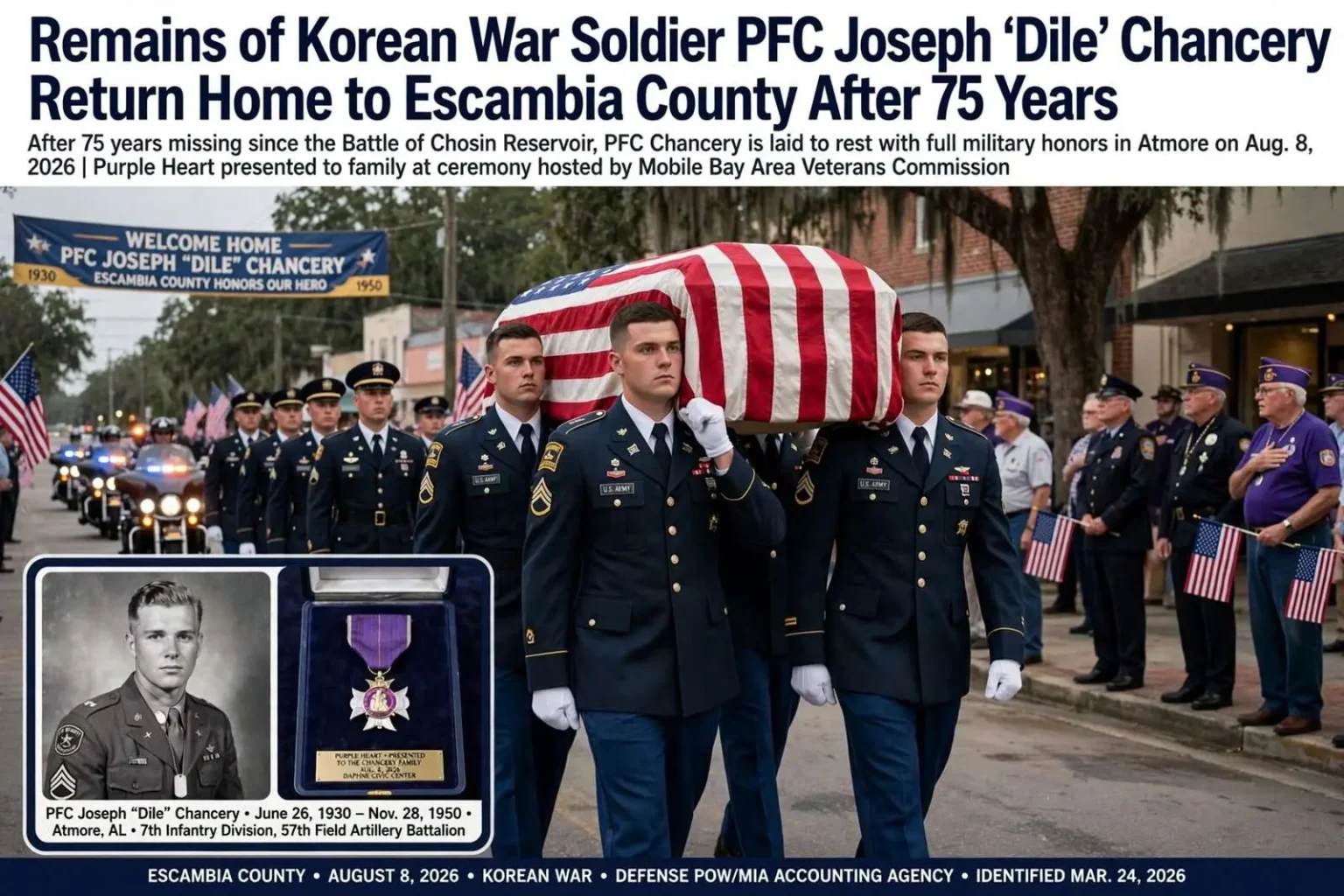
Update, Aug. 8: The Purple Heart Salute took place as planned Thursday night at the Daphne Civic Center, hosted by the Mobile Bay Area Veterans Commission and the South Alabama Veterans Council.
Around 50 Purple Heart recipients from Alabama, Florida, Texas and Wisconsin attended the ceremony honoring those wounded or killed in combat. Colonel Steve Carey, president of the Mobile Bay Area Veterans Commission, formally presented Chancery’s Purple Heart to his family during the event.
“It’s just more than I can imagine. It’s just unbelievable. We’ve been waiting so long for this and so many of us have been waiting to hear this,” Kelly said of receiving her uncle’s medal at the ceremony. Carey said the presentation carried deep personal meaning for him as well.
“It’s deeply emotional for me because I recognize the importance of a country making sure that we find all those soldiers and airmen giving their lives, bring them home for their families and also to put them at rest with those that love them and they’ve made the ultimate sacrifice,” Carey said.
After being missing for more than 75 years, the remains of PFC Joseph “Dile” Chancery are being returned home with a military escort.
Chancery was a 20-year-old U.S. Army private first class from Atmore who was killed in action during the Korean War.
According to an obituary from Radney Funeral Home in Mobile, his remains were set to arrive at the Pensacola airport Thursday, Aug. 6, at 10:43 a.m.
Chancery served in the Army’s Battery A, 57th Field Artillery Battalion, 7th Infantry Division. His unit came under attack Nov. 28, 1950, at the Battle of Chosin Reservoir in North Korea. Chancery, born June 26, 1930, in Brewton, was one of 12 children born to George Leonard Chancery and Martha Jane Posten Chancery in rural Escambia County.
“He was reported killed in action after fierce combat under brutal conditions, but his remains could not be recovered,” the release said. He was later classified as missing in action.
Chancery’s remains were officially identified March 24, 2026, by the Defense POW/MIA Accounting Agency, and he was posthumously awarded the Purple Heart. For members of the Chancery family, the homecoming closes a chapter that has spanned three generations.
His niece, Leaster (Chancery) Kelly, was three years old when he left for the war and grew up hearing relatives talk about him. “Everybody loved him, and then they were all waiting for him to come home,” Kelly said.
“When he left, it was such a sad day, but this has been such a happy time.” Olivia DiFilippo, a great-great-niece of Chancery, said the family never expected to see this day. “It’s crazy to think that he’s been missing for 75 years,” DiFilippo said.
“I never thought we would see the day where he got to be brought home, but I think it’s always an honor to get to bring home an American soldier.” Kelly said an uncle, Edward Chancery, provided a DNA sample that helped confirm the identification. The identification also gave new significance to a letter the family has preserved for more than 70 years.
In December 1952, fellow soldier Pfc. Isreal Samuels wrote to the Chancery family from Fort Benning, Georgia: “We were in the same battery… he was killed at the Chosin Reservoir in North Korea. I was with him at the time of his death.” The Defense POW/MIA Accounting Agency said Chancery’s case reflects a decades-long effort to account for Americans lost in the Korean War. “Since 1982, the remains of over 450 Americans killed in the Korean War have been identified and returned for burial with full military honors,” DPAA spokesperson Michael Mee said in a written statement.
According to the agency, more than 7,300 Americans remain unaccounted for from the Korean War, including approximately 144 service members from Alabama. Chancery’s remains will be escorted to Radney Funeral Home in Mobile by a procession of law enforcement, military personnel, Patriot Guard Riders and family members.
The Mobile Bay Veterans Commission is hosting a Purple Heart Salute from 5 to 7 p.m. Friday at the Daphne Civic Center, where organizers expect 45 to 50 Purple Heart recipients to be honored and the Purple Heart medal to be formally presented to the Chancery family.
A funeral service with full military honors is scheduled for Saturday, Aug. 8, at 10 a.m. at Lottie United Methodist Church Cemetery, 59635 Jack Springs Road near Atmore, officiated by retired Rear Adm. Phillip Lee Jr., U.S. Navy. A procession similar to the one escorting Chancery from the airport will carry his remains from the funeral home at 3155 Dauphin Street in Mobile to the cemetery, departing around 8:30 a.m. Saturday. Chancery will be buried next to his parents, Leonard Chancery and Martha Jane Posten Chancery, his brother George, and his sister Gladys.
The service is open to the public and will be followed by a luncheon for family, friends, veterans and the community at the Lottie Volunteer Fire Department. Instead of flowers, the family is asking that donations be made to the Lottie United Methodist Church Cemetery.
Kelly said she first learned of the identification when a letter arrived at her home. “I got a letter and when I opened it, it said that they had found Uncle Dile’s remains,” she said.
She remembered her great-uncle as “a very jolly person” who loved his country and had always dreamed of serving in the Army. “He just loved his country, and his dream was to be in the Army, and he made it there,” she said.
Update, Aug. 8: Burial With Full Military Honors
Pfc. Joseph “Dile” Chancery was laid to rest Aug. 8 with full military honors at Lottie Cemetery, closing a wait that had stretched more than 75 years since he went missing in 1950 during the Korean War.
The burial followed the identification of his remains and their return to south Alabama earlier in the week.
The Battle of Chosin Reservoir
The Battle of Chosin Reservoir was fought in late November and December 1950 in subzero cold, after Chinese forces entered the Korean War and attacked U.S. and allied troops in the mountains of northeastern North Korea. Army units of the 7th Infantry Division positioned east of the reservoir, including the 57th Field Artillery Battalion, suffered heavy losses, and many of the soldiers killed there could not be recovered during the withdrawal.
The Defense POW/MIA Accounting Agency, part of the Department of Defense, identifies recovered remains using methods that include DNA comparison with samples provided by relatives, dental records and anthropological analysis.