
Rep. Ernie Yarbrough Renews Push Against ‘Mass Surveillance’ Flock Cameras
State Rep. Ernie Yarbrough is renewing his opposition to Flock Safety cameras, calling the license plate readers 'mass surveillance' that violates the Constitution.
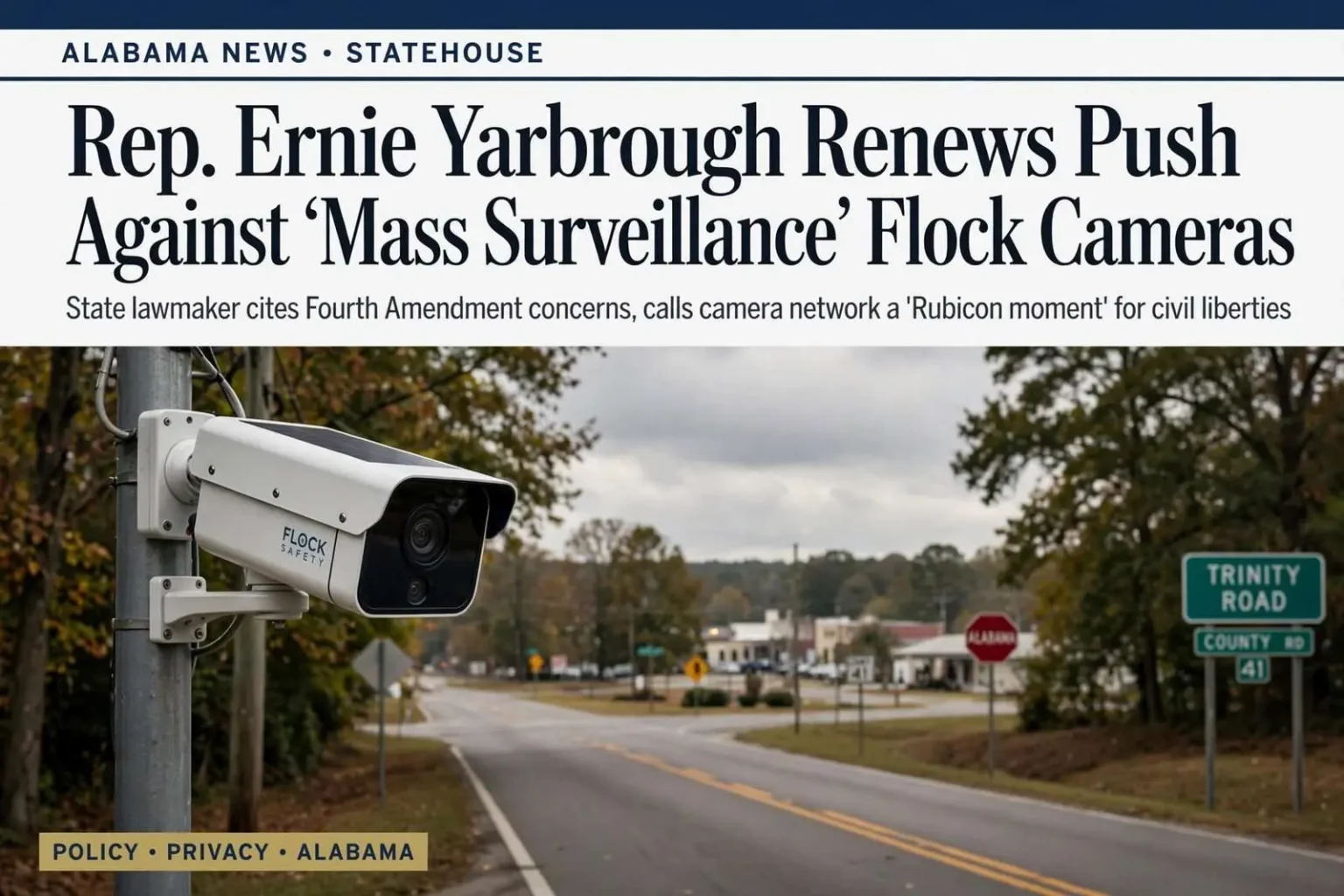
State Rep. Ernie Yarbrough (R-Trinity) is holding firm in his opposition to what he calls the “mass surveillance” that comes with law enforcement’s use of Flock Safety cameras. The Republican legislator has made the automated license plate reader systems a defining issue of his advocacy in the Statehouse, arguing that the networks of cameras mounted at intersections and along roadways amount to a tracking apparatus pointed at ordinary citizens.
According to Yarbrough, his fight against the cameras is aimed at protecting the freedoms of the people. He asserted that the camera system’s tracking abilities abuse the Fourth Amendment and the Alabama Constitution, framing the dispute not as a disagreement over traffic enforcement or policing tactics but as a constitutional question about the reach of government into the movements of the public.
Flock Safety cameras, deployed by police departments and sheriff’s offices across Alabama and the country, photograph license plates and run them against databases in seconds, logging where vehicles travel and when. Supporters describe the systems as powerful crime-fighting tools that have located stolen cars, missing persons and suspects in violent cases. Critics, including a growing contingent of conservative and civil-liberties voices, describe them as a dragnet that records the movements of everyone on the road, guilty and innocent alike, without individualized suspicion.
“Could you imagine looking into the eyes of our forefathers who stormed the beaches of Normandy … and said, ‘D-Day, you did all of that so we could mass surveil innocent Americans,’” he said Tuesday. “I mean, does anybody in their right minds think that our forefathers would not be heartbroken?”
A ‘Rubicon moment’
Yarbrough said in a Mobile radio interview that the nation was facing a “Rubicon moment” in stopping the use of Flock cameras. The phrase, invoked from the story of Julius Caesar crossing the river that marked the point of no return for the Roman Republic, cast the spread of the camera networks as a threshold beyond which, in his view, the country’s relationship between citizen and state would permanently change.
“Why is it that our fathers and our forefathers didn’t have crime like this? It’s because there was a much more swift execution of justice upon the head of perpetrators,” Yarbrough stated. “The solution to crime is not to surrender our freedom. The solution to crime is to do what Romans 13 says, which is to be a terror to those that do evil and a rewarder to those that do good.”
The reference to Romans 13, the New Testament passage on the purpose of civil authority, tied his argument to the moral framework he brings to legislation: that government’s legitimacy rests on punishing wrongdoing, not on monitoring the population at large in advance of any crime. In his telling, the cameras invert that order, treating every driver as a subject of observation in the name of catching the few.
“I think this is a Rubicon moment,” he added, saying that he loved law enforcement but was against the use of automated systems like traffic cameras. “To me, the more I studied the whole idea of Flock camera systems, it’s just fundamentally unconstitutional,” Yarbrough continued.
The distinction he draws — support for police, opposition to the automated systems they are increasingly equipped with — has become the central rhetorical ground of the Flock debate in statehouses across the country. Lawmakers who object to the readers insist they are not anti-police but anti-mass-surveillance, arguing that the technology gives agencies a capability the Constitution’s drafters never contemplated and that the public has never explicitly authorized.
He added that any future legislation he filed or supported in the upcoming session would be governed by the Constitution. That pledge frames his legislative agenda going forward, with the Flock fight positioned as a test of whether constitutional limits will constrain technologies that arrived in Alabama communities faster than the laws regulating them.
The technology behind the dispute
Flock Safety’s cameras are automated license plate readers that capture an image of every vehicle passing their field of view, convert the plate number to searchable text, and compare it against lists of wanted vehicles. A single camera can log thousands of plates a day, and a network deployed across a city or county can, in effect, reconstruct the travel patterns of any vehicle over time.
That capability is what makes the systems useful to investigators and alarming to critics. A plate reader network can confirm an alibi or place a suspect’s car at a crime scene; the same data, critics note, can map who attended a church, a rally, a clinic or a bar. Data-sharing agreements between agencies multiply the concern, allowing a query in one jurisdiction to sweep up records from many others.
In Alabama, the cameras have spread rapidly through municipal police departments and sheriff’s offices, often at little upfront cost to the agencies that install them. That growth curve is precisely what opponents like Yarbrough want to interrupt — before, in their view, the networks become so embedded that dismantling them becomes politically impossible.
The constitutional argument
Yarbrough’s invocation of the Fourth Amendment rests on the claim that blanket plate collection is a search without suspicion. Courts have historically treated what a person exposes in public — a license plate among them — as outside the scope of the amendment’s protections, but the aggregation of millions of public observations into a searchable record of movement is the part of the technology that has not been fully settled in law.
The Alabama Constitution carries its own protections against unreasonable searches, and Yarbrough’s argument leans on both charters at once: that a citizen’s comings and goings, pieced together by a state-warranted network of readers, exceed what either document intended government to collect without cause. His position places him among the legislators nationally who have pushed for restrictions ranging from data-retention limits to outright bans.
Law enforcement officials who deploy the systems answer with results. Stolen vehicles recovered, suspects identified and missing people found form the core of their case, and agencies argue that the data is used within policy limits — queried for specific investigations rather than browsed at will. The disagreement, at bottom, is over whether policy limits are a sufficient substitute for legal ones.
That is the ground Yarbrough means to hold. In his framing, a legislature that declines to act has effectively authorized the surveillance by default, and the upcoming session offers the chance to establish, in statute, where the lines sit between public safety and public monitoring.
The politics of the fight
The Flock debate is unusual in that it cuts across conventional ideological lines. Libertarians and conservative constitutionalists object to the tracking on the same grounds that civil-liberties organizations on the left do, while police associations and many local officials defend the cameras as force multipliers for stretched departments. The result is a coalition for restriction that looks unlike most coalitions in the Statehouse.
For Yarbrough, a legislator from Trinity in north Alabama, the issue has also become a case study in persistence. His public statements — the radio interview in Mobile, the floor rhetoric invoking Normandy and Romans — are aimed as much at his colleagues as at the public, seeking to move the question from a niche technology debate to a constitutional priority.
Whether the upcoming session produces restrictions on the cameras, a reprieve for their operators or a compromise governing data use will say much about how the state handles the next wave of surveillance technologies, from facial recognition to shot-spotting networks, that arrive on the same trajectory: adopted first, regulated later, if at all.
Yarbrough has made clear he intends to keep raising the question until it is answered in law rather than left to procurement decisions. “I think this is a Rubicon moment,” he said — and the crossing, in his view, is one Alabama still has the chance to decline.
The session ahead will test whether that argument carries the votes. Until then, the debate proceeds on the terms Yarbrough has set: a question of constitutional principle rather than policing preference, pressed with the conviction of a lawmaker who believes the moment demands it.
His critics will continue to point to the crimes solved and the vehicles recovered, and the agencies that operate the networks will continue to describe them as indispensable. The legislature will have to decide, in effect, whether Alabama’s answer to mass surveillance will be written by statute or left to the quiet accumulation of camera poles at intersections across the state.
For Yarbrough, the choice is already made. He believes the technology treats innocent Alabamians as suspects, and he has pledged that his own legislation will be governed by the Constitution — the same document he says the cameras cannot survive. The cameras keep photographing the plates, the databases keep growing, and the fight keeps building toward the session where, for better or worse, the state’s answer will have to be given.