Review: 1065 Festival 2016 Brings Blind Melon, Trombone Shorty and More to Mobile
The 1065 festival, which rose from the ashes of Bayfest, returned to downtown Mobile Sept. 30-Oct. 2 with Blind Melon, Trombone Shorty and more.
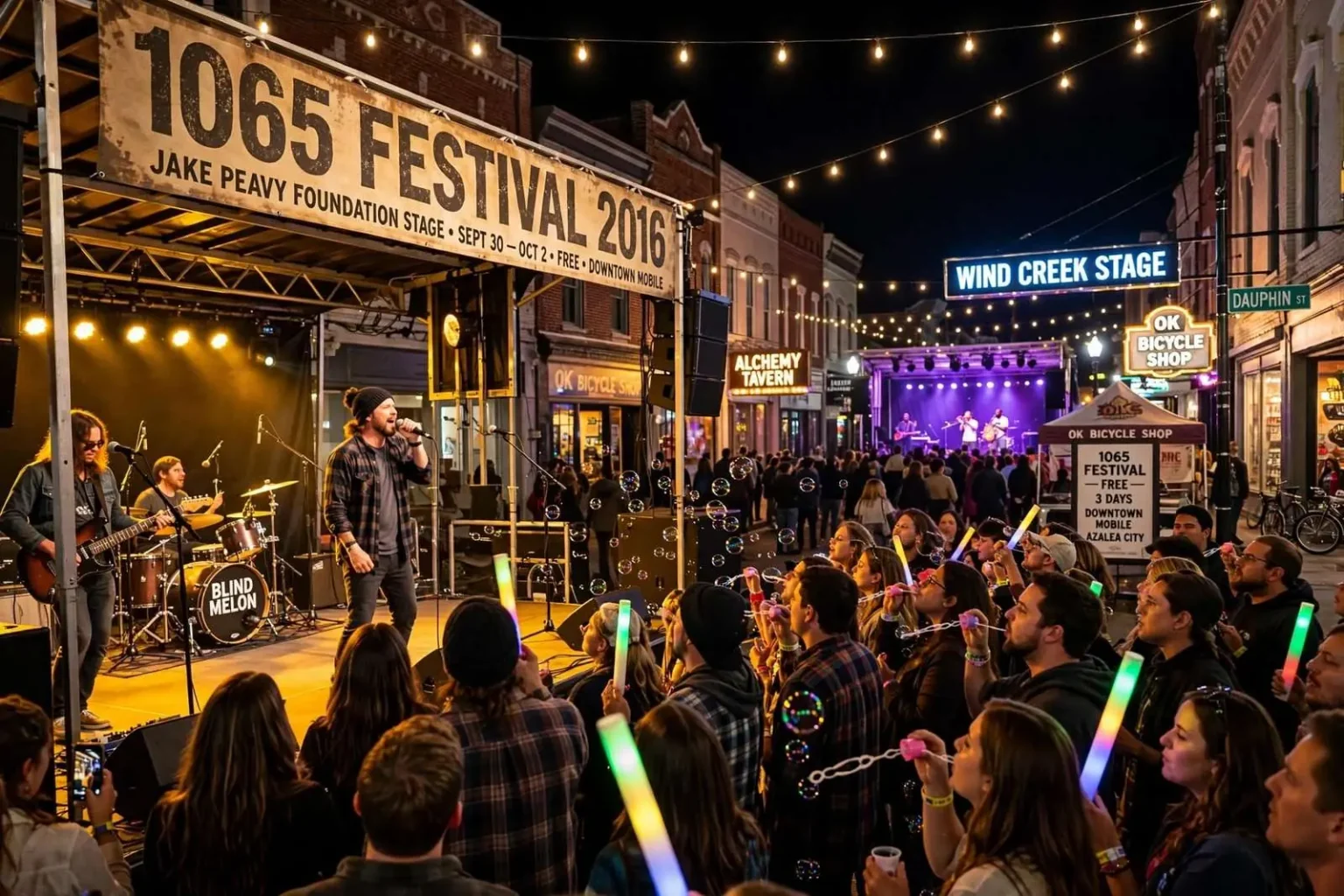
1065, the free downtown festival that rose from the ashes of BayFest in 2015, returned to Mobile from Sept. 30 to Oct. 2, spreading music across the city center in a format that treated the whole downtown as the venue. Crowds wandered the Azalea City discovering music not just on main stages but in bars, restaurants and side streets, a decentralized layout that turned the festival into a self-guided tour of Mobile’s nightlife.
The festival’s name and structure carried forward the memory of BayFest, the long-running October festival that had anchored Mobile’s music calendar for decades before its end. Where BayFest had concentrated crowds on fenced-off downtown streets, 1065 scattered the experience across established venues, letting fans move freely between a main stage show and a late-night set a few blocks away. The free admission model removed the ticket barrier entirely, making the weekend accessible to anyone willing to walk downtown.
Friday’s biggest draw was Blind Melon, whose fans clustered near the Jake Peavy Foundation Stage with glowsticks and bubble wands, an audience that spanned the band’s nineties-era followers and younger listeners who had found the group’s catalog through the years since. The band’s set carried the anticipation of a crowd that had waited decades for the chance to sing along.
Lead singer Travis Warren told the crowd, “Thank you — this is one of the best crowds we’ve had in a while.” The band surprised listeners with a stripped-down “No Rain” before the hit version, a sequencing choice that let the audience hear the song that made the band famous in a new shape before releasing them into the familiar chorus they had come to hear.
Trombone Shorty Takes the Wind Creek Stage
Trombone Shorty then took the Wind Creek stage like “a force of nature,” drawing a crowd stretching to the OK Bicycle Shop and surprising everyone with an instrumental “Brain Stew.” The New Orleans bandleader’s blend of brass power, funk and rock energy made him the weekend’s gravitational center, pulling listeners from every corner of downtown toward the riverfront end of the footprint.
The crowd that stretched to the OK Bicycle Shop testified to the reach of Trombone Shorty’s draw. Fans standing blocks from the stage still caught the full force of the performance, and the crowd’s sprawl across Dauphin Street gave the festival the feel of a neighborhood celebration rather than a confined concert. The surprise instrumental run through Green Day’s “Brain Stew” added a rock-and-roll jolt to a set already built on genre-blending, and the cover choice underscored the spirit of a weekend in which Mobile’s venues and stages traded songs and audiences freely.
Elsewhere on the footprint, Moon Taxi overlapped on the Jake Peavy stage, forcing fans to choose between two of the weekend’s strongest draws, a scheduling dilemma that veterans of multi-stage festivals know well. The Nashville band’s blend of indie rock and improvisational jams gave Friday a second headliner-caliber option, and the overlap kept the Jake Peavy Foundation Stage side of downtown full while Trombone Shorty commanded the Wind Creek stage.
OK Bicycle Shop hosted overflow acoustic sets, giving the weekend a lower-lit, up-close counterweight to the main stage productions. Alchemy Tavern and Hayley’s Bar filled with late-night revelers, keeping Dauphin Street’s bar district humming well past the point when the larger stages went quiet. That late-night layer was central to the 1065 concept: with no ticket required, the festival’s energy flowed on foot from venue to venue, and the clubs that anchor downtown’s nightlife became stages in their own right.
Saturday and Sunday Keep the Momentum
Saturday and Sunday brought Infant Richard and the Delta Stones, The Struts, Seether and Counting Crows, extending the festival’s range from Delta-inflected rock and roll to British glam revivalism to nineties alternative radio staples. The lineup’s spread across styles was characteristic of the 1065 approach, booking headliners with deep catalogs and loyal followings while leaving room on the undercards for regional acts to play before their largest hometown audiences.
The Struts’ arrival on the bill brought a theatrical, arena-sized rock sensibility to a street festival setting, while Seether carried the post-grunge weight of a band whose catalog has Soundtracked two decades of alternative radio. Counting Crows, closing the weekend, gave Sunday the kind of singalong-heavy setlist that turns a festival’s final night into a communal event, with a multigenerational audience trading verses the band has been playing since the nineties.
Infant Richard and the Delta Stones represented the local and regional thread of the lineup, a band whose name alone announces its musical debts and whose sets have made them a fixture of Gulf Coast stages. Their slot on the weekend’s lineup put them before the biggest crowd of their run, the kind of exposure that festivals exist to provide for working regional bands.
The Jake Peavy Foundation Stage itself tied the festival to a hometown story, bearing the name of the Mobile-born pitcher whose foundation supports youth and charitable causes across the Gulf Coast. Sponsors like Wind Creek attached their names to stages that doubled as landmarks within the festival footprint, helping fans navigate a weekend spread across multiple blocks and venues.
For downtown businesses, the three-day run of free music was a gift. Bars and restaurants along Dauphin and the surrounding blocks reported the festival crowds that festivals exist to deliver, and the acoustic overflow sets turned the venues themselves into destinations. The 2016 edition confirmed that the 1065 model, free admission, decentralized venues and a genre-spanning lineup, had filled at least part of the space BayFest left behind, with a flavor all its own: less a fenced festival ground than a city turned loose on its own nightlife for a long weekend.
By the time Counting Crows sent the crowd home Sunday night, the festival had showcased Blind Melon’s comeback energy, Trombone Shorty’s brass-fueled showmanship, and a procession of national and regional acts across the stages and barrooms of downtown Mobile. The weekend of Sept. 30 to Oct. 2 gave the Azalea City three days of walkable, free, full-volume music, and the crowds that wandered it seemed to relish every stop along the way.
The 2016 edition also demonstrated how Mobile’s downtown geography suited the festival format. The compact grid between the riverfront and the bar district meant that fans could see a main stage act, walk a few blocks and land in an intimate club set within minutes. Streets that BayFest had closed to traffic and fenced into admission gates returned to their ordinary roles, with the music layered on top of a functioning downtown rather than replacing it. Residents who lived in the upper floors of downtown buildings heard the weekend through their windows, and the city’s October visitors stumbled into a free festival they had not planned to attend.
Blind Melon’s booking was the kind of nostalgia play that festival audiences reward. The band’s history, a nineties run cut short by tragedy, a later revival with Travis Warren carrying the vocal duties, gave the set a narrative beyond the music itself, and the glowsticks and bubble wands in the crowd near the Jake Peavy Foundation Stage showed a fan base that treats the band’s shows as gatherings as much as concerts. The stripped-down “No Rain” before the full version inverted the usual festival logic of saving the hit for the encore, letting the moment breathe twice.
Trombone Shorty’s rise from New Orleans’ Tremé neighborhood to international touring made him a fitting centerpiece for a Gulf Coast festival. His band’s sets run on kinetic energy, trombone and trumpet fronting a rhythm section that borrows as much from rock as from second-line tradition, and the crowd stretching to the OK Bicycle Shop responded accordingly. The instrumental detour through “Brain Stew” linked New Orleans brass swagger to the punk and alternative canon, exactly the crossover the 1065 lineup was built to showcase.
The overlap scheduling that pitted Moon Taxi against the tail of other sets was one of the weekend’s few complaints, and also one of its compliments, evidence that the festival had more good booking than any single fan could cover. Fans split their evenings, caught half a set here and a half there, and the sidewalks between stages stayed busy all night. For a free festival, that abundance of choice was the point: 1065 in 2016 gave Mobile a weekend where the hardest decision was which direction to walk.
The weekend’s success was also a story about the venues and promoters who kept Mobile’s live music scene alive between festival seasons. Clubs like Alchemy Tavern and Hayley’s Bar book national touring acts year-round, and their cooperation with the festival format created a pipeline: bands that play the rooms in March return to the stages in October, and festival audiences become club audiences in the months between. That continuity is what distinguishes a healthy music city from one that simply hosts events, and Mobile’s downtown ecosystem showed its strength across the three days of the 2016 festival.