Review: Mule Fest 2016 Brings 12 Nights of Music and Comedy to Mobile
A review of Mule Fest 2016 in Mobile, 12 nights of music and comedy featuring Black Titan, Rooster Blues and comedian Vince Gulino.
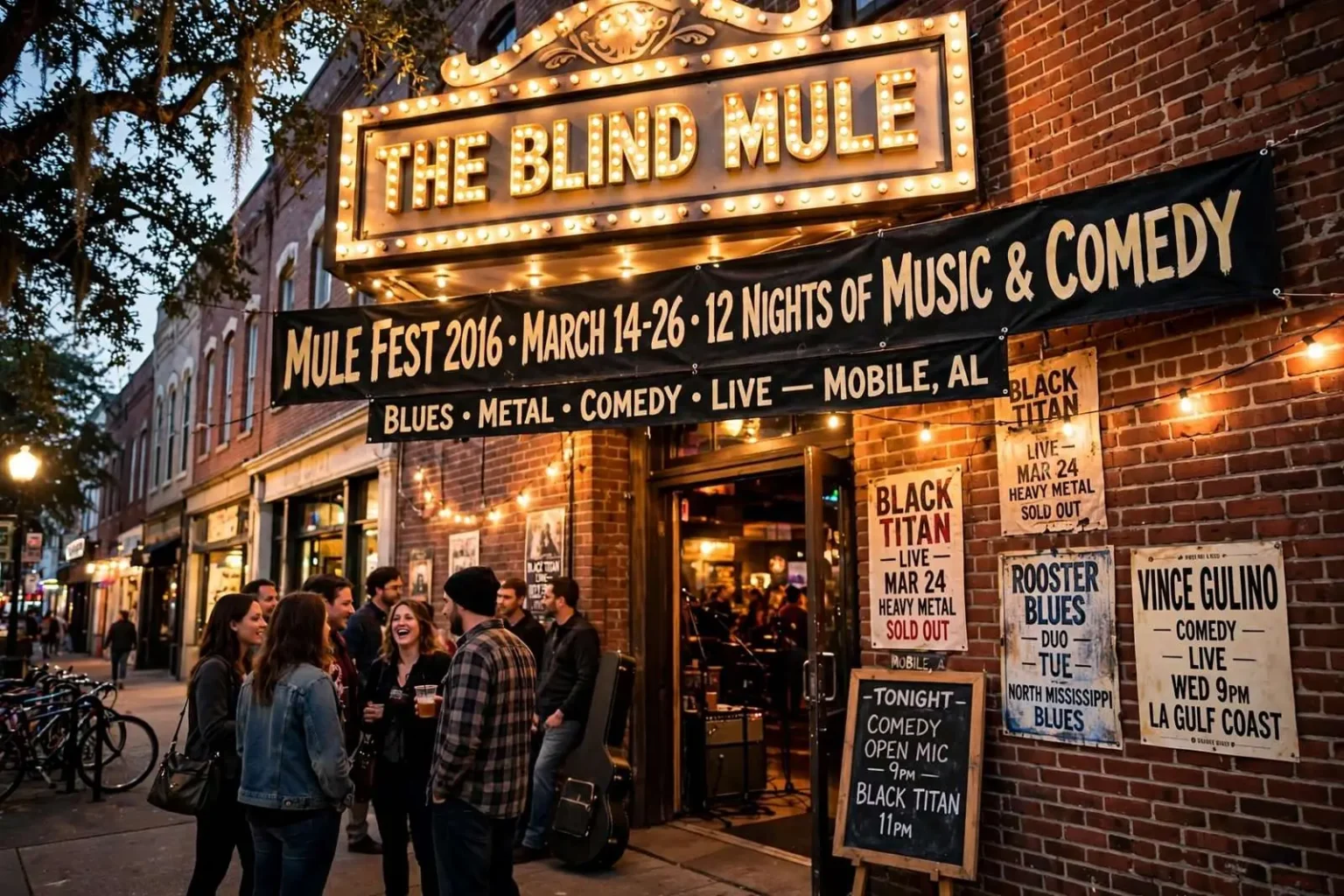
The second annual Mule Fest, held March 14 to 26, 2016, brought 12 nights of entertainment to Mobile, mixing blues, metal, comedy and everything between. The festival gave the Port City a sustained stretch of live programming at a time of year when much of the Gulf Coast cultural calendar had already quieted after Mardi Gras, and it did so with a lineup that deliberately refused to sit in one genre. On any given night, a crowd could move from a stripped-down blues duo to a full-throttle metal band to a stand-up showcase, often within the same walls.
That range was the point. Mobile’s music and comedy scenes have long lived in the shadow of New Orleans, just two hours west along Interstate 10, and events like Mule Fest give local performers and touring acts alike a reason to build their schedules around the city. Organizers spread the 12 nights across the second half of March, a window that lets the festival ride the momentum of springtime foot traffic in the downtown and Oakleigh Garden districts without colliding with the bigger regional festival season that arrives in April.
Beyond interviewing SXSW alumnus Dead Stars ahead of the event, we spent festival nights talking with musicians and comedians about what it takes to make a living on the Gulf Coast club circuit. Those conversations, held between sets and over the noise of soundchecks, painted a picture of a scene that is smaller than the one across the state line but noticeably hungrier — venues willing to book original material, performers willing to drive for a Tuesday gig, and audiences that show up when the bill is interesting.
Music for Every Taste
Comedian and Black Titan member Clay Bates warmed up crowds before headliners throughout the run, a double duty that made him one of the festival’s most familiar faces. Bates would deliver a comedy set to loosen up the room, then return to the stage later in the night with Black Titan, whose brand of heavy, aggressive metal has earned the band a devoted following in south Alabama. The band itself played March 24, and its popularity drove strong turnout, filling the venue with the kind of audience that follows a local metal act from bill to bill regardless of the night of the week.
Black Titan’s slot illustrated something Gulf Coast promoters have known for years: homegrown bands with loyal local followings can anchor a multi-night festival in a way that traveling headliners cannot, because the crowd arrives already invested. Mobile audiences have historically shown up for heavy music, from the rock rooms that lined Dauphin Street in earlier decades to the smaller stages that now carry the scene, and the March 24 crowd continued that tradition.
Regional duo Rooster Blues, from Tupelo, Mississippi, delivered a mighty sound despite a stripped-down setup. Two musicians, a minimal stage footprint and no reliance on layers of overdubs — the pair made the format work by leaning on songwriting and interplay rather than volume alone. Touring acts from north Mississippi pass through Mobile less often than acts from New Orleans or Pensacola, which made the booking a small coup for the festival and a change of pace for local audiences accustomed to the same rotation of regional names.
“Mobile is a very welcoming place,” Judson Vance said, noting that local venues wanting original music make a difference for touring acts. His comment cut to the heart of what sustains a regional scene. Cover-band-heavy lineups pay the bills, but it is the rooms that book original songs that keep songwriters on the road, and Rooster Blues has built its career on exactly that kind of venue. For a duo based in Tupelo — a city best known musically as the birthplace of Elvis Presley and a crossroads of north Mississippi blues tradition — a welcoming room 250 miles from home is the difference between a tour and an empty calendar.
The duo’s fourth album was recorded at Zebra Ranch and was in mastering as the festival ran, a detail that matters to anyone who follows Mississippi roots music. Zebra Ranch is the Dickinson family’s studio in rural north Mississippi, a converted property where producer Luther Dickinson — known for his work with the North Mississippi Allstars and for stints with the Black Crowes — has recorded a long list of regional and national acts. Cutting an album there places Rooster Blues in the same lineage of north Mississippi hill country and blues recording that has drawn attention from labels and festivals far beyond the region, and having Luther Dickinson behind the board signals the duo is being taken seriously by the people who know that sound best.
For Mobile audiences, the payoff is straightforward: the chance to hear the new material in a small room months before it reaches streaming services or record stores. Festivals of this size have always functioned as a listening room for work in progress, and the 2016 edition was no exception. Fans who caught Rooster Blues during the run were hearing songs that would later carry the polish of Dickinson’s production but still bore the raw shape they had in the club.
The wider festival lineup moved comfortably between genres night to night, and that eclecticism reflected the booking philosophy that has made the event’s home venue a reliable stop on the Gulf Coast circuit. Blues acts shared the calendar with metal bands, singer-songwriters and comedians, mirroring the way Mobile audiences actually consume entertainment rather than forcing them into a single-scene silo. It is a model borrowed in spirit from the multi-venue festivals of larger cities but scaled to what a mid-sized Gulf Coast market can support.
Comedy on the Rise
Southern comedian Vince Gulino of Slidell, Louisiana anchored a comedy night during the run, bringing a Louisiana Gulf Coast perspective to a Mobile stage. Gulino’s set included a moment that captured the improvisational streak of working club comedians: at one point he improvised by reading random tweets to an amused crowd, turning the audience’s own social media feeds into material. The bit worked precisely because it demonstrated the skill that separates road comics from open-mic regulars — the ability to build laughs out of whatever the night hands them.
“Being able to think on your feet and read your crowd is a real thing,” Gulino said. Any comedian who has worked a Gulf Coast weeknight knows the truth of that. A packed Friday room and a sleepy Wednesday crowd demand entirely different rhythms, and comics who tour the small-venue circuit between New Orleans and Pensacola develop the adaptability as a survival skill. Gulino, based in Slidell on the north shore of Lake Pontchartrain, works a circuit that includes both cities, and Mobile has become a regular stop for comedians making the same drive.
The Blind Mule has become a Mobile comedy hub, a role that has grown alongside the venue’s music bookings. The room now runs Wednesday open mics for beginners and established comedians every Saturday, a schedule that gives new comics a low-stakes place to learn and working comics a guaranteed weekend stage. That two-track approach is how healthy comedy scenes are built: the open mic feeds the weekend show, the weekend show gives the open mic regulars something to aim for, and the venue builds a following that knows exactly which nights to show up for.
Gulino’s advice for newcomers was characteristically blunt: “You bomb a million times and you piece together what is good.” The line doubles as a description of how every working comedian actually develops, despite the polished finished product audiences see on weekend shows. Comedy, like the original music Vance described, depends on rooms willing to let performers fail in public, and Mobile’s willingness to host both has quietly made the city a place where Gulf Coast performers can grow without relocating to New Orleans, Atlanta or Nashville.
The comedy expansion also reflects a broader shift in how Gulf Coast venues do business. Live comedy is comparatively cheap to produce — a microphone, a stage and a room — yet it draws a midweek audience that music alone often cannot, particularly on nights when touring bands are scarce. Venues that pair weekend music with weeknight comedy spread their risk across formats, and The Blind Mule’s schedule shows the model working in real time in a neighborhood just south of downtown.
What the Festival Means for Mobile
By its second year, Mule Fest had already settled into a rhythm that longer-running festivals spend half a decade finding. The 12-night format lets organizers feature far more acts than a single weekend could, which in turn means more local performers on the bill and more touring acts with a reason to route through Mobile. For a city whose entertainment calendar revolves heavily around Mardi Gras in winter and the spring festival season in April, a mid-March anchor fills one of the sparsest stretches of the year.
The economics matter too. Every night of a festival like this puts paying customers in a neighborhood business and a day’s work in front of local musicians, bartenders, sound engineers and comics — the gig workers who make up the backbone of the live entertainment economy. Multi-night runs also give regional acts a more substantial payday than a one-off Tuesday booking, which is part of why names from Tupelo to Slidell were willing to make the drive.
Just as important is what the festival signals to performers deciding whether Mobile is worth the trip. Vance’s praise for venues that want original music, Gulino’s comfort working the room, and the strong turnout for Black Titan all point the same direction: the city has rooms that treat performers well and audiences that reward variety. Word travels fast on the club circuit, and festivals that leave acts with good stories — about the crowd, the venue, the hospitality — become easier to book the following year.
As the 12 nights wound down on March 26, the takeaway was less about any single set than about the scene itself. Mobile in 2016 had a metal band that could fill a room mid-week, a Mississippi duo cutting an album with a noted producer, a Louisiana comic refining his craft on a Gulf Coast circuit, and a comedy stage hosting open mics and weekend showcases under the same roof. Mule Fest gathered all of that under one banner for two weeks, and the result was a portrait of a small scene doing the things big scenes do: developing talent, importing variety, and giving residents a reason to stay close to home for a good night out.
The festival’s second year also laid a foundation for the third. Multi-night festivals live or die on repetition — audiences need to learn the pattern before they plan around it, and acts need to see the gig survive more than one year before they commit to routing through. With a full 12-night run completed, a genre spread broad enough to cover blues, metal and comedy, and performers already talking about the rooms and the crowds, Mule Fest 2016 did the quiet work that turns an event into an institution. For Mobile’s musicians and comedians, that is not a small thing: it is another stage, another paycheck, and another reason the Gulf Coast’s creative class can keep building careers without leaving the coast.