Rita Chiarelli Brings ‘Music of the Big House’ to Avalon 360
Juno Award-winning Canadian blues artist Rita Chiarelli returned to Mobile in November 2012 to present her documentary Music of the Big House alon.
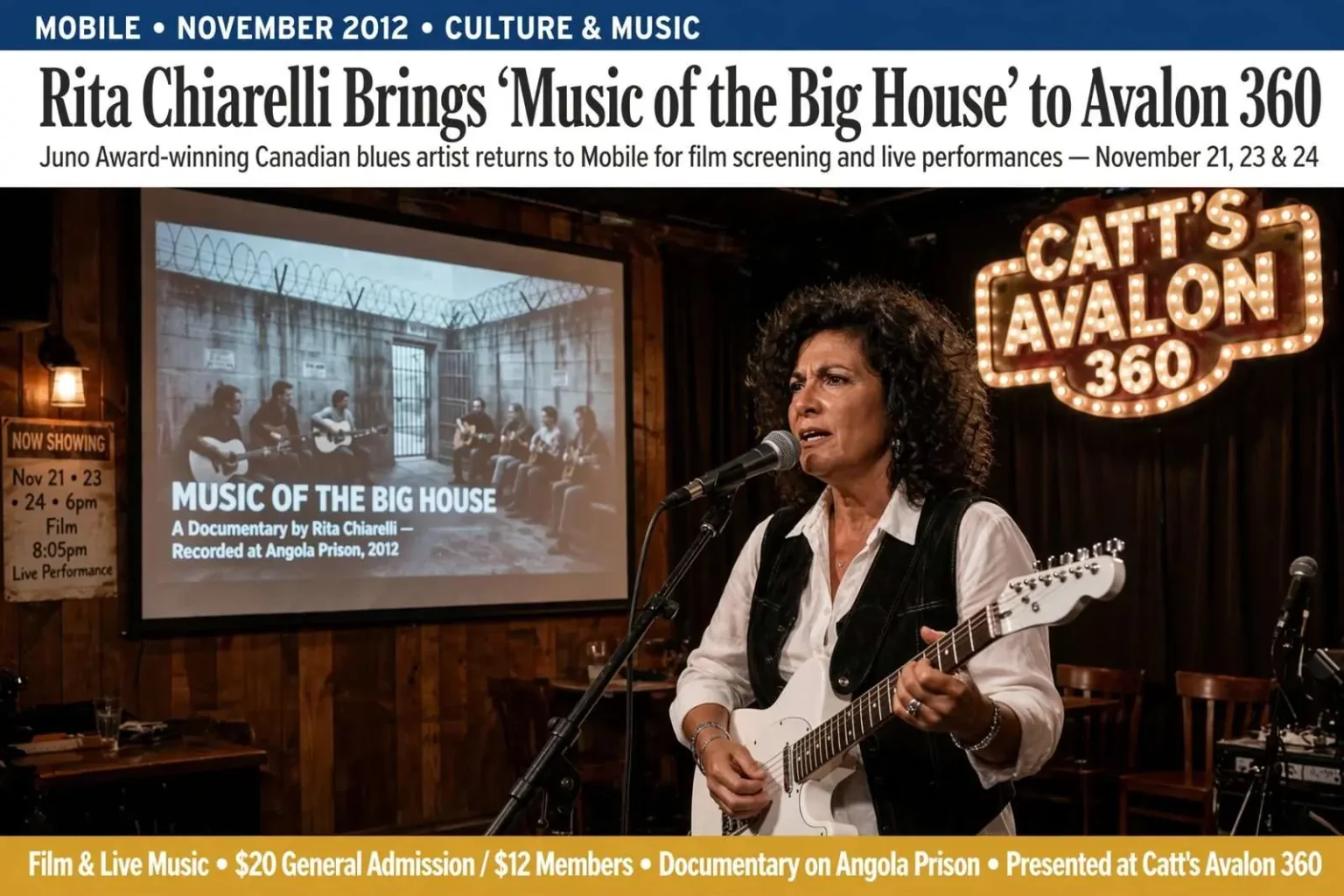
Juno Award-winning Canadian blues artist Rita Chiarelli returned to Mobile in November 2012 to present her documentary Music of the Big House alongside live performances at Catt’s Avalon 360. The engagement paired screenings of the film, which follows Chiarelli’s musical work inside Louisiana’s Angola Prison, with full evening sets from the singer herself, giving Gulf Coast audiences a chance to experience both the story and the voice behind it in a single sitting.
Chiarelli, who has long been regarded as one of the leading figures in Canadian blues, built her reputation across decades of recording and touring, earning multiple Juno Awards along the way. Her connection to the Gulf Coast had grown steadily over the years, with visits to Mobile that blended film showings, live music and community events. The November 2012 run at Avalon 360 was a continuation of that relationship, bringing a project that had already drawn attention on the festival circuit to a more intimate local setting.
The Film and Its Story From Angola Prison
At the center of the engagement was the documentary itself. Music of the Big House takes its name from the nickname long associated with the Louisiana State Penitentiary at Angola, the largest maximum-security prison in the United States, where Chiarelli traveled to record music with incarcerated musicians. The film captures those sessions and the conversations that surrounded them, documenting how blues, gospel and roots music function inside the prison walls as both a creative outlet and a means of connection.
For Chiarelli, the project grew out of a simple but powerful idea: that the history of the blues is inseparable from the history of the American South, and that the men serving long sentences at Angola carried that musical tradition in a form few outside audiences had heard. The documentary follows her as she meets the musicians, sets up recording equipment and listens to their stories, weaving the resulting songs into a portrait of life at the prison that is by turns sobering and unexpectedly warm.
Angola Prison occupies a former plantation property in West Feliciana Parish, Louisiana, and its size and isolation have made it a subject of fascination for filmmakers, journalists and musicians for decades. The institution’s history with music is deep, from the field recordings made there in the mid-twentieth century to the prison’s famous rodeo, which features inmate entertainment. Against that backdrop, Chiarelli’s project stood out for the way it centered the musicians themselves rather than treating them as a curiosity.
By the time the documentary reached Mobile audiences in late 2012, it had already begun building a following on the strength of its subject matter and Chiarelli’s profile as a performer. Screenings frequently concluded with the artist discussing the project and performing songs connected to it, a format that turned a movie showing into something closer to a full evening of theater.
An Earlier Mobile Stop at the Crescent Theater
Chiarelli’s November appearance at Avalon 360 was not her first visit to Mobile that year. Earlier in 2012, she had attended showings of the documentary at the Crescent Theater during a stop in the city, an appearance that helped introduce local audiences to the film. Those showings gave Mobile viewers their first look at the Angola project on the big screen and set the stage for a return engagement that would expand on the format by adding live music to the program.
The Crescent Theater, a small independent cinema known for showcasing art house and documentary titles, was a natural first stop for a film of this kind, and the response to those early screenings demonstrated that there was an audience on the Gulf Coast for the subject matter. Returning later in the year with performances attached allowed Chiarelli to build on that foundation and reach concertgoers who might not otherwise have sought out the documentary.
Three Nights of Film and Live Music at Avalon 360
For the November run, Catt’s Avalon 360 structured each evening as a two-part event. Showtimes were set for November 21, 23 and 24, with the film screening at 6 p.m. and a live performance from Chiarelli following at 8:05 p.m. The roughly two-hour gap between the end of the film and the start of the music gave attendees time to eat, move around the venue and settle in for the concert portion of the night.
Tickets were priced at $20 for the general public, with a discounted rate of $12 for members, making the combined film-and-concert format one of the more accessible music events of the season in downtown Mobile. The pairing of a documentary screening with a headlining set was a distinctive offering for the venue, which hosted a range of live acts and events, and it reflected Chiarelli’s preference for presenting the film as part of a complete artistic experience rather than as a standalone screening.
Avalon 360 had established itself as a stop for touring acts and tribute performances in the Mobile market, and its layout suited an evening built around both film and music. Audiences who attended all or part of the three-night run saw a program that moved from the documentary’s portrayal of music inside a Louisiana prison to Chiarelli’s own live interpretations of the blues material that has defined her career.
The Blues Tradition on the Gulf Coast
Mobile and the broader Gulf Coast have long shared a musical kinship with the blues tradition that Chiarelli represents. The region’s proximity to New Orleans and its own history of juke joints, roadhouses and waterfront bars made it fertile ground for blues, soul and roots music, and venues across the area continued to book national and international blues artists well into the 2010s. A Canadian artist earning a reputation in that world, and documenting its deepest roots at a place like Angola, resonated with local audiences who understood the music’s Gulf Coast connections.
Chiarelli’s Juno Awards placed her among the most decorated Canadian blues artists of her generation, and her willingness to step away from the conventional touring circuit to make a documentary at a prison reflected a career defined by taking on substantial subjects. That combination of credentials and creative ambition was part of what made the Avalon 360 engagement notable for Mobile audiences: it was not simply a concert, but a chance to see the full scope of a project that had taken the artist from the recording studio to the largest prison in the United States and back to the stage.
What Audiences Saw Over the Run
Across the three nights, the structure of each show gave attendees two distinct experiences built around a single subject. The 6 p.m. screening presented the documentary in full, from Chiarelli’s arrival at Angola to the recording sessions that anchor the film, while the 8:05 p.m. performance let her answer the film in the language she knows best: live music. Viewers who knew her only as a recording artist could hear the songs in person, and concertgoers who arrived without having seen the film left with a much fuller understanding of where those songs came from and why the prison recordings mattered to her.
The format also reflected a broader trend in how documentary films were reaching audiences in the early 2010s. As theatrical runs for independent documentaries became harder to secure, filmmakers and artists increasingly turned to combined events, pairing screenings with discussions, performances or Q-and-A sessions to give theaters and venues a reason to book them. Chiarelli’s film-and-concert evenings fit squarely in that model, and the Avalon 360 run showed how well it could work in a market like Mobile, where audiences had already demonstrated an appetite for the material during the earlier Crescent Theater showings.
The November dates also highlighted the role that independent venues play in bringing projects of this kind to mid-sized markets. A documentary about music recorded inside Angola Prison was unlikely to receive wide theatrical distribution, and an artist like Chiarelli was unlikely to appear in Mobile without a venue willing to build an evening around her work. By combining the film with a live performance and keeping ticket prices at $20, or $12 for members, the venue made the event available to a broad cross-section of the community.
For the musicians documented in the film, the project carried a different significance. Music programs inside prison systems are frequently among the first casualties of budget constraints, and recordings made with incarcerated artists rarely reach outside listeners. Music of the Big House preserved those performances and the voices behind them, giving them a life beyond the prison walls and introducing them to audiences in Mobile and elsewhere who would never hear them in person.
As the Gulf Coast dates wrapped up, the engagement stood as an example of the kind of programming that connected Mobile audiences to stories far beyond the region while remaining rooted in a musical tradition the Gulf Coast knows well. Chiarelli’s combination of award-winning musicianship and documentary storytelling gave the city three evenings that were part concert, part film screening and part conversation about the origins of the blues, and the $20 tickets, with the $12 member rate, made all of it accessible to anyone willing to spend a November evening at Avalon 360.