
Rock Band 10 Years Brings Independent Spirit to Mobile’s Alabama Music Box
Knoxville rock band 10 Years brings its hard-edged Southern sound to Mobile's Alabama Music Box on Sept. 8, 2013, behind its independent new release.
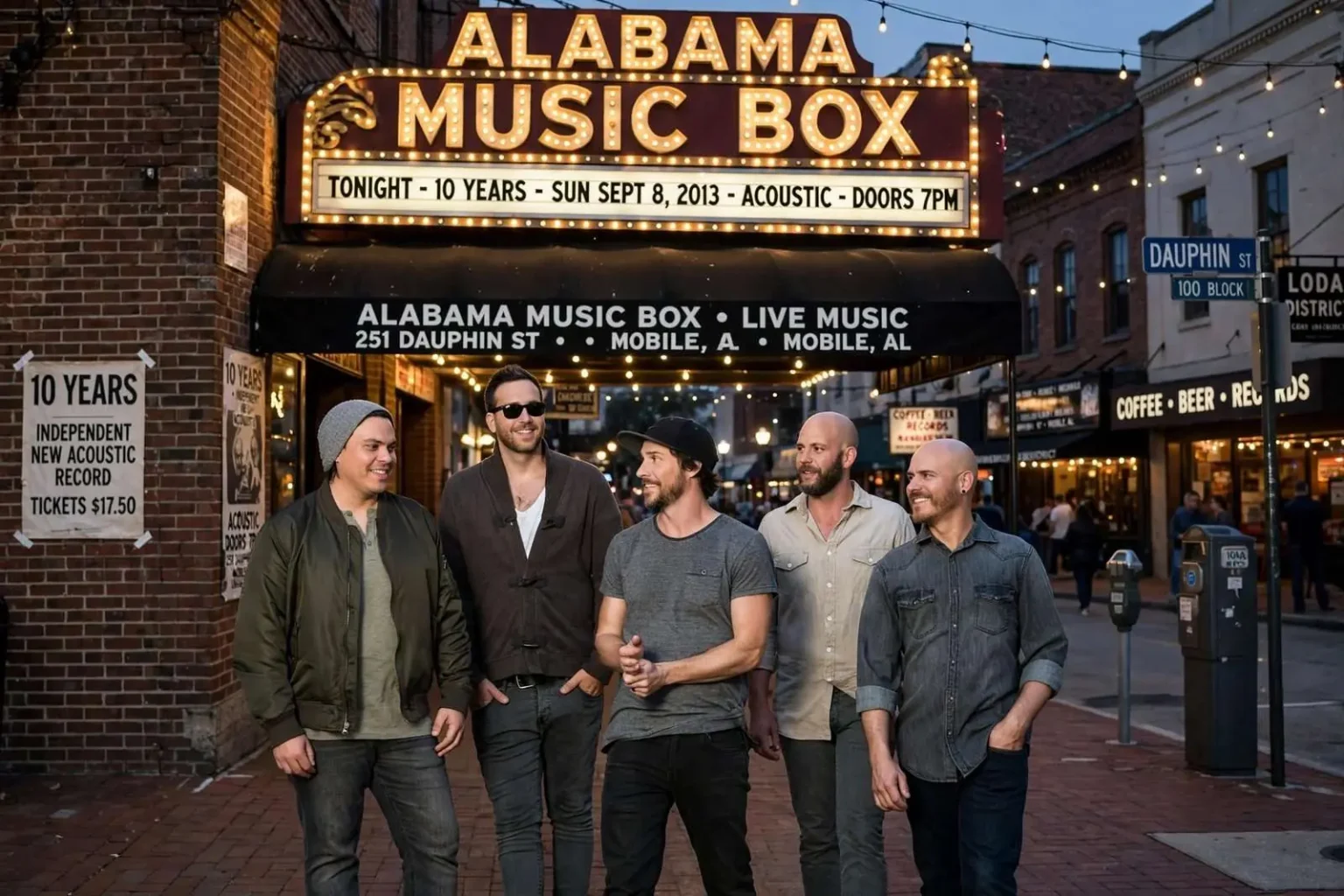
MOBILE, Ala. — Knoxville, Tenn., rock band 10 Years brings its distinctive sound to the Alabama Music Box in Mobile on Sunday, Sept. 8, 2013. The group made crossover waves with its 2005 hit “Wasteland” and has stayed close to its Southern roots ever since, and its stop in Mobile lands at a moment when the band is charting its own course through the music business — on its own label, on its own schedule, and on its own terms.
For a band that spent its formative years inside the major-label machine, the independent path has changed how 10 Years writes, records, and tours. The Mobile show offers local fans a chance to see that evolution up close in one of downtown’s most beloved independent venues, and it doubles as a showcase for the band’s newest material, an acoustic recording that marks a turn even longtime listeners may not expect.
From “Wasteland” to Working Without a Net
10 Years broke through nationally with “Wasteland,” a track from its 2005 major-label debut era that crossed over from active rock radio into broader success and made the Knoxville band a fixture of mid-2000s rock. The song’s blend of melody and heaviness became the band’s calling card, and it carried the group through years of touring that included major festivals and arena support slots. But crossover success on a major label came with the usual trade-offs: budget meetings, release schedules, and creative decisions made by committee.
After five years on a major label, 10 Years struck out independently with Pale Horse Records, an imprint the band controls itself. The move followed a period in which the members watched the industry shift beneath their feet and decided that staying on the label path was no longer worth the cost. “We couldn’t continue on that label path when rock music isn’t really a priority for the bigger labels,” drummer and guitarist Brian Vodinh said. “We wanted to take our business into our own hands.”
Vodinh’s blunt assessment reflected a reality much of the rock world had come to accept by 2013. The major labels that once pushed guitar-driven bands to multi-platinum sales had redirected their attention toward pop, hip-hop, and electronic music, leaving veteran rock acts to fend for themselves on shrinking promotion budgets. For a band like 10 Years — with a loyal national fanbase, a decade of touring experience, and a clear artistic identity — the arithmetic of independence had flipped. The same fans who bought their records would now fund them directly, and the band would keep both the profits and the control.
This fall marks the band’s second independent release, an acoustic recording that follows its aptly titled first indie effort, “Minus the Machine.” The title of that 2012 album was as much mission statement as wordplay: the machine in question was the record industry itself, and the record proved the band could make compelling music without it.
The band’s journey to that point had been a textbook mid-2000s rock story. Formed in Knoxville, a city better known for its bluegrass and indie scenes than for hard rock, the group ground through the regional club circuit before the major-label era arrived. When “Wasteland” hit, it did so with unusual staying power, remaining on rock charts long enough to become one of the defining singles of its year and to keep the band on the road for years afterward. That kind of song changes a band’s life — it brings the tours, the festival slots, and the audience — but it also binds a band to the expectations and accounting of the label that paid for it.
Building in the Studio
Vodinh also produces the band through his own Kashmir Recording studio, a role that grew naturally from his engineering background. Working without a major-label clock, the members recorded more freely and captured the songs they wanted rather than cherry-picking only album tracks. In the old model, studio time was budgeted by the day and every hour of overtime was a negotiation with an accountants’ department; in the new model, the band answers only to itself.
That freedom has practical artistic consequences. Songs can sit and breathe. Arrangements can be revised weeks later without anyone asking what the delay costs. Ideas that a label would have vetoed as “not a single” can be recorded anyway, because the people deciding are the four or five men who wrote them. Vodinh’s production role closes the loop even further — the same person who drums and plays guitar in the band also sits behind the console, shaping the sound from the first take to the final master.
For the band’s fans, the results have been a deepening of the 10 Years sound rather than a departure from it. The acoustic project takes songs and new material into more intimate territory, foregrounding melody and voice over the layers of guitar that define the band’s electric records. Stripping songs down is also a practical bet on the modern touring economy: acoustic material travels well, works in smaller rooms, and gives fans who have seen the electric show several times a reason to come back.
A Fitting Room in Mobile
The choice of the independent Alabama Music Box felt fitting for a newly independent band. “I believe in businesses like that, and I love hearing when independents are thriving,” Vodinh said. The venue has become one of downtown Mobile’s signature music rooms, part of the Dauphin Street entertainment corridor that has anchored the city’s nightlife for decades. Independent clubs like the Music Box occupy a fragile but essential place in the touring ecosystem — they are the rooms where mid-level bands build their audiences and where fans can see national acts within arm’s reach of the stage.
Mobile’s downtown music scene had been on an upswing in the years leading up to 2013, with the LoDa district’s bars and venues drawing crowds from across the Gulf Coast. For touring bands, the city sits conveniently along the Interstate 10 corridor between New Orleans and the Florida Panhandle, making it a natural stop on Southeast runs. For local fans, a Sunday-night show at the Music Box carries the particular pleasure of seeing a band that once headlined theaters and festivals in a room small enough to hear the vocals unplugged.
Venue and band, in other words, were telling the same story from opposite ends. The Music Box’s owners had built a room that national acts want to play in a city big enough to fill it, while 10 Years had built a career that no longer required permission from anyone in New York or Los Angeles. A Sunday night in Mobile put those two independent projects on the same stage, which is roughly how the music business is supposed to work — artist to audience, room to city, with nobody in between.
What Fans Can Expect
The Sept. 8 show gives Mobilians a look at a band in its second act. Listeners can expect the familiar catalog — “Wasteland” chief among it, the song that remains the band’s signature — alongside material from the independent era, including the acoustic work that prompted the tour. The band’s Knoxville roots and Southern sensibility have always played well on the Gulf Coast, where audiences have followed 10 Years since the mid-2000s radio days.
Tickets are $17.50 online, a price point that reflects the economics of independent touring. Without label support, bands at this level depend on door receipts and merchandise, and fans who buy tickets in advance do more than guarantee entry — they fund the next record. It is a shorter loop than the old industry model, and by all accounts from the band’s perspective, a healthier one.
The evening also carries a small local lesson about the music economy Vodinh described. Every independent venue that survives, like every independent band that thrives, strengthens the network that lets original music reach cities like Mobile without passing through corporate filters. When a band that once rode a major label chooses to play a room like the Alabama Music Box and calls it a fitting choice, it is both a booking and an endorsement — of the venue, of the district it anchors, and of the idea that the music business works best when the people who make the music own more of it.
Doors opened on a Sunday night in a city that has long loved its live music, for a band that bet on itself and won the chance to keep playing. For Mobilians, the math was simple: $17.50, one night, and a national act close enough to touch. For 10 Years, it was one more show in a career that now belongs entirely to the people who built it.