
Baldwin County Commission Democrat Roy Browning Confirms He Dropped Out of Race Months Ago
Baldwin County Commission candidate Roy Browning says he told local Democratic Party leaders in March he was dropping out of the race.
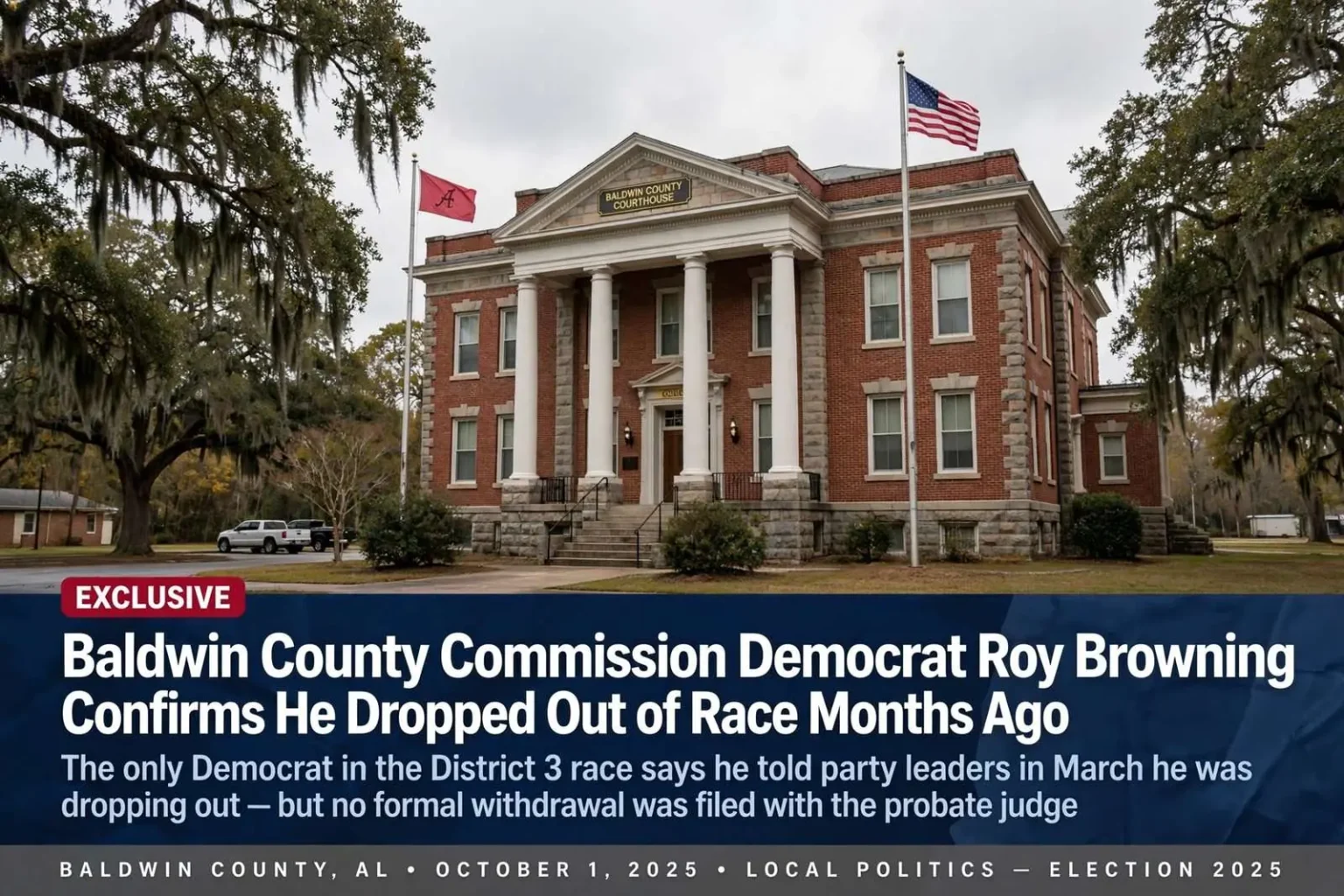
BALDWIN COUNTY, Ala. — The only Democrat running for the Baldwin County Commission this year says he told party leaders in March he was dropping out of the race — but no one notified election officials until this week.
What Browning Told Party Leaders
Baldwin County Commission District 3 candidate Roy Browning said Tuesday he informed Baldwin County Democratic Party Chairman John Sloan of his decision well before the May 19 primary. “It was around March when I actually had a conversation with him, and then there’s been no type of correspondence with him since then,” Browning said, adding that Sloan told him he would check with Baldwin County Probate Judge Harry D’Olive and get back to him, and that was the last time the two spoke. Browning said his decision stemmed partly from turmoil within the party and several personal reasons, as well as from being told he would receive campaign fund assistance from the party that never materialized. “I’m not in a position to finance this,” he said. “It’s just not a thing where I would be able to take on the role and to efficiently serve the community.”
Browning’s withdrawal, if it becomes official, would mark the second time this cycle that a Baldwin County Democratic candidate has exited a countywide race. Earlier in the year, Drew Arredondo stepped away from the District 4 commission contest, leaving Republican incumbents in both districts unopposed by any Democratic nominee. Browning’s name remained on the ballot that voters saw in the May 19 primary, and the question of whether he would appear on the Nov. 3 general election ballot remained unresolved as of Tuesday.
What the Party Chairman Says
Sloan said he sent Browning the documents needed to formally withdraw his name with the probate judge’s office last spring, but Browning never turned them in. “Roy indicated back in March or April that he was not going to go forward, and I then spent a month asking him, telling him, actually giving him the necessary letter to send to the probate judge to withdraw his name,” Sloan said. “That was not my responsibility. That was his responsibility. So, if he didn’t do it, then he didn’t do it.” Sloan, who took over as party chairman after predecessor Robyn Monaghan left to work on Doug Jones’ gubernatorial campaign, said campaign funds had been available to Browning before he announced his intention to drop out: “If you drop out, you’re not going to get any financial assistance.”
Sloan’s account of the timeline differs from Browning’s chiefly in the question of who was supposed to file the formal paperwork with the probate court. In Alabama, a candidate who wishes to withdraw from a general election race must submit a written, signed request to the appropriate probate judge before the ballot is certified. Sloan said he provided the letter and waited for Browning to return it. Browning said the conversation never produced a follow-up.
What the Probate Judge Says
D’Olive said his office should have received formal notice from the Democratic Party but was unaware, as of Tuesday, that any had been sent, and it remained unclear whether Browning’s name would still appear on the Nov. 3 general election ballot. In Alabama, once the probate judge has certified a name to the ballot, removing it requires the candidate’s own written and signed request. The judge has no authority to drop a name unilaterally on the strength of a party chairman’s word alone. The Alabama Attorney General’s Office, asked whether Browning would still appear on the November ballot, did not respond to a request for comment.
What the Republican Incumbent Says
Browning is the second Baldwin County Democrat this year to back out of a county race, following Drew Arredondo’s earlier withdrawal from the District 4 race; both departures leave Republican incumbent Commissioner Billie Jo Underwood positioned to win District 3 unopposed. Underwood declined to comment on Browning’s situation directly. “I really don’t think it’s appropriate for me to comment on something I haven’t independently confirmed,” she said. “If my opponent has decided to withdraw, that’s his decision, and I’ll respect it. Until there’s an official confirmation, I’m going to stay focused on doing my job and serving the people of Baldwin County. I just run my race whether I have an opponent or not. That’s what I do … I don’t even really know my opponent.”
The Baldwin County Commission and How Its Districts Are Drawn
Baldwin County, the largest county in Alabama by land area, is governed by a four-member county commission whose members are elected from single-member districts. The District 3 seat currently held by Underwood covers a portion of the county that includes fast-growing residential and commercial corridors east of Mobile Bay. The commission sets the county’s operating budget, oversees the Baldwin County Sheriff’s Office and county road programs, and makes appointments to a long list of boards and authorities that administer public services from garbage collection to mental health.
Baldwin County’s population has grown sharply over the past two decades as commuters, retirees and second-home owners have moved to the Eastern Shore and the Gulf beaches. That growth has changed the political geography of the county, especially in commission districts that include the fastest-growing suburbs. Republican candidates have dominated Baldwin County’s commission and countywide offices in recent election cycles, and the practical effect of two Democratic withdrawals has been to remove contested races from ballots where Democrats had hoped to field at least nominal opposition.
What Happens Next With the Ballot
Under Alabama election law, a candidate’s name may be removed from a general election ballot after certification only if the candidate personally files a signed, notarized request to withdraw. A party chairman’s statement that a candidate intended to drop out is not, by itself, sufficient. That procedural requirement is what makes the question of whether Browning’s name stays on the Nov. 3 ballot dependent on what paperwork, if any, crosses Harry D’Olive’s desk in the days ahead. Local probate offices typically publish a final certified ballot well in advance of the election, and any withdrawal must be completed before that certification deadline.
Even if Browning’s name remains, the absence of any active campaigning in District 3 means Republican incumbent Billie Jo Underwood is positioned to win the seat without organized opposition. Underwood, who has represented the district since being elected to the commission, has focused her public work on infrastructure, drainage and coastal resilience issues affecting the communities along the eastern shore of Mobile Bay.
What the Finance Reports Showed
Campaign finance filings underline how one-sided the contest had become. Browning had reported no contributions or spending of any kind since qualifying for the race in January, according to Secretary of State records. Underwood, who won the May 19 Republican primary with roughly 57 percent of the vote over former Summerdale Police Chief Kevin Brock and Philip Dembowski, had raised $55,305 by that primary, a total bolstered by more than $30,000 carried over from previous election cycles, and had spent more than $60,000. She reported no contributions since the primary through the most recent state reporting deadline.
Her donor list leaned on political action committees and businesses. Barber Marina Inc., an Elberta boat dealer, gave $10,000 in July 2025, the largest single contribution of the cycle. The Montgomery-based Alabama Realtors Association added $5,000, the Adams and Reese PAC contributed $2,500, and BSS of Mississippi, a Ridgeland, Mississippi, government affairs firm, gave $2,000. For the Nov. 3 general election, absentee ballot applications are due by mail on Oct. 27 or in person by Oct. 29.
Why the Matter Matters Locally
Although the dispute is a small one in raw political terms, it raises questions that residents in any Alabama county can recognize. Who is responsible for making sure a candidate’s stated intention to withdraw becomes a formal change on the ballot? The candidate, the party, the probate judge, or all three? The answer, under state law, is clear: the burden falls on the candidate. The case in Baldwin County is a reminder that what is said in a private conversation between a candidate and a party chairman does not, by itself, change the ballot that voters will see.
For voters in District 3, the practical question over the coming days is whether Browning’s name will appear on the Nov. 3 ballot. The probate judge’s office said Tuesday it had not received formal notice, and it remained unclear whether such notice would arrive in time to be acted on before the next certification deadline.
Background on Baldwin County Politics
Baldwin County sits on the eastern shore of Mobile Bay and stretches south to the Gulf of Mexico. It is one of the fastest-growing counties in Alabama, with population gains driven by retirees moving to the coastal communities, families seeking the schools along the Eastern Shore, and commuters willing to trade a longer drive for lower housing costs than they can find across the bay in Mobile. The county’s politics have shifted in step with that growth, with Republican candidates dominating countywide offices, including the commission, the sheriff and the probate judge.
The Baldwin County Democratic Party, which John Sloan now chairs, has worked to recruit candidates for local offices in a county where Democrats have struggled to mount competitive campaigns. The party invested modest resources in local races this cycle, including Browning’s District 3 campaign and Arredondo’s District 4 race, both of which are now without an active Democratic candidate. The withdrawal of two candidates in a single cycle has complicated the party’s effort to maintain a visible presence on local ballots even in races it is not favored to win.
Sloan took over as party chairman after Robyn Monaghan stepped aside to work on Doug Jones’ gubernatorial campaign, a transition that put Sloan in charge of coordinating with both the probate judge and the local Democratic candidates during a busy election year. The arrangement between Browning and Sloan — a private conversation followed by what both sides describe as a months-long absence of follow-up — illustrates how thin the local Democratic infrastructure can be when the party’s statewide energy is directed elsewhere.
Locally, the District 3 race is unlikely to change the composition of the Baldwin County Commission regardless of how the withdrawal paperwork resolves itself. Underwood, the Republican incumbent, has won her previous races comfortably, and the district’s voter registration numbers have favored the GOP for years. But the procedural question of whether Browning’s name stays on the ballot is one that election administrators will need to resolve cleanly, both for the integrity of the November ballot and to avoid the kind of confusion that arises when a candidate’s intentions and the formal paperwork are not in sync.