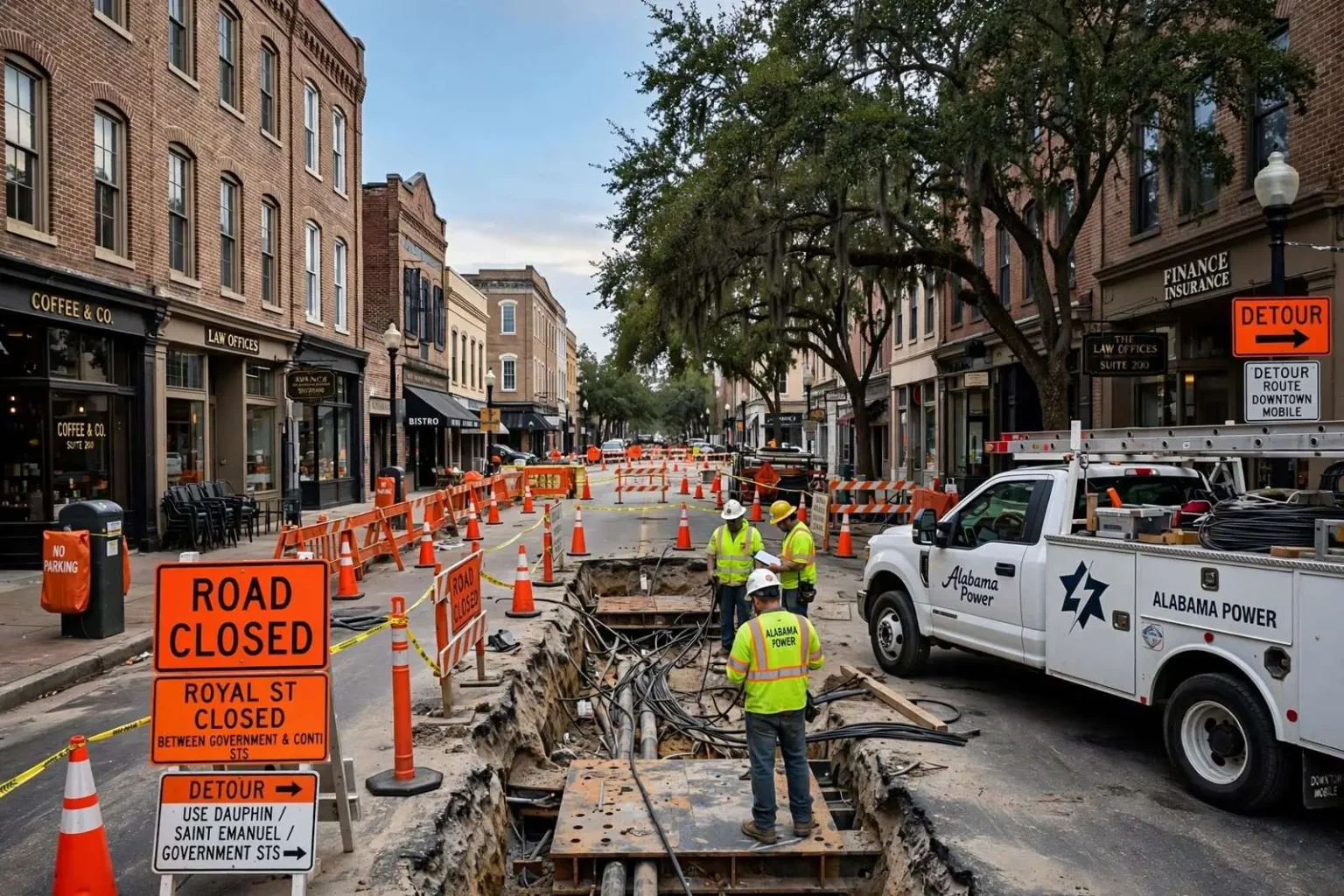
MOBILE, Ala. — Royal Street is closed between Government and Conti streets for the next two to three weeks as Alabama Power carries out electrical upgrades in downtown Mobile, a disruption that utility officials describe as an investment in the reliability of the city’s oldest commercial district.
Alabama Power said the work is being done underground, replacing pipes and cables that have served the downtown grid for decades. While the area is closed, drivers can detour using Dauphin, Saint Emanuel and Government streets, which bracket the work zone on the street grid just blocks from Mobile’s riverfront.
Officials said the current system is several decades old, and the upgrades will mean fewer outages and a better experience for the people who live, work, and spend time downtown. Beth Thomas with Alabama Power described the project as part of a five-year upgrade plan for the downtown area that began in 2018 and is about halfway complete.
“The goal is to provide downtown with more reliable electric service for the future,” Thomas said.
Royal Street’s place in downtown Mobile
Royal Street runs through the heart of Mobile’s historic business district, a corridor of older commercial buildings that stretches south from Government Street toward the Congo Street area and the edges of the Lower Dauphin and Bienville Square neighborhoods. The blocks between Government and Conti carry office traffic, restaurant customers, and visitors moving between downtown landmarks, and the street’s narrow width and mature tree cover make it one of the more recognizable stretches of the district.
The closure between two of downtown’s principal east-west streets interrupts a route that many drivers use without thinking — one block over from Dauphin Street, the district’s main entertainment corridor, and a block of Royal Street lined with businesses whose customers now face a short walk from detour parking. Two to three weeks is a long closure by downtown standards, but city and utility officials coordinate such projects to keep them concentrated and completed rather than drawn out in repeated lane restrictions.
For the businesses inside the work zone, the practical concerns are familiar to any commercial district that hosts infrastructure work: access for customers, signage that makes clear the doors are open, and deliveries that can still get through. Cities and utilities typically work with merchants during underground projects to maintain pedestrian access and keep interruption of individual service connections as brief as possible.
Why the work is underground
Undergrounding electrical distribution is the most disruptive and most expensive way to upgrade a grid, and utilities choose it for exactly the reasons Alabama Power cites. Overhead lines on poles are cheaper to build and repair but are exposed to weather — wind, falling limbs, and hurricane-force gusts that snap poles and drop lines across streets. Underground cable avoids most storm exposure, and in a Gulf Coast city that sits squarely in hurricane territory, the resilience argument carries weight.
The tradeoff is access. When underground cable fails or needs replacement, crews must open trenches or use vaults and duct banks to reach it, which is why the Royal Street project requires a full closure rather than a lane restriction. Replacing pipes and cables in a downtown corridor means cutting pavement, managing traffic around open work, and restoring the street surface afterward.
The reference to replacing pipes as well as cables reflects the way utilities bundle downtown work. Aging duct systems, conduits, and associated infrastructure often get replaced alongside the electrical cable itself, since opening the street once and doing the full job is far cheaper for customers than returning repeatedly for separate projects.
A five-year plan at the halfway mark
The Royal Street project is one element of the five-year upgrade plan Alabama Power began downtown in 2018. Roughly at the halfway point, the plan has been working through the downtown grid section by section, targeting the oldest segments of a system whose parts, by the utility’s own description, are several decades old.
That age matters in ways residents see mostly during outages. Distribution equipment — transformers, switchgear, cable, connectors — degrades with time and heat, and in a downtown with hundreds of buildings served by a dense network of underground and overhead infrastructure, failures concentrate where the equipment is oldest. Utilities typically plan systematic replacement ahead of the failure curve, because planned replacement is cheaper, faster, and far less disruptive than emergency repair.
For Alabama Power, a utility that serves more than a million customers across the southern half of Alabama and maintains its Mobile Division operations in the city, downtown Mobile represents a special case. The concentration of government offices, courts, banks, restaurants, and event venues — plus the convention center and the hotels that support it — makes downtown reliability a business issue as much as a residential one. An outage downtown stops more transactions per block than an outage almost anywhere else in the service territory.
The halfway status also sets expectations for what comes next. If the plan’s remaining years follow the pattern, additional downtown corridors will see similar closures and detours as crews reach them, with the utility staging work to spread the disruption across the calendar and avoid stacking projects in the same blocks.
What reliability means for downtown
The improvements, in Thomas’s description, are aimed at fewer outages and a better experience downtown. That phrase covers more than the absence of blackouts. Reliable service shapes how businesses operate — restaurants with refrigeration and kitchen equipment, offices with server rooms, retail shops with point-of-sale systems — and how confidently new businesses choose downtown locations over newer buildings on the city’s outskirts.
Downtown Mobile has been the focus of public and private reinvestment for years, from the preservation of historic commercial buildings to the growth of the Dauphin Street entertainment corridor and the events calendar that fills Bienville Square and the surrounding blocks. Each reinvestment adds customers and expectations to the electrical grid underneath, and utilities that serve revitalizing downtowns face the same choice Mobile’s does: rebuild ahead of demand or chase failures after the fact.
Short of major upgrades, the consequences of an aging grid show up as flickers, momentary interruptions, and outage events that individual businesses absorb as lost product and lost hours. Systematic replacement, done in phases like this one, is the alternative — costlier per project, but spread out and predictable.
Underground projects of this kind also carry coordination requirements most residents never see. Crews work around existing utilities sharing the same right of way — gas lines, telecommunications conduit, water and sewer mains — and each excavation requires locating and protecting those facilities before digging proceeds. Scheduling between the utility, city public works, and the contractors doing the trenching is often what determines whether a two-to-three-week estimate holds or slips, which is another reason utilities concentrate their downtown work in defined corridors like this one.
Getting around the closure
The detour routes — Dauphin, Saint Emanuel and Government streets — form the natural frame around the closed block, and drivers crossing downtown during the work period will find the signed detours shorter than they might expect. Downtown Mobile’s compact grid, laid out in the 19th century with closely spaced streets, gives closures like this one more alternative routes than a suburban arterial would offer.
Dauphin Street, one block north of Royal, handles the heaviest share of detour traffic and is itself the district’s best-known strip of restaurants and bars. Saint Emanuel Street, a block east, and Government Street, the corridor that defines the southern edge of the historic district at its western end, absorb the remainder. Motorists approaching from the east and west on Government will see the closure signs ahead of the intersection, and local drivers who know the grid have been taking the parallel blocks since the closure began.
City officials’ advice during such closures is consistent: allow a few extra minutes, follow the posted detours rather than improvising through alleys, and pay attention to the workers and equipment inside the work zone. Construction zones in downtown settings put crews within feet of live traffic, and the two- to three-week timeline reflects not only the underground work itself but the restoration of the street surface afterward.
Part of a longer story
Projects like the Royal Street closure rarely make headlines on their own, but they mark the physical upkeep that keeps a downtown functioning — work that becomes visible only when a street closes or the power fails. Alabama Power’s five-year plan is the utility’s answer to a system built for the downtown of several decades ago, applied block by block while the city above it goes about its business.
The halfway point of that plan means residents and business owners downtown should expect more of what Royal Street is experiencing: periodic closures, detour signs, and crews in trenches, followed by quieter streets and, in the utility’s framing, a grid built for the decades ahead.
When the work between Government and Conti is finished and the street reopens, the change will be invisible — new cable and conduit beneath restored pavement. The difference, if the project delivers what officials promise, will show up on the hottest afternoons of the next hurricane season, when downtown’s lights stay on and its buildings keep running through weather that once tested the old system to its limits.