Salads at Satori: A West Mobile Coffee House’s Fresh Take on Lunch
Satori Coffee House, at 5460 Old Shell Rd. beside the University of South Alabama, has long been a favorite study and coffee spot for students and.
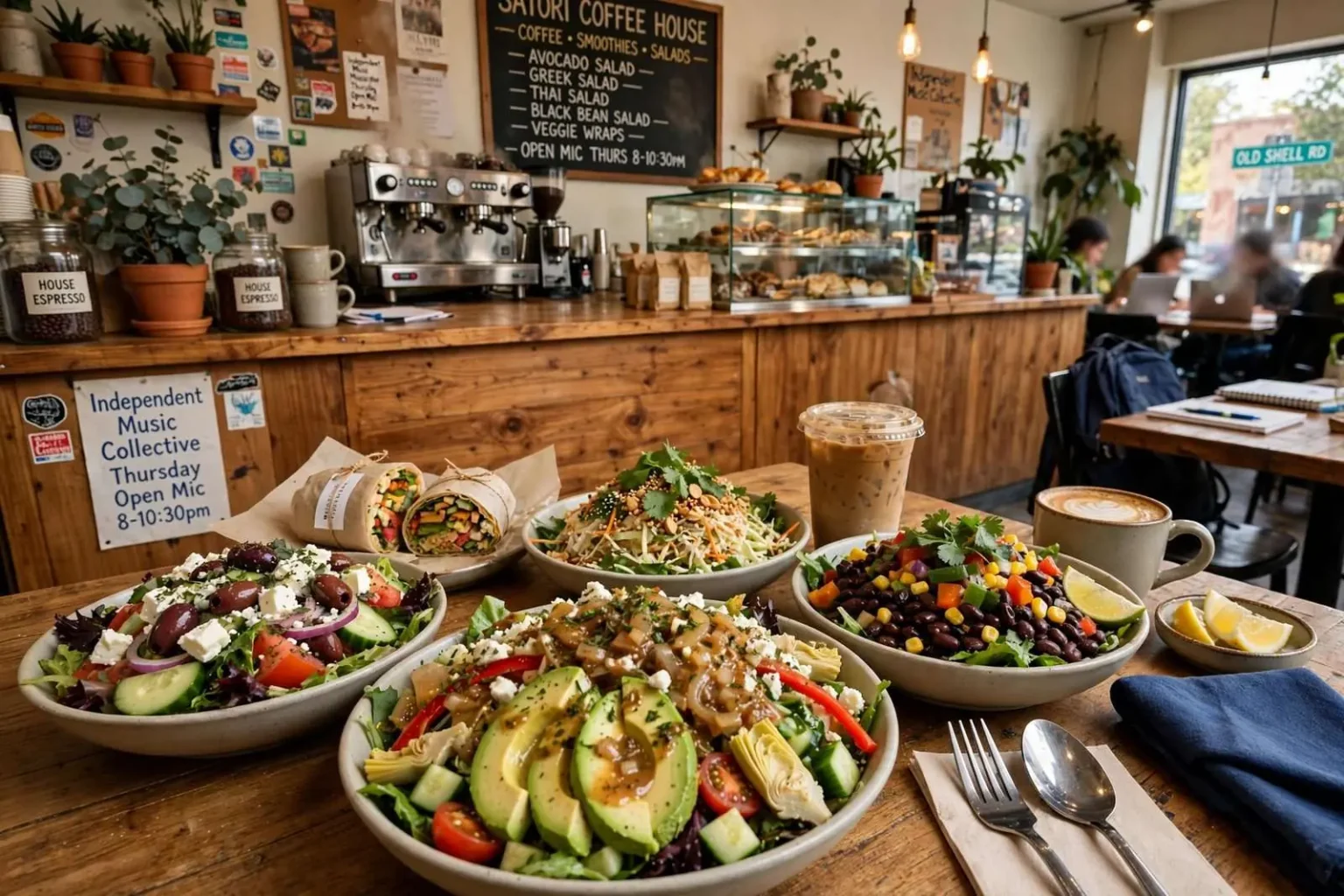
Satori Coffee House, at 5460 Old Shell Rd. beside the University of South Alabama, has long been a favorite study and coffee spot for students and neighbors. But beyond espresso, smoothies and a rotating indie soundtrack, the West Mobile cafe has built a quiet reputation for something less expected from a coffee shop: genuinely good food — especially its salads.
The location is half the story. Sitting directly beside the USA campus, Satori absorbs the daily traffic of students carrying backpacks and laptops, professors escaping offices for an afternoon cup, and neighbors from the surrounding streets who treat the shop as their living room. Old Shell Road is one of Mobile’s classic commercial corridors, and the strip near campus has long supported the kind of independent businesses that give a college neighborhood its character.
Walk in during a semester week and the scene is the one regulars describe: laptops open at the tables, espresso machine hissing, smoothie blenders running between songs from the shop’s independent playlist. It is an atmosphere that corporate chains spend marketing budgets trying to imitate and rarely capture, because it grew organically from the shop’s place in the neighborhood rather than from a template.
Owner Chuck Cox said running an independent Mobile business is challenging but rewarding, thanks to the relationships formed with regulars. That is the quiet truth of neighborhood coffee: the product brings people in the door once, but the relationships — knowing the order, holding the usual table, asking about the semester — are what keep them coming back for years.
Barista Joshua Plummer praised the close-knit, non-corporate feel of the job. In a city where national chains line every major corridor, working at an independent shop means being part of a small crew that makes its own decisions, learns the customers’ names and has a stake in the place’s identity — a working experience the chain model, by design, does not offer.
That independence shows up most clearly in the food case. Rather than the packaged sandwiches and shrink-wrapped snacks that carry most coffee shops through the lunch rush, Satori has put real effort into a menu of fresh, made-in-house salads that have earned a following of their own.
Beyond Iceberg
The salads are anything but the usual refrigerated iceberg with cheddar and a ranch packet. The headliner is the Avocado Salad, which pairs fresh greens with avocado, cucumber, tomato, peppers, artichoke and feta, finished with a sweet Vidalia onion dressing. It is a construction that reads more like a bistro plate than a coffee shop special — the kind of salad that justifies a trip on its own merits.
The avocado does the heavy lifting that makes the salad a meal: creamy, substantial and rich enough to stand up to the sharper notes of feta and pepper. The artichoke adds a brined, savory depth, the cucumber and tomato bring freshness, and the Vidalia onion dressing — built on Georgia’s famously sweet onion — ties the plate together without the vinegary bite of a standard vinaigrette.
The Thai, Greek and Black Bean salads round out the vegetarian-friendly options, giving the menu genuine range rather than a single token meatless dish. The Greek leans on the Mediterranean combination the name promises — feta, vegetables, briny and bright. The Thai brings the sweet-heat-sour balance of Southeast Asian dressing to a fresh salad base. The Black Bean salad adds protein and heartiness, the choice for a customer who wants lunch to actually fill them up.
Alongside the salads, the shop serves a range of veggie wraps, extending the same fresh-food philosophy to the handheld end of the menu. For a campus crowd that includes plenty of vegetarians and plenty of students looking for something better than fast food between classes, the combination covers real ground.
The broader point is what the menu says about the shop’s ambitions. Coffee is the anchor — the espresso program, the smoothies, the afternoon refills — but the food case turns Satori from a place to grab a cup into a place to spend a lunch hour, and that is a meaningful difference in a neighborhood full of options.
A Gathering Place
Satori also serves as a hub for like-minded locals. The Independent Music Collective, a USA campus organization, hosts performances there, and Thursday Open Mic Night draws area musicians from 8 to 10:30 p.m. On those nights the coffee house becomes a small venue, and the stage — such as it is — has heard singer-songwriters, poets, acoustic bands and first-timers working up the nerve to play their first song in public.
Open mic nights occupy a special place in a music scene’s ecosystem. They are where young players get stage time, where songs get tested in front of a forgiving crowd, and where the connections form that later become bands. By hosting a standing Thursday night session, Satori functions as an incubator for the local scene — a role that costs the shop little and gives the neighborhood an amenity no chain would ever provide.
The Independent Music Collective’s partnership works the same way from the campus side. Student organizations need venues, and independent businesses need programming; when the two align, the result is the kind of community infrastructure that makes a college neighborhood feel like a place rather than a corridor. Performances at the shop give student musicians an audience beyond the dorms and give non-students a reason to discover local acts.
That gathering-place function is the invisible half of Satori’s business model. The espresso and the salads pay the bills, but the open mics, the club meetings and the daily table of regulars are what make the shop irreplaceable to the people who use it — and what make it resistant to the chain competition that can undercut any single product on the menu.
The same logic explains why the shop’s reputation travels by word of mouth rather than advertising. A student who discovers Satori in freshman year tells a roommate, who brings a study group, whose members graduate and keep coming back when they are in the neighborhood. Over years, that chain of recommendations becomes the shop’s customer base — steadier and more loyal than anything a promotion could buy, and built entirely on the experience walking through the door.
For Mobilians choosing local over corporate chains, Satori offers a uniquely Mobile experience — and a genuinely good lunch. The combination of serious coffee, fresh salads, campus adjacency and a live music calendar has few parallels in the city, and it explains how an independent shop holds its own beside a university for years on end.
Old Shell Road’s Independent Streak
The stretch of Old Shell Road near the University of South Alabama has long been home to independent businesses serving the campus crowd — bookshops, restaurants, bars and coffee houses that come and go with the decades. Survival in that ecosystem is its own achievement; the businesses that last are the ones that become institutions, woven into students’ memories and neighbors’ routines.
Satori’s approach to longevity has been to do several things well rather than one thing adequately: coffee that stands on its own, smoothies for the after-gym and between-class crowd, a food menu good enough to build a lunch reputation, and a space that earns loyalty by hosting the neighborhood’s cultural life. Each element reinforces the others, and together they give the shop a resilience that a single-product cafe rarely achieves.
The economics of independent coffee are unforgiving — thin margins, chain competition on every corner and rising costs — which is why owners like Cox describe the work as challenging. The reward side of the ledger is less quantifiable: a shop that knows its regulars by name, a staff that treats the job as a craft, and a wall of memories from years of open mic nights, study sessions and afternoon conversations.
For the University of South Alabama community, the shop’s presence just off campus rounds out the neighborhood. Students need a third place — not home, not class — where they can think, work and be around other people, and the university district is stronger when that place is local.
A Visit Worth Making
Anyone who has dismissed coffee shop food as an afterthought owes the salads a try. The Avocado Salad alone makes the case, and the Thai, Greek and Black Bean options give every palate in a group something to order. Add an espresso or a smoothie, and the visit covers both halves of the shop’s reputation in one sitting.
Thursday evenings, the recommendation changes: come for the open mic, order anything, and plan to stay. From 8 to 10:30 p.m. the shop belongs to the musicians, and the audience gets a tour of the local scene for the price of a cup of coffee — one more reason the unassuming spot on Old Shell Road keeps earning its place in Mobile’s independent landscape.