
Sandy Stimpson Laid Out His Vision for Mobile in 2013 Mayoral Bid
In a 2013 interview, Mobile mayoral candidate Sandy Stimpson outlined his platform on public safety, small business and downtown revitalization.
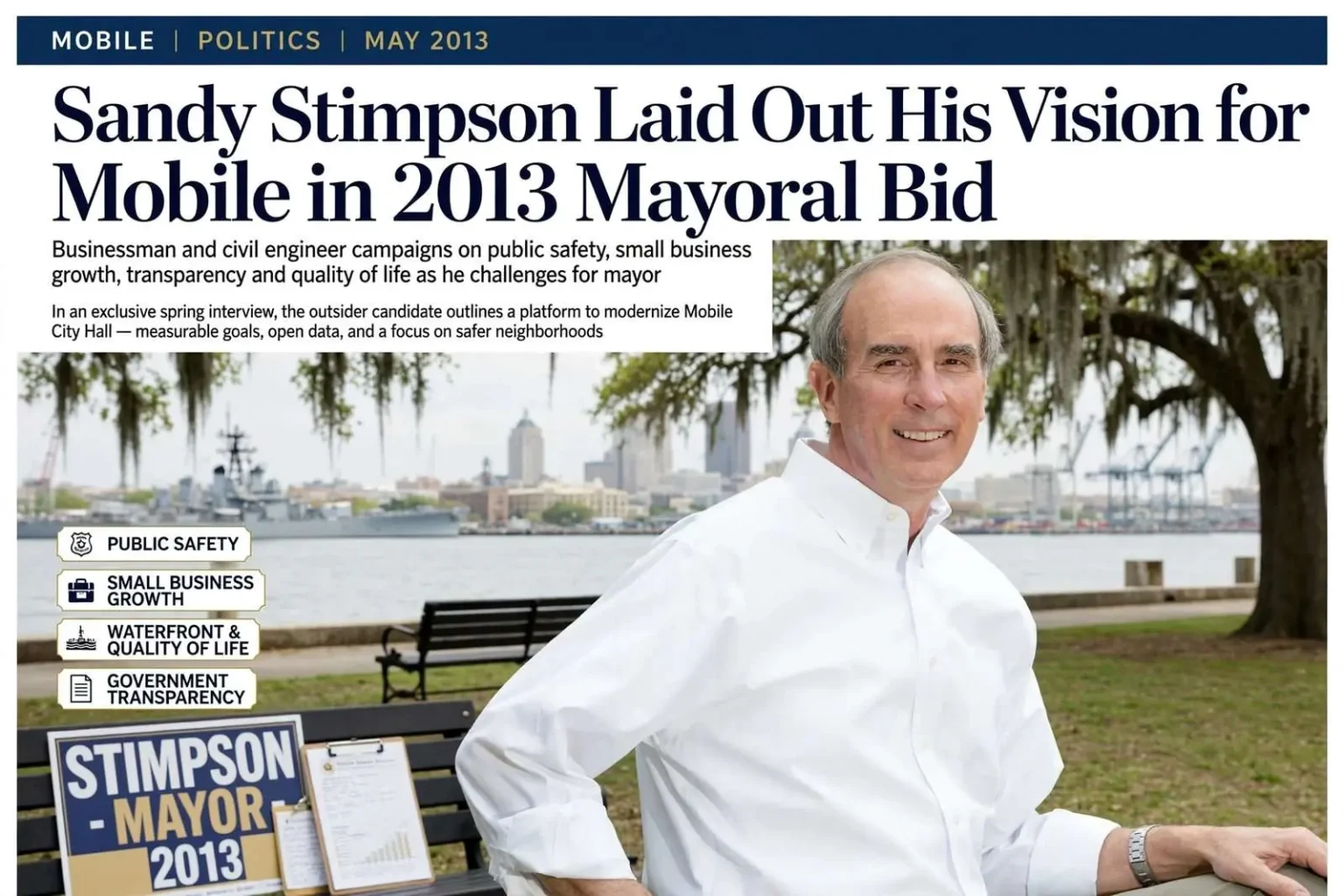
In the spring of 2013, Mobile businessman Sandy Stimpson sat down for an in-depth interview as he campaigned to become the next mayor of Mobile, Alabama. A civil engineering graduate and longtime chief financial officer, Stimpson presented himself as a fresh alternative to the city’s existing leadership, outlining an ambitious platform built around public safety, small business growth, quality of life, and government transparency. The interview, conducted while the campaign was still taking shape, captured the arguments he would carry through the summer and into the August election — arguments about what kind of city Mobile was becoming and who should be steering it.
Stimpson entered the race from outside elected politics, a position he framed as an asset rather than a liability. After a career spent managing budgets, projects and operations in the private sector, he pitched voters on the idea that city government could be run with the same discipline: measurable goals, accountable departments, and a mayor who treated taxpayer money as an investment to be managed rather than a resource to be allocated by habit. The framing resonated in a city where frustration with the pace of progress had been building for years, and it set up the central question of the campaign — whether Mobile’s problems were failures of vision or failures of execution.
A Call for New Leadership
Stimpson said he entered the race because he could no longer stand on the sidelines while other cities appeared to be moving forward more quickly than Mobile. He spoke of an “unprecedented opportunity” and said too many residents who wanted to participate in shaping the city’s future had been left out of the process. The comparison cities he had in mind were the region’s peers — places like Huntsville, Nashville and Baton Rouge — that were visibly converting economic development into new neighborhoods, restored parks and growing tax bases while Mobile’s downtown and neighborhoods struggled through the aftermath of the recession.
“There are people who wanted to be engaged that were not at the table,” Stimpson said. “And so I decided to weigh in.”
The exclusion he described was partly procedural — residents who showed up to council meetings or planning hearings feeling their input changed nothing — and partly cultural, a sense that city hall made decisions for neighborhoods rather than with them. His answer was to promise a more open operation: public dashboards for city performance, straightforward communication from departments, and a mayor’s office that answered questions rather than deflecting them. In 2013 those commitments sounded modest; in retrospect they became the signature of how his administration would distinguish itself from the one it replaced.
Public Safety as the Top Priority
Stimpson identified public safety as the foremost concern of Mobile residents. He argued that when citizens do not feel safe, they add locks, install alarm systems, stop going out, and eventually leave the community altogether. The sequence he described was not rhetorical flourish; it tracked what demographers and police analysts had documented in cities across the South through that period, where crime perception drove residential decisions long before schools or taxes entered the calculus. Mobile’s homicide totals in the years preceding the campaign had been among the highest in its modern history, and neighborhood associations across the city — from Toulminville to Spring Hill to Tillman’s Corner — had made public safety their standing first item.
His proposed goal was bold: making Mobile the safest city in America. Setting that as the bar rather than a modest improvement target was itself a strategic choice, signaling that the administration would be judged on outcomes rather than activity. “You’re only going to do it by having a mayor that works with the police, gives them the tools and resources they need,” he said, adding that community action groups and faith-based organizations also had critical roles to play in reducing crime. The formulation reflected a two-track philosophy: the police department needed equipment, staffing and technology, but sustained crime reduction in a city Mobile’s size also required the neighborhood institutions — churches, block associations, mentoring programs — that could reach young people before arrests did.
That partnership language anticipated the approach Stimpson would take in office, pairing investment in the police department with visible cooperation between officers and community organizations. Mobile had a long tradition of both — strong police leadership and deep church networks — but the two had often operated on separate tracks, and the candidate’s argument was that the tracks had to converge.
Making Mobile Business-Friendly
While praising the city’s success in attracting large employers such as Airbus — whose announcement of a $600 million final assembly line at Brookley the year before had put Mobile on the global industrial map — Stimpson argued that Mobile had “absolutely strangled” small businesses and entrepreneurs with red tape. The contrast he drew was deliberate: the city could celebrate a landmark deal with a multinational manufacturer while a local restaurant owner still spent months navigating permits, inspections and approvals that competitors in neighboring jurisdictions did not face.
He said City Hall needed to make it easier for young college graduates and startup founders to launch businesses locally, rather than driving them to other cities. The argument rested on a simple demographic fact: Mobile was exporting its ambitious young people to Atlanta, Birmingham, Houston and beyond, and each departure weakened the customer base, the tax base and the civic energy the city needed to grow. Retention, in his framing, was an economic development strategy in its own right — cheaper and more durable than chasing the next big announcement.
“Time and time again I’ve had people say that they will never try to do business in the City of Mobile because of their interactions with city government,” he said, describing entrepreneurs who had been worn down by permitting processes they experienced as arbitrary and slow. The remedy he proposed was procedural: streamlined permitting, clear published timelines, a customer-service orientation inside the departments that touched businesses, and leadership that treated a small business owner as a client rather than an obstacle.
Quality of Life and the Case for Execution
The fourth pillar of Stimpson’s platform — quality of life — tied together the concerns that residents raised most often in neighborhood meetings: streets that had not been repaved in years, parks that had aged past their maintenance schedules, blighted structures that sat as constant invitations to vandalism, and a waterfront whose potential the city had talked about for decades without fully realizing. His argument was that none of these required exotic solutions, only consistent execution — and that execution was what the incumbent administration had failed to deliver.
He connected quality of life directly to the economic argument. Companies deciding where to locate look at schools, crime data and the condition of the public realm, and Mobile’s ability to build on the Airbus milestone depended on the city presenting itself as a place where engineers and their families wanted to live. A downtown with functioning streets, an active waterfront and safe neighborhoods was, in that framing, not an amenity but a competitive weapon in the fight for the aerospace supply chain and the other industries Mobile hoped to attract to Brookley and the port.
Transparency ran through all four pillars as the connective tissue. Stimpson argued that residents could not evaluate whether the city was improving unless the city published its own performance — response times, paving miles, permit turnaround, budget execution — and he promised to measure and disclose rather than defend. The promise drew on his private-sector background, where operational metrics were the standard language of management, and it implicitly criticized a city hall where progress was described in narratives rather than numbers.
The Campaign Context
Stimpson’s candidacy emerged in a Mobile that had been governed by Mayor Sam Jones since 2005, a tenure that spanned Hurricane Katrina recovery, the recession, and the Airbus announcement. Jones had presided over significant projects — the renovation of downtown’s historic core, new investment along the waterfront, the expansion of the cruise terminal — but by 2013 the city faced strained finances, persistent violent crime and neighborhoods that felt neglected while attention concentrated downtown. Challenger after challenger had tested that record in previous cycles; Stimpson’s candidacy was distinguished by the specificity of its operational critique.
The spring interview came as the field was forming, and Stimpson’s positioning — businessman, engineer, outsider — was calibrated for an electorate tired of institutional politics. He campaigned on walking neighborhoods block by block, attending association meetings across the city, and building the kind of ground-level familiarity that a first-time candidate needs to convert into votes in a mayor’s race that attracts a crowded field. His fundraising drew on the business community’s networks, which shared his frustration with permitting and saw in him an executive who would run the city like the enterprises they managed.
The arguments laid out that spring proved durable through the campaign’s final months: public safety first, small business relief, quality of life, transparency. Voters heard variations of them at every forum, and the incumbent’s response — defending the administration’s record while disputing the criticism — framed a clear choice about Mobile’s direction. When the August election arrived, Stimpson unseated Jones, winning on the strength of the coalition his platform had assembled: business leaders, neighborhood associations and residents who had concluded that a change in management was the change the city needed.
The Vision’s Afterlife
Looking back from the perspective of the administrations that followed, the 2013 platform reads as the founding document of a governing style that reshaped Mobile’s city hall. The transparency commitments became dashboards and open-data practices; the business-friendly argument produced permitting overhauls and a customer-service reorganization inside city departments; the public safety priority drove sustained investment in the police department and expanded cooperation with community and faith-based organizations; and the quality-of-life agenda surfaced in paving programs, park renovations and the multi-year effort to reconnect downtown to the Mobile River waterfront.
None of those outcomes was automatic, and each involved years of budgeting, hiring and political negotiation that no spring interview could capture. But the four pillars established in that 2013 campaign defined the metrics by which Stimpson’s mayoralty would be judged — and the fact that he was repeatedly re-elected afterward suggests the coalition that responded to those arguments held together as the promises were converted into programs. For students of Mobile politics, the 2013 interview remains a useful artifact: it shows what a candidate promised before winning, in his own words, and it marks the moment Mobile’s civic conversation shifted from debating whether the city was behind to deciding who could execute its way forward.