Saraland Council to Hold Special Meeting on Hurricane Sally Recovery Efforts
The Saraland City Council holds a special called meeting Monday at 6 p.m. to discuss Hurricane Sally recovery efforts.
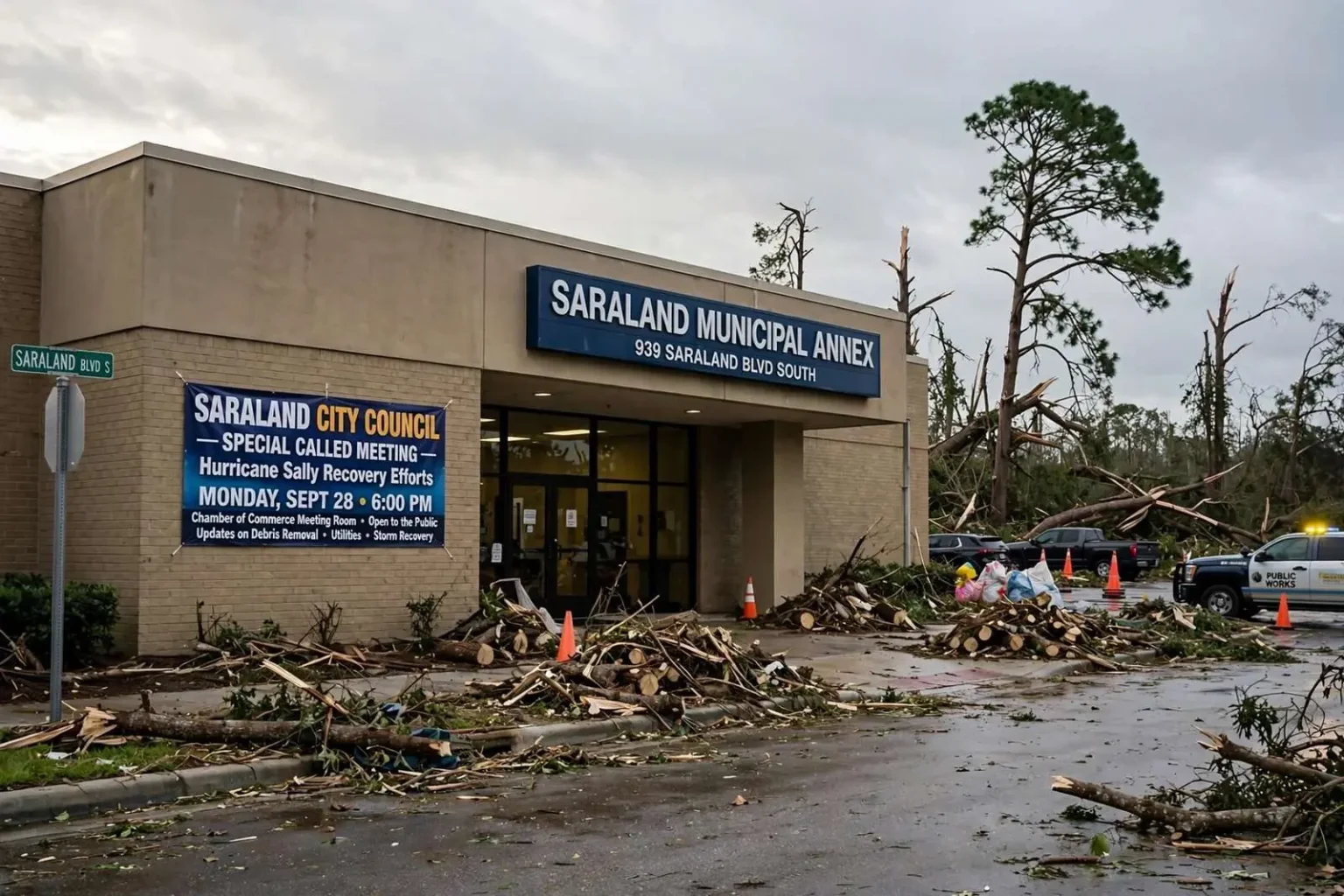
Two weeks after Hurricane Sally battered the Gulf Coast, the City of Saraland is bringing residents a formal update on where recovery stands. The Saraland City Council will hold a special called meeting Monday, September 28, at 6 p.m. to discuss the city’s ongoing Hurricane Sally recovery efforts. The meeting takes place in the Chamber of Commerce Meeting Room at the Saraland Municipal Annex, 939 Saraland Boulevard South. Residents with questions about debris removal, utilities and other storm-related matters will be able to hear directly from city leaders as cleanup work continues across Mobile County.
The meeting arrives at a moment when the entire Gulf Coast is still taking stock of what Sally left behind. The hurricane came ashore in mid-September as a slow-moving storm that parked itself over the region, pouring down rain and driving winds across south Alabama for hours longer than most residents expected. Saraland, sitting just north of Mobile along the Interstate 65 corridor, took its share of the damage: trees and limbs down across streets and yards, power lines stretched across roadways, fences and roofs torn up, and neighborhoods left in the dark for days as crews worked to restore electricity.
For a city government, the two-week mark after a hurricane is when the initial emergency fades and the long recovery becomes visible. Storm debris piles line the streets. Residents are asking about curbside pickup schedules, about when utilities will be fully stable, and about what help may be available to repair homes and businesses. A special called meeting gives the council a formal, public setting to answer those questions in one place rather than one phone call at a time.
The choice of venue reflects the practical scale of the gathering. The Saraland Municipal Annex at 939 Saraland Boulevard South houses city operations along the city’s main commercial corridor, and the Chamber of Commerce Meeting Room provides space for the council, city staff and residents to convene. The 6 p.m. start puts the meeting within reach of residents who work daytime hours, an intentional accommodation for a community still digging out.
What recovery looks like at two weeks
Two weeks after landfall, a Gulf Coast city is typically working through three overlapping jobs. The first is restoration: getting power back to every customer, clearing major roadways, and restoring water and sewer service where the storm disrupted it. The second is debris removal, an operation that can run for months, as crews gather vegetable debris, construction material and household waste left curbside by residents. The third is documentation, the unglamorous but essential work of tracking costs and damages that determine what state and federal reimbursement a city eventually receives.
Sally’s slow track made all three jobs harder. The storm’s forward pace as it came ashore meant winds hammered the same areas for an extended period, toppling trees into saturated ground and stressing power infrastructure beyond what a faster storm would have. Rainfall totals across the central Gulf Coast reached remarkable levels, flooding low-lying areas and leaving the ground so wet that shallow-rooted pines and oaks went over with ease. Communities across Mobile County, from the bayfront to the northern suburbs, reported widespread tree damage and outages that lasted for days.
Saraland’s position in the metro area shaped its experience of the storm. The city stretches along both sides of Interstate 65 north of Mobile, with established neighborhoods, schools, churches and a growing commercial base along Saraland Boulevard and Highway 43. A storm that snaps limbs and uproots trees in that setting produces hazards on every street: blocked roads, damaged service lines and debris entangled in power infrastructure that utility crews must clear section by section before lights come back on.
City leaders have spent the two weeks since landfall coordinating with county and state partners, and the special meeting is the point where that coordination becomes visible to residents. Debris removal after a declared disaster follows specific rules, with eligible storm debris tracked separately from routine waste, and cities typically contract hauling crews that work street by street for weeks. Residents’ questions about schedules, sorting requirements and what can be placed at the curb are exactly the kind of items a public meeting is designed to address.
Why the meeting matters to residents
Public meetings also give the council a record of what residents are most concerned about, which shapes how city departments prioritize the work that follows. A council that hears repeatedly about a particular neighborhood’s debris pile or a lingering outage can direct crews accordingly, and the give-and-take of a public session surfaces issues that phone lines and social media posts can miss.
Utility restoration is likely to be a central topic. Power outages after Sally stretched across the entire Mobile area, and repairs to the electrical grid proceeded feeder by feeder as crews from across the region poured into south Alabama. By the two-week mark, most customers had service restored, but the aftermath of a major outage lingers in the form of damaged service entrances on individual homes, replaced meters and questions about who bears the cost of repairs on the customer’s side of the line. Water and sewer systems, too, can need days of flushing and testing after pressure losses, and residents want confirmation that their systems are fully stable.
Saraland and the regional recovery picture
Saraland’s recovery effort is one piece of a much larger operation across Mobile County and south Alabama. County government, municipal public works departments, the Alabama Department of Transportation and utility crews have all been engaged since landfall in clearing roads, restoring services and removing debris. The storm’s damage footprint extended across state lines, but the Gulf Coast’s recovery proceeds city by city, block by block, with each municipality managing its own streets while coordinating on the major corridors.
The city sits in the northern band of the Mobile metro area, and its recovery matters beyond its boundaries. Saraland’s schools, industries and retail centers serve residents of surrounding communities, and getting the city fully back to operation contributes to the whole region’s return to normal. Local officials have emphasized that recovery is a marathon rather than a sprint, with debris collection alone expected to continue well past the initial weeks after the storm.
Special called meetings are a standard tool in the aftermath of a disaster. Councils convene outside their regular schedule to ratify emergency expenditures, authorize debris contracts, update residents and formally document the recovery effort. Each public session creates a record that supports the city’s case for reimbursement and keeps the public informed of how recovery money is being spent. Residents who attend gain not only answers but also a window into the scale of the operation their city is running.
The September 28 meeting also lands at a point when federal assistance programs begin to touch individual households. After a major federal disaster declaration, affected residents may qualify for individual assistance programs that help with temporary housing, home repairs and other storm-related needs not covered by insurance. Cities play a role in spreading word about how to apply and what documentation homeowners need, and public meetings are among the most effective channels for that outreach.
The long road after Sally
Hurricane Sally’s legacy along the Gulf Coast will be measured in months of work rather than days. Trees that fell two weeks ago still need to be cut, hauled and ground. Roofs damaged by wind await contractors working through a backlog that stretches across the entire region. Flooded homes are being gutted and dried. The recovery from a storm of this kind typically runs through the fall and into the following year, with each phase managed by a different mix of city crews, contractors, insurers and government agencies.
For Saraland, the Monday, September 28 meeting is a checkpoint on that road — a formal moment for the council and city staff to tell residents where things stand and for residents to tell leaders what still needs attention. The setting at the Municipal Annex on Saraland Boulevard South puts the discussion in the middle of the corridor the storm affected, and the evening hour invites the broadest possible turnout.
For homeowners still dealing with roof damage, spoiled food from outages and yards full of downed limbs, the meeting is a chance to get answers directly rather than through rumor. Storm recovery generates a constant stream of practical questions: When will debris trucks reach my street? Is the city picking up construction debris or only vegetation? What should I do about a damaged fence or shed? Where do I report a streetlight that is still out? City staff who have been managing those issues since landfall can lay out the answers for everyone at once.
Residents planning to attend will find the city’s leadership prepared to discuss debris removal progress, utility restoration and the other storm-related matters that have dominated the two weeks since Sally came ashore. The meeting is open to the public, and city officials have encouraged anyone with questions about the recovery to come hear the update in person. In a community still clearing its streets, the session represents both accountability and reassurance: the work is underway, the plan is public, and the city is answering directly to the people it serves.
As cleanup continues across Mobile County, updates from the city and its departments will carry the details residents need, but the special called meeting remains the clearest opportunity for dialogue between Saraland’s government and its residents. Two weeks after Hurricane Sally battered the Gulf Coast, that dialogue is part of the recovery too.