Saraland to Hand Out Sandbags to Residents Ahead of Storm Threat
The City of Saraland will distribute sandbags to residents only, Sunday 1-5 p.m. at Public Works, ahead of Hurricane Sally.
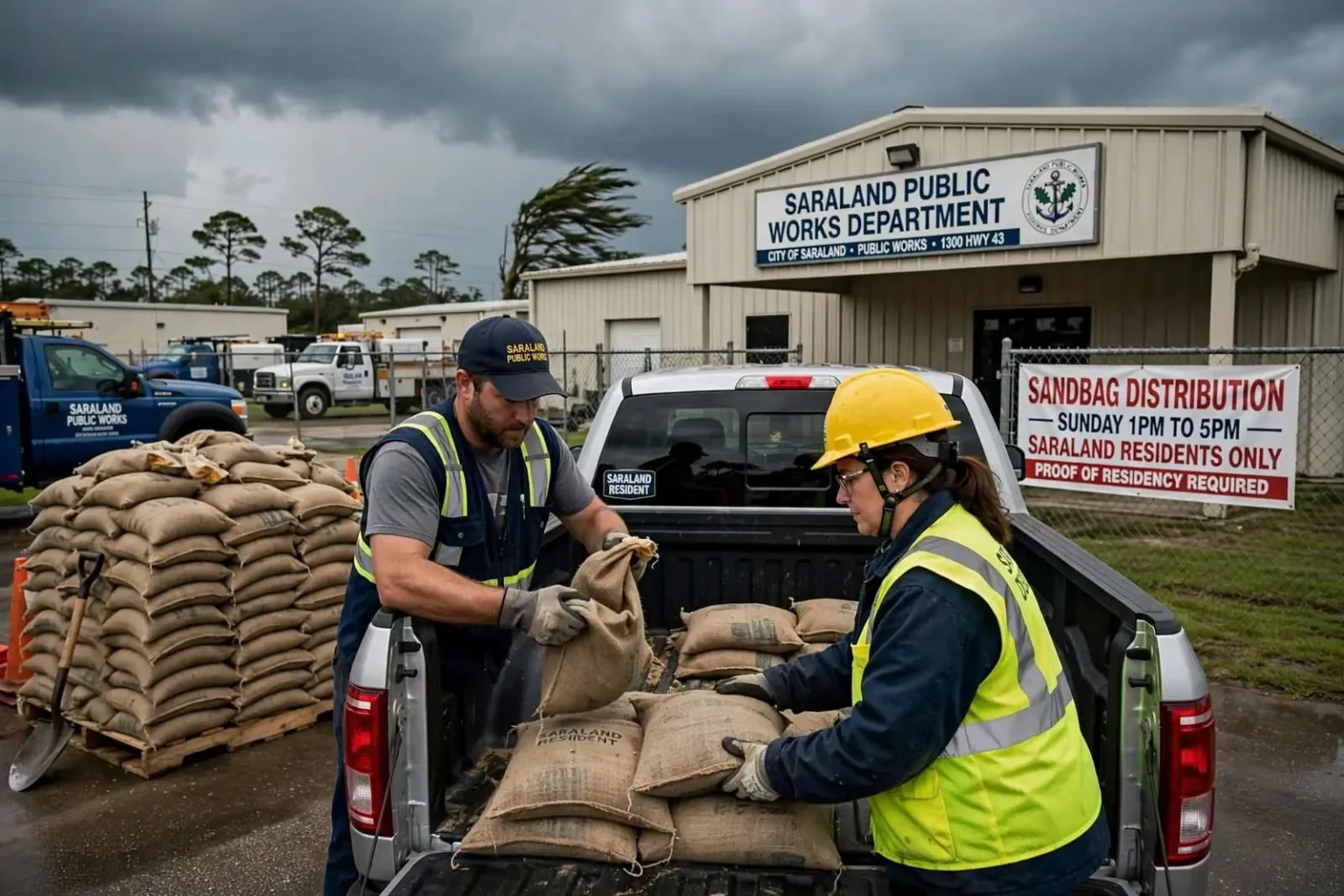
Saraland residents preparing for potential flooding from Hurricane Sally can pick up sandbags this weekend, but only city residents will be served. The city announced that the distribution would run Sunday from 1 p.m. to 5 p.m. at the Saraland Public Works Department, where workers will load bags for residents as the Gulf Coast braced for the approaching storm.
The arrangement differs from the self-service model many Gulf Coast cities use: instead of handing residents a shovel and pointing them at a sand pile, Saraland’s public works crew will do the loading. Residents simply arrive — with proof they live in the city — and workers fill and place bags in their vehicles. The city limited the event to its own residents to keep the supply available for the community it serves, a common policy when demand for sandbags outpaces what a small municipal crew can produce.
Why Saraland prepares for water
Saraland sits in southern Mobile County just north of Mobile, and its storm history is written by water. The city straddles the low ground along U.S. 43 and the Norfolk Southern rail corridor, with creeks and drainage channels that rise quickly when Gulf systems drop heavy rain. In hurricanes and even strong tropical storms, the first damage Saraland typically sees is not wind but water — streets flooding in low-lying neighborhoods, creeks escaping their banks and storm drains overwhelmed by hours of rain.
Hurricane Sally, which was approaching the central Gulf Coast as the sandbag announcement went out, was shaping up as exactly that kind of storm. Forecasters expected Sally to be a slow mover, and slow storms are the ones that pile up catastrophic rainfall totals on the northern Gulf Coast. A system that crawls at five or ten miles per hour can dump twenty or thirty inches of rain on communities in its path, and every municipality from Mobile County across the state line was preparing for the possibility that Sally would be a flooding event as much as a wind event.
Sandbags remain one of the simplest defenses against storm-driven floodwater. Stacked across garage doors, in front of door thresholds and along driveways that slope toward the street, bags of sand redirect shallow flowing water and block the inch or two of intrusion that ruins flooring, baseboards and anything stored at floor level. They do not stop a serious surge, and no public works director claims otherwise — but for the flooding that most residents of inland Gulf Coast cities actually experience, sandbags are the difference between a wet garage and a ruined home.
The routine before the storm
Gulf Coast municipalities routinely stage sandbag giveaways ahead of landfalling hurricanes, and the playbook has been refined by decades of storms. Cities announce locations and hours, often through social media and local news; they cap the number of bags per household, commonly ten to twenty; and they decide between self-service fill sites, which can serve large crowds with few workers, and crew-loaded events like Saraland’s, which move faster per resident but require staffing.
The Sunday afternoon window was chosen with an eye on the forecast. Sally’s outer effects were expected to begin arriving within a day or so of the giveaway, which meant residents had a narrow but sufficient window to pick up bags, place them at home and finish other preparations — securing loose yard items, checking generators, charging phones and reviewing evacuation zones — before conditions deteriorated.
Mobile County’s emergency management apparatus coordinates behind the municipal efforts. The county EMA tracks the storm, communicates with the National Weather Service office in Mobile and supports cities with resources when local capacity runs short. Saraland, like neighboring Prichard, Chickasaw, Satsuma, Creola and the city of Mobile, runs its own public works department, and each makes its own call on when and how to open sandbag operations based on local demand and staffing.
Sally’s approach and what it became
As the sandbag announcement went out, Sally was organizing in the Gulf of Mexico after crossing the far southern part of the state as a depression. Forecast tracks had shifted the storm’s landfall eastward toward the Alabama-Mississippi border region, putting the Mobile area — and Saraland with it — on the dangerous western side of the system, where onshore winds pile water into the bay and rain bands train over the same ground for hours.
Sally went on to make history along the Gulf Coast. The slow-moving hurricane came ashore near Gulf Shores as a Category 2 storm and then stalled, dumping extraordinary rainfall across the central Gulf Coast. Streets in Mobile, Saraland and communities across two states flooded, creeks and rivers stayed above flood stage for days, and the storm became one of the most significant flood events in the region’s modern history. For the residents who picked up sandbags on Sunday, the bags they stacked that afternoon were among the last hours of ordinary preparation they would get before the water came.
The storm’s aftermath tested every community in Mobile County. Power was out for days across the region, roads were blocked by fallen trees, and neighborhoods that had never taken water before saw flood damage. Public works crews — the same ones who had loaded sandbags on Sunday — became the front line of recovery, clearing drains and debris while residents pulled soaked carpet from their homes.
Lessons the coast keeps relearning
Every hurricane season revives the same preparation advice on the Gulf Coast, and sandbags anchor the list for a reason. Emergency managers advise residents to get bags early rather than waiting for the last hours before landfall, when lines grow long and supplies run short. They advise placing bags correctly — a staggered, overlapping stack like bricks, arranged so water flows around the protected opening — and they remind residents that bags filled and left in a pile do nothing until they are placed.
Cities also learn from each storm. Crew-loaded distributions like Saraland’s serve elderly residents and households without a second pair of hands, and the resident-only policies that cities enforce protect against the supply being drained by people from outside the community. The policies occasionally frustrate residents of neighboring towns whose cities opened later or not at all, but municipal leaders say the arithmetic is simple: the bags were bought with Saraland’s budget, and the first obligation is to Saraland’s taxpayers.
What residents were told to do after the bags
Sandbags are one layer of a preparation checklist that Gulf Coast residents know by heart. Along with placing the bags, residents were urged to secure or bring indoors anything the wind could turn into a projectile, to move vehicles under cover and out of flood-prone low spots, to store important documents in waterproof containers or photograph them digitally, and to plan for the possibility of extended power outages. Anyone in a manufactured home or a known flood-prone structure was encouraged to identify where they would go if conditions worsened, even if official evacuation orders never came.
Communication was part of the checklist too. Officials asked residents to keep phones charged, to sign up for or monitor local alert systems, and to rely on the National Weather Service in Mobile and verified local sources for forecast updates rather than on rumor. Sally’s slow movement meant the storm dominated the forecast for days, and the hours of the Sunday giveaway sat squarely in the calm before the rain bands arrived.
For Saraland, the weekend distribution was municipal government doing the unglamorous work that defines storm season on the Gulf Coast: a public works yard open on a Sunday afternoon, a crew loading bags, and a city making sure its own residents had their simplest flood defense in hand before Sally arrived to test it.
The economics of a sandbag program
Sandbag operations cost cities real money, which is why the resident-only rule and per-household limits exist. Empty bags, sand and the crews to load them all come from a municipal budget, and a single storm can consume thousands of bags in a few hours. Cities on the Gulf Coast typically restock before each season begins in June, storing sand and bags at public works yards so that a distribution can be organized within hours of a storm entering the Gulf.
Public works departments also maintain the infrastructure the bags are meant to supplement. Drainage crews clear ditches and culverts ahead of storms because the best flood defense in a slow-moving hurricane is a drainage system running at full capacity; bags across a garage door matter less if the street in front of the house is already a foot deep because a culvert is clogged. That is why cities like Saraland combine their sandbag announcements with reminders that crews are out clearing drains in the days before landfall.
Residents have their own role in keeping that system working. Public works directors across Mobile County ask residents not to pile yard debris in ditches before a storm, since the first heavy rain sends grass clippings, limbs and leaves straight into the drains that carry water away from their streets. The storm after the storm — cleanup — goes faster in neighborhoods where the debris was managed before the rain started.
After the bags come down
When the water recedes, the sandbags come down, and cities collect or advise residents on disposal. Sand that has been in floodwater is typically contaminated and should not be spread in gardens or yards; most municipalities ask residents to bring used bags to designated collection points where the sand can be handled properly. Bags that stayed dry can sometimes be stored and reused, and many Gulf Coast residents keep a stack in the garage between seasons as a matter of routine.
Insurance is the other half of flood readiness that events like Sally’s teach. Standard homeowners policies do not cover flood damage — that protection comes only through flood insurance, most of it under the National Flood Insurance Program — and policies carry waiting periods that make last-minute purchases impossible once a storm is named. Emergency managers use every sandbag announcement as a chance to repeat that lesson, because the residents who discover the gap in their coverage after a storm are uniformly the ones who wish they had heard it sooner.
Sunday’s giveaway at the Saraland Public Works Department closed with the same quiet efficiency that marked its opening. Workers loaded the last bags, the yard emptied, and the city turned its attention to the forecast still grinding north through the Gulf. Whatever Sally brought, Saraland’s residents would meet it with water stacked against their doors and a city that had done its part before the first band of rain came ashore.