Satsuma High School Cancels Activities as Severe Weather Threatens Mobile County
Satsuma High School canceled after-school activities April 25, 2019 as severe weather threatened Mobile County; more schedule changes possible.
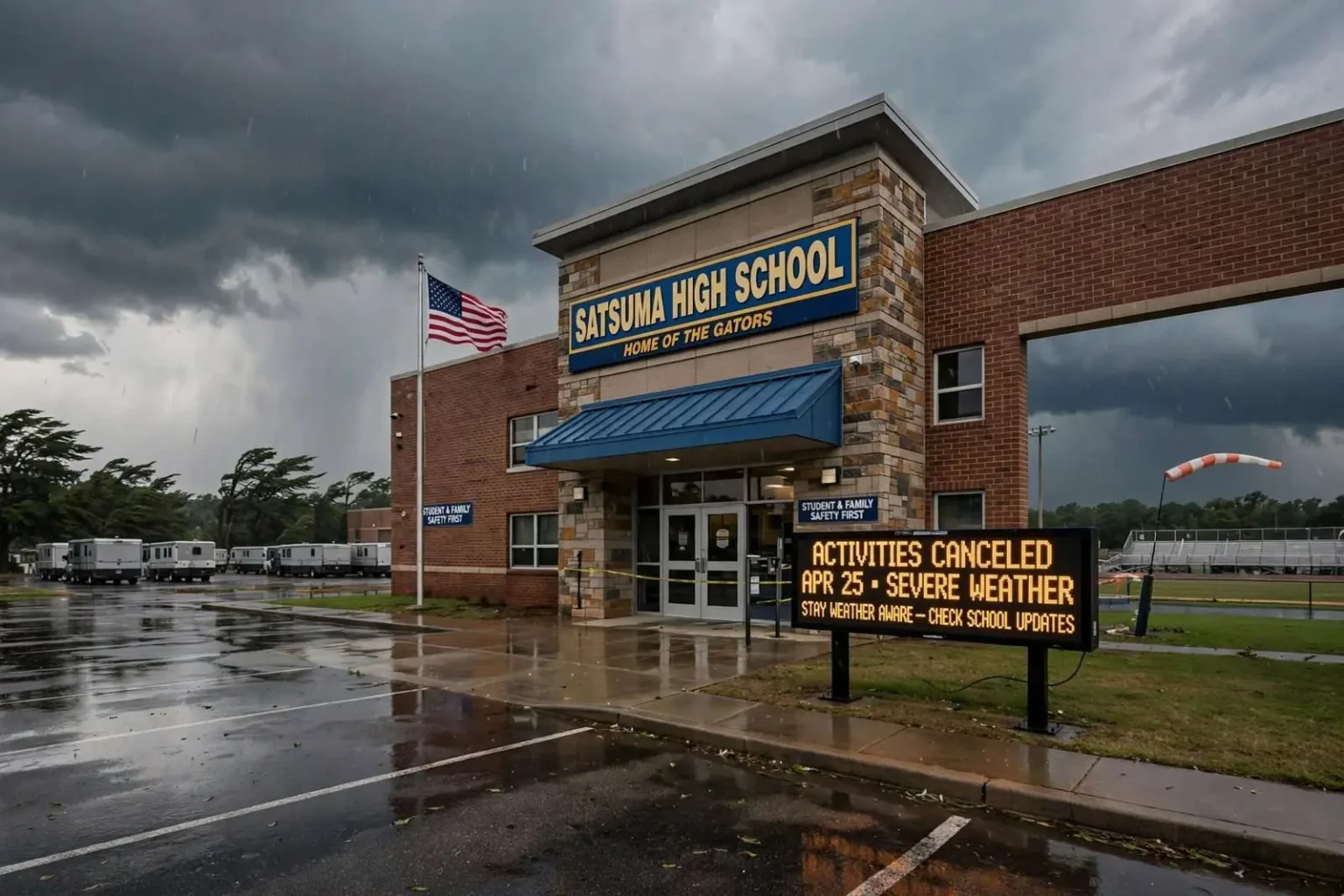
Schools around Mobile County began pulling after-school events from the calendar Thursday, April 25, as forecasters warned of possible severe weather moving into the region. Among the first to act was Satsuma High School, which announced that day that its activities were called off ahead of the storm threat.
Satsuma, a small city in the northern part of Mobile County along the west bank of the Mobile River, operates its own city school system, one of several independent districts in the county alongside the much larger Mobile County Public Schools. Decisions about games, practices and ceremonies in Satsuma are made by local administrators, which is why the high school’s announcement came quickly and independently once the forecast turned ominous.
In a message posted to the school’s social media accounts, officials urged families to stay weather-aware through the afternoon and evening. The notice was short but direct: activities were canceled, and parents were asked to keep an eye on forecasts and official updates as the day went on. Social media has become the fastest channel for school-to-parent communication in South Alabama, reaching families on their phones within seconds of a posting rather than waiting for take-home letters or evening news broadcasts.
How schools make the call
The decision to cancel is rarely made in a vacuum. Athletic directors check with visiting schools, principals confer with district leaders, and everyone watches the timing of the expected line of storms against the scheduled start times. A 5 p.m. practice and a 7 p.m. ballgame can produce different answers from the same forecast, and administrators try to give families as much notice as the uncertainty allows.
Satsuma’s early announcement set the tone for the day. Being among the first to act spared local families the afternoon scramble of deciding whether to send students to a practice or game that might be called off at the last minute, and it signaled to neighboring districts that the threat was being taken seriously across the northern part of the county.
The moves also fit a broader shift in how South Alabama institutions handle severe weather. After generations of storms that produced casualties among people caught outdoors or on the roads, schools and government agencies across the region have adopted a bias toward caution: when in doubt, cancel, reschedule and accept the inconvenience. Weather days built into academic calendars and generous rescheduling rules for athletics exist precisely so that no administrator feels pressured to hold an event in front of a dangerous sky.
More changes possible
Administrators across the area said they would continue monitoring conditions and adjust schedules for games, practices and other events as needed. That posture — watch, wait and decide — is standard practice for Gulf Coast schools during severe weather season, when a forecast can shift several times between morning and dismissal and a cancellation made too early or too late creates its own problems for working parents.
Families were advised to watch for updates directly from their schools before heading to any scheduled activity. The advice reflected the reality that decisions in one district do not bind another: a game canceled in Satsuma might go on as scheduled across the county line, and a practice called off in the morning could be reinstated by afternoon if the storm track shifted east or weakened. School officials urged parents not to rely on rumor or secondhand word, since final calls often came only an hour or two before an event’s start time.
Athletic schedules bore the brunt of the reshuffling. Spring is one of the busiest seasons on the high school sports calendar, with baseball, softball, track, soccer and tennis all in full swing across Mobile County, and each canceled date creates a rescheduling headache that ripples through district standings and postseason seeding. Band rehearsals, club meetings and award ceremonies faced the same domino effect, forcing administrators to weigh the inconvenience against the risk of students and families on the roads as storms arrived.
A familiar spring pattern
The moves came as a line of storms capable of heavy rain, lightning and damaging wind approached the central Gulf Coast, a familiar spring pattern for South Alabama communities. The region sits in one of the more active severe weather corridors in the United States, where warm, humid air flowing north from the Gulf of Mexico collides with spring cold fronts, setting up the instability that produces squall lines, supercells and occasional tornadoes.
Meteorologists with the National Weather Service office serving Mobile track these setups closely, issuing watches hours ahead and warnings as storms develop, and local school officials watch those products alongside radar throughout the day. April is historically one of the peak months for severe weather in Alabama, and spring outbreaks in the state have shaped everything from building codes to the weather-alert procedures schools now follow as a matter of routine.
Damaging wind is among the most common threats from a squall line. Straight-line winds from a fast-moving line can down trees and power lines across a broad area, creating hazards long after the line itself has passed. Heavy rain adds a second danger, ponding water on roadways and reducing visibility during the evening commute. Lightning, frequent with any spring storm line, makes outdoor practice fields and ballparks unsafe well before the worst wind arrives, which is why athletic events are typically the first items scratched from a schedule.
The countywide picture
Satsuma was one piece of a much larger puzzle. With public school systems in Mobile, Saraland, Chickasaw and Baldwin County all reviewing their own calendars the same day, families with students in different districts often faced a patchwork of decisions — a practice canceled in one city while a game across the bay stayed on the schedule. Officials urged patience with the inconsistencies, explaining that each district answers to its own weather timing and its own transportation realities.
Businesses, churches and community organizations across the two counties faced similar choices, weighing evening services, meetings and youth activities against the same forecast. The cumulative effect of all those cancellations is intentional: empty ballfields and canceled practices on a storm day mean fewer people exposed to the hazards traveling to and from them.
What parents and residents should know
For families, the cancellation announcements served as a prompt to review their own storm plans. Emergency managers across south Alabama recommend that households know where they will shelter — a lowest-floor interior room away from windows — and have multiple ways to receive warnings, since storms that arrive overnight or during power outages can knock out television and internet alerts.
The same guidance applies to drivers. April storms that sweep across Mobile County often arrive during the afternoon and evening hours, exactly when school events would have put students, parents and buses on the road. Canceling activities keeps hundreds of people out of their cars during the most dangerous window, one of the quieter benefits of the decisions administrators made that Thursday.
Satsuma’s quick action was echoed by schools across the region as the afternoon progressed, a routine that plays out multiple times each spring across south Alabama. In a region where severe weather is a seasonal certainty rather than a surprise, the coordination between forecasters, administrators and families has become a well-practiced drill: watch the radar, send the alert, cancel the event, and wait out the storm. Residents were reminded that schedules would return to normal once the line of storms cleared the coast — and that the next round of spring weather was never far behind.
The rhythm of the spring storm season means Thursday’s disruptions were unlikely to be the last of the year. Between now and the arrival of summer’s heat, Mobile County schools will typically face several more rounds of strong to severe weather, each bringing the same calculus: measure the risk, notify the families, empty the fields and gyms, and pick the schedules back up when the sky clears.
For Thursday, the priority was simple and shared across every district that acted: no student, parent, coach or fan needed to be standing in a parking lot or driving a highway when the line arrived.
Communication was expected to continue into the evening as well. Schools that canceled early events planned to keep posting updates as conditions evolved, and residents were pointed to local forecast offices, emergency management agencies and official district accounts for the latest information. In an era when a storm’s track can change within an hour, the officials’ final advice echoed the morning’s message: stay weather-aware, verify before you travel, and let the alerts — not the calendar — decide where you need to be.
The games and practices will be made up; the calendar absorbs them every year. What the cancellations bought, as administrators across Mobile County saw it, was the one outcome no schedule can replace — everyone home safe when the storms came through.