School bus involved in accident on Highway 43 in Clarke County
A school bus was involved in an accident on Highway 43 in Clarke County, Alabama, north of Walker Springs Road; no major injuries were reported.
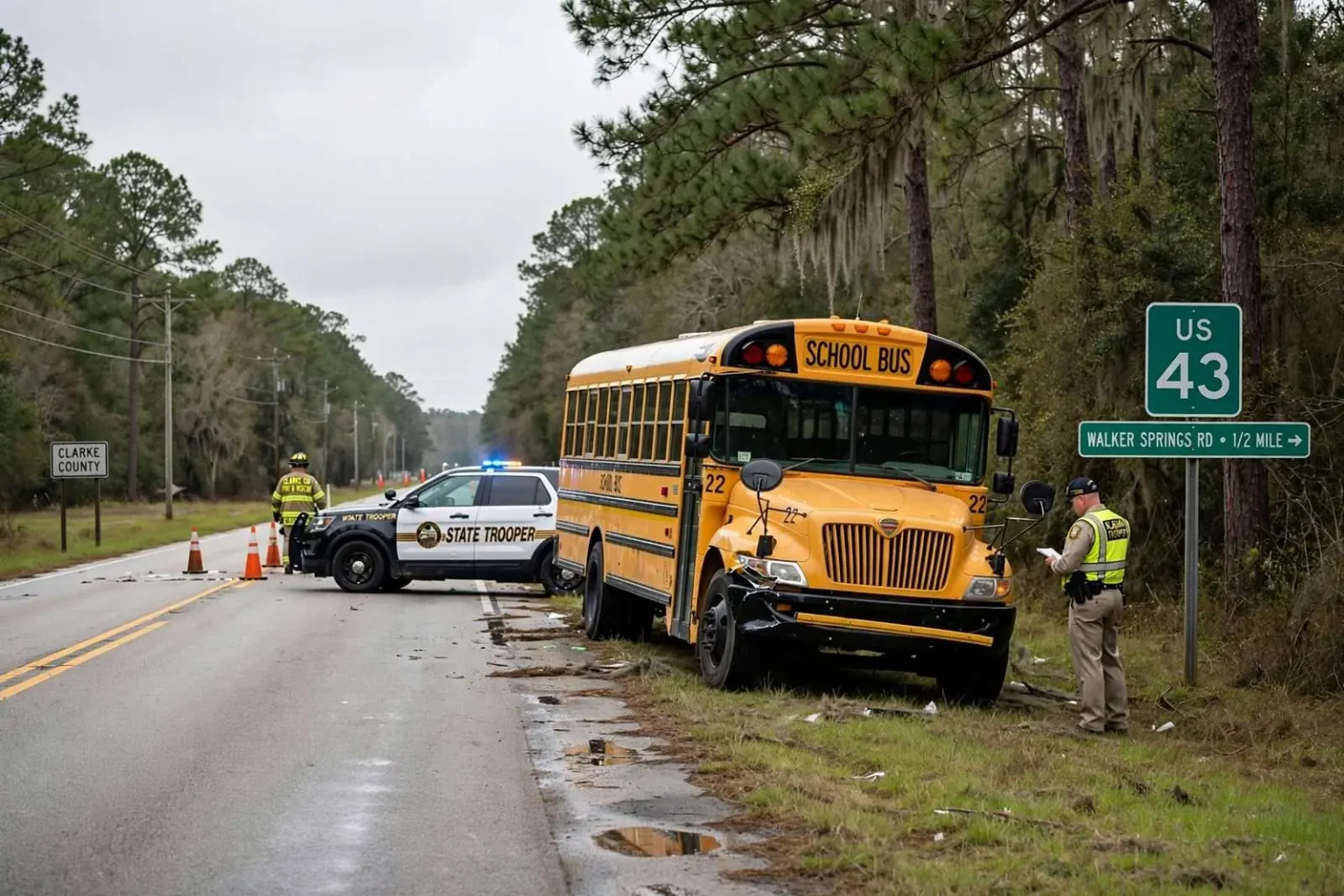
JACKSON, Ala. — A school bus was involved in an accident on Highway 43 in Clarke County on Monday, according to authorities. A viewer sent in a photo of the crash north of Walker Springs Road. Officials said there did not appear to be any major injuries. The children on the bus were reported to be doing fine, and none of the bus occupants were injured.
The crash occurred along U.S. Highway 43, the main north-south route that runs through Clarke County and connects Jackson with communities to the north and south. The accident location north of Walker Springs Road places it in the stretch of highway between Jackson and the Walker Springs community, a rural corridor where the highway carries a mix of local traffic, school traffic, and commercial vehicles passing through the county.
Responding agencies worked the scene and checked everyone involved, and officials confirmed that no major injuries were found. The children riding the bus were reported to be doing fine, and no one aboard the bus was injured. A photograph of the crash scene submitted by a viewer showed the aftermath along the highway as authorities responded, and the image circulated locally while officials worked to clear the roadway.
School Bus Safety in Rural Alabama
School buses remain one of the safest forms of transportation on American roads, a record built on the distinctive design standards that apply to every bus built for student transport. Federal requirements call for compartmentalized seating, with closely spaced, energy-absorbing, high-backed seats that cushion passengers without the need for seat belts in most configurations. Buses are also raised above the typical passenger car impact height, which protects the compartment in collisions with smaller vehicles.
Drivers who operate school buses in Alabama must hold a commercial driver’s license with passenger and school bus endorsements, pass background checks, and complete recurring training through the Alabama State Department of Education. The state’s pupil transportation program sets standards for bus maintenance, inspection cycles, and route safety, and local school systems in counties like Clarke follow those requirements for their fleets.
In rural counties, buses travel long routes on two-lane highways like Highway 43, often before sunrise or during afternoon traffic. Those routes put buses on the same roads as commuters, logging trucks, and farm equipment, which is why state officials emphasize visibility, reflective markings, and careful route planning for rural systems. The stop-arm law requires drivers in both directions on undivided highways to stop for a bus loading or unloading children, one of the most aggressively enforced traffic rules in the state.
The Highway 43 Corridor Through Clarke County
U.S. Highway 43 is a critical artery in southwest Alabama, running from Mobile north through Washington and Clarke Counties and on toward Tuscaloosa. In Clarke County, the highway serves Jackson, the county’s largest city, before continuing north through rural terrain toward Grove Hill, the county seat. The road carries school traffic, commuters, timber and paper industry trucks, and through travelers, producing a traffic mix that keeps state troopers and local deputies busy along the corridor.
The Walker Springs Road area lies north of Jackson, where the highway passes through lightly developed countryside marked by pine forests, creek bottoms, and scattered homes. Intersections along this stretch are the sites of most of the corridor’s crashes, particularly where side roads meet the highway without turning lanes. The Alabama Department of Transportation maintains the highway and periodically reviews signage and lighting at rural intersections across the county.
Crashes involving school buses draw immediate attention from state and local authorities because of the number of children typically involved. Even when no one is hurt, as officials reported here, the standard response includes notifying the school system, arranging alternative transportation for students if needed, and documenting the scene thoroughly for the state’s crash records.
Who Investigates Crashes in Clarke County
Crash investigation on a state highway in rural Clarke County typically falls to the Alabama Law Enforcement Agency’s Highway Patrol Division, which handles most reportable crashes on roads outside municipal police coverage. Troopers document the scene, interview drivers and witnesses, and file the state crash report that becomes the official record for insurance and any potential charges. Local sheriff’s deputies and volunteer fire departments often assist with traffic control, first aid, and scene safety while troopers work.
In crashes involving a school bus, the school system is notified immediately, and transportation officials respond to the scene to account for every student and coordinate with parents. Bus drivers involved in crashes are tested under federal and state drug and alcohol testing rules that apply to commercial drivers in certain collisions. The findings of the investigation determine whether any citations are issued and feed into the school system’s review of the route and the bus.
Clarke County’s emergency response network reflects its rural character. Volunteer fire departments cover much of the county’s territory, ambulance services are staged in Jackson and Grove Hill, and serious medical cases are flown or driven to regional hospitals. For a crash with no major injuries, the response focuses on clearing the roadway quickly and getting students safely home or back to school.
What Happens After a Bus Crash With No Injuries
When a school bus is involved in a collision, the vehicle is inspected before it returns to service. Alabama school systems follow state inspection requirements, and any damage from a crash must be evaluated and repaired before the bus resumes routes. Mechanics check the frame, brakes, steering, lights, and emergency exits, and the repair record becomes part of the vehicle’s maintenance history.
Parents of the students aboard are typically contacted by the school, and school administrators may review the incident with students and drivers. Even in minor crashes, systems across Alabama use the event to reinforce loading-zone safety, route timing, and driver fatigue rules. The state’s pupil transportation office tracks bus-involved crashes as part of its safety program, looking for patterns that might justify route changes or road improvements.
For drivers who witnessed the crash or submitted photos, authorities generally ask that images and accounts be provided directly to investigators rather than shared widely, since official documentation of the scene matters for the state crash report. A viewer’s photo, like the one submitted in this case, often helps authorities confirm details such as vehicle positions and road conditions at the time of the crash.
Jackson and the Clarke County Community
Jackson, the community closest to the crash site, is home to just under five thousand residents and anchors the southern half of Clarke County. The city’s economy has long been tied to the timber and paper industries, and its schools serve students across a broad rural attendance zone, with many of them riding buses along Highway 43 and the county’s secondary roads each day. The Clarke County School System operates schools in Jackson and Grove Hill, and bus transportation is central to how those students get to class.
Rural school transportation in Alabama faces challenges that urban systems rarely see: long routes, mixed road surfaces, weather ranging from Gulf Coast storms to fog-prone creek bottoms, and wildlife crossings. State transportation officials and local systems work together on route risk assessments, and drivers are trained for the specific conditions of the roads they serve. Monday’s crash, occurring with no injuries to the children aboard, was reported as a single incident without any broader pattern of school route problems in the county.
Officials said the investigation of the crash would proceed through the normal channels, with the state crash report documenting what occurred north of Walker Springs Road. Authorities again noted that the children on the bus were doing fine and that none of the bus occupants were injured, closing out the immediate safety concerns from the scene.
Advice for Drivers Sharing the Road With Buses
State safety officials use crashes like this one to remind drivers how to reduce risk around school buses, especially on rural highways. Keeping a following distance of several seconds behind a bus gives both drivers room to react to sudden stops, and watching for the amber flashing lights that precede a stop-arm activation allows traffic to slow before children are near the roadway. On two-lane roads like Highway 43, passing a bus in motion is both dangerous and illegal when the bus is loading or unloading students.
Distracted driving remains a leading factor in crashes across southwest Alabama, and officials note that a moment of inattention near a school bus stop or a rural intersection can have serious consequences even at moderate speeds. Drivers traveling the Highway 43 corridor during morning and afternoon school hours are encouraged to plan for slower movement near bus stops and to expect buses turning in and out of side roads throughout the week.
Anyone who witnessed the Monday crash and has not spoken with investigators is encouraged to contact the Alabama Law Enforcement Agency, which can add witness accounts to the crash report. Authorities closed the scene after clearing the roadway, and no further advisories were issued for travel along that stretch of the highway.