School Bus with Augusta Evans Students On Board in Accident on Howells Ferry Road
A school bus carrying Augusta Evans School students was in an accident at Howells Ferry Road and Overlook Road in Mobile; no students were injured.
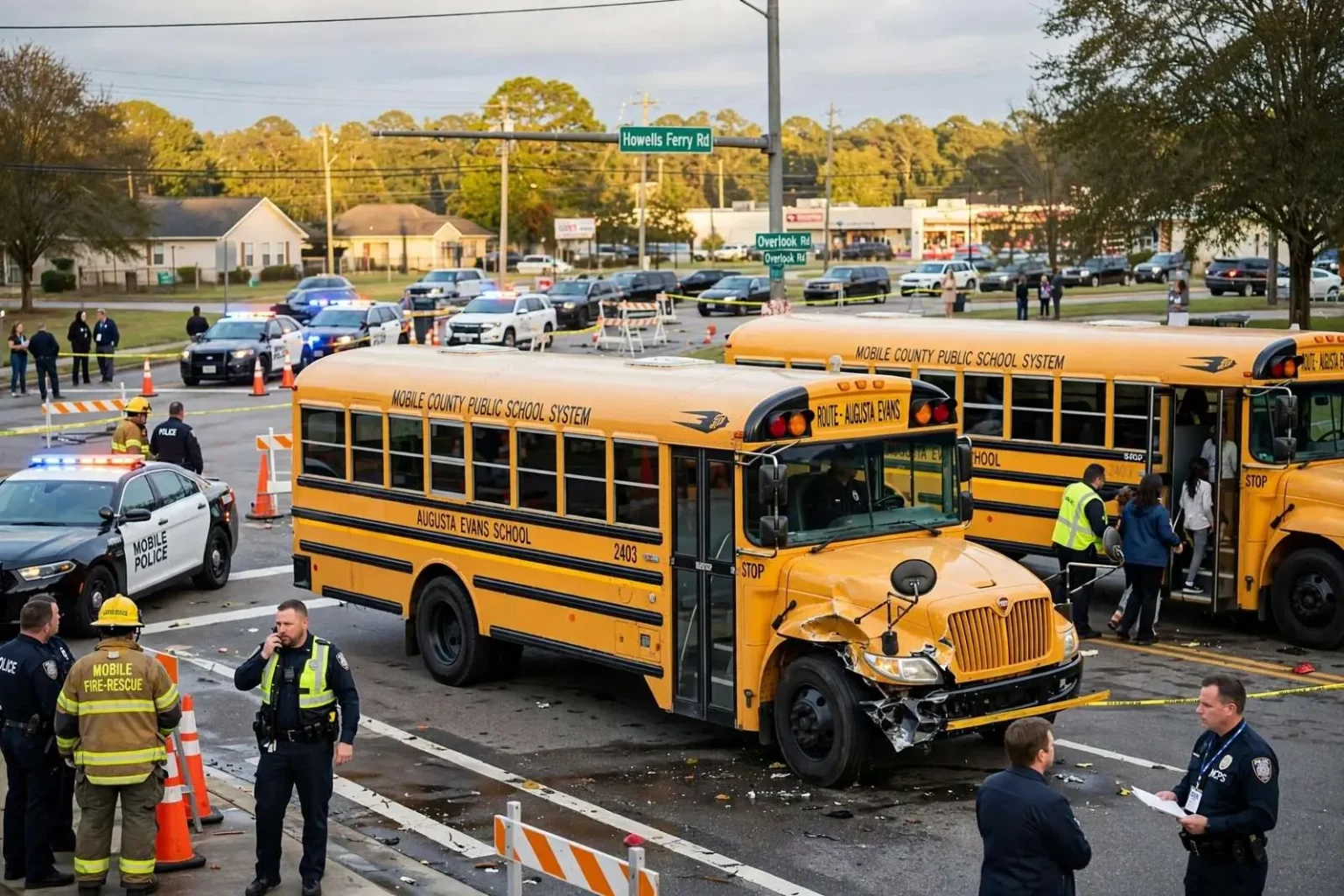
MOBILE, Ala. — An accident involving a school bus happened Friday afternoon at the intersection of Howells Ferry Road and Overlook Road in west Mobile, bringing police, and emergency responders to the scene during the height of the after-school travel window. The collision prompted a response from Mobile police and other agencies as officers worked to sort out the circumstances, document the scene, and keep traffic moving around the busy intersection while the damaged vehicles were cleared from the roadway.
The Mobile County Public School System confirmed that students from Augusta Evans School were on board the bus at the time of the accident, but said no one on the bus was injured. That announcement was the first piece of news anxious families wanted to hear, and it allowed the school system to shift its focus from medical concerns to the practical logistics of getting every child home safely on a Friday afternoon.
Students were transferred to another bus to be taken home, or parents could pick their children up at the scene. That dual option is standard practice in school transportation incidents: some parents, once notified, choose to come directly to the scene rather than wait, while the district completes its normal transportation plan for the students whose families have not yet arrived. At an intersection like Howells Ferry and Overlook, with its mix of residential neighborhoods and cut-through traffic, officers held the scene long enough for both parts of that plan to unfold.
The Intersection Where It Happened
Howells Ferry Road runs through a densely developed part of west Mobile, connecting residential subdivisions and commercial strips between University Boulevard and Schillinger Road. Overlook Road intersects it amid that mix, and the crossing sees steady afternoon volume, including school traffic from the campuses clustered in the area. Afternoon accidents there are complicated by the same factors that make the corridor busy: numerous driveways and side streets, turning vehicles, and drivers shortcutting between the major north-south arterials that frame the neighborhood.
When a school bus is involved in a crash at such an intersection, the response is deliberately heavier than the damage alone might dictate. Responding units account for the possibility of injuries among the students on board, position apparatus to protect the bus from passing traffic, and establish a controlled area for the transfer of children. Friday afternoon timing meant the accident occurred precisely when school buses citywide were on their routes, adding to the volume of parents and drivers moving through west Mobile streets as the workweek ended.
The transfer of students from one bus to another is itself a carefully managed procedure. Drivers and aides account for every child by name against the route manifest before anyone moves, a discipline that exists precisely so that no student is left unaccounted for amid the confusion of a crash scene. Substitute buses dispatched to take over a route are typically pulled from nearby schools or from the transportation department’s spare fleet, and drivers arriving at the scene receive a briefing on which students remain to be delivered and any special needs or instructions attached to individual children along the route.
Parents, meanwhile, received word through the notification channels the district uses for transportation incidents. In Mobile County, that process generally begins with calls from school administrators to the families of the students on board, followed by broader communication to the school community as facts are confirmed. For families of special-needs students, who often maintain close, personal relationships with school staff and drivers, the reassurance that no one was injured carried particular weight, and by early evening the district was able to confirm that every child on the route had been accounted for.
Augusta Evans School and Its Students
Augusta Evans School, part of the Mobile County Public School System, serves students with special needs from across the county, drawing its enrollment from a wide geographic area rather than a single neighborhood zone. Because its students come from throughout Mobile County, bus transportation is a central part of daily life at the school, and its routes cover long distances across the city and beyond. That reality makes any incident involving an Augusta Evans bus a matter of concern for families scattered across far more neighborhoods than a typical school attendance zone would reach.
Transporting students with disabilities involves additional considerations that the district’s transportation department builds into every route: specially trained drivers and aides, equipment such as lifts and securement systems where required, and individualized plans for students whose needs require them. When accidents happen, the district’s first calls go to the affected families, followed by coordination among school administrators, transportation supervisors, and the responding law enforcement officers to determine the safest way to complete the children’s trips home.
How Mobile County Handles Bus Incidents
The Mobile County Public School System operates one of the largest school bus fleets in Alabama, running thousands of routes each day across a county that spans more than 1,200 square miles, from the Mississippi line to Mobile Bay. With a fleet that large, incidents involving buses occur every year, and the district has established procedures that mirror what played out Friday at Howells Ferry Road: dispatch notification, law enforcement response, injury assessment for everyone on board, family notification, and re-transport of students on a replacement bus when the original vehicle cannot continue its route. The system is designed so that a single afternoon incident, however disruptive, never leaves a child stranded or unaccounted for.
School buses are built to federal safety standards that make them among the safest vehicles on the road, with compartmentalized seating, high seat backs, and reinforced construction designed to protect passengers without seat belts in most configurations. In low-speed collisions, that design typically prevents serious injury, which is consistent with the outcome school officials reported Friday: students checked, no one on the bus hurt, and children delivered either to their parents at the scene or home on a substitute bus.
The district’s drivers, who must hold a commercial driver’s license with school bus and passenger endorsements and complete ongoing training and annual recertification, are also trained specifically in post-collision procedures: securing the bus, checking every seat, accounting for students, and communicating with dispatch until responders arrive. Those procedures were evident in the orderly way the Friday incident was resolved, with the students moved to another bus and the district able to report within hours that no injuries had occurred.
Accident investigations involving school buses also proceed on parallel tracks. Police document the collision and determine fault as they would in any crash, while the school district conducts its own review of the driver, the route, and the vehicle, and insurers and the fleet maintenance team assess the bus itself. Any driver involved in an injury-risk collision may also undergo standard post-accident evaluation before returning to duty. None of that process, however, changes the immediate outcome that mattered most to families on Friday: no injuries on the bus, students accounted for, and every child on the route either in a parent’s arms or safely on the way home.
What Happens Next for Families and the District
In the days following an incident like this, parents typically hear from the school directly, and the district’s transportation department completes its internal documentation of the event. Students who were on the bus receive whatever follow-up attention their families and school staff decide is appropriate, and the children involved generally return to their normal routines, including their regular bus route, once the substitute transportation plan for the day has run its course.
For the wider community, the crash served as a recurring reminder about afternoon driving habits in school zones and along bus routes. West Mobile’s corridors fill with buses between roughly 2 p.m. and 4 p.m. on school days, and intersections like Howells Ferry and Overlook carry a blend of student drivers, commuters, and delivery traffic during those same hours. Law enforcement agencies in Mobile County regularly emphasize patience around school buses, larger following distances, and readiness to stop for loading and unloading buses, simple habits that reduce the sort of collisions that briefly, and fortunately without injury here, disrupt a Friday afternoon.
The investigation into the cause of the accident remained with Mobile police, who had not released details about the other vehicle involved or whether any citations would be issued. The school system’s statement closed the loop on the questions families ask first — whether the children were hurt, and how they would get home — and by Friday evening, the students of Augusta Evans School who had been on that bus were accounted for at home, ahead of the weekend. Officials thanked the responding officers and the families for their patience at the scene, noting that the calm cooperation of parents made the transfer and release of students far smoother than it might otherwise have been on a busy west Mobile afternoon.