School threat found written in bathroom at Fort Walton Beach high school
A threatening message was found written in a bathroom at Choctawhatchee High School in Fort Walton Beach; the Okaloosa County Sheriff's Office is.
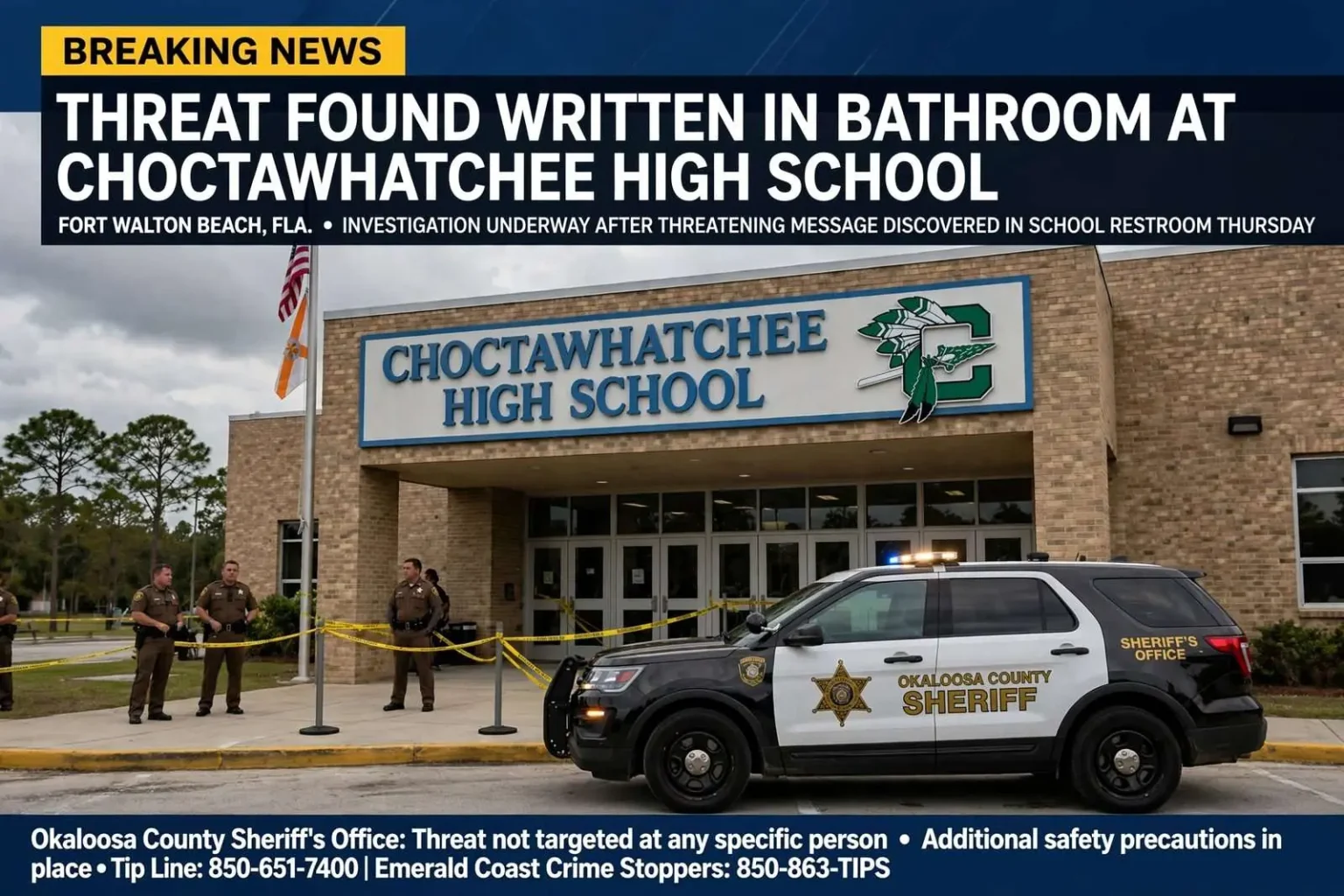
Threatening Message Found Written in Bathroom at Choctawhatchee High School
FORT WALTON BEACH, Fla. — A student found a threatening message written in a boys’ bathroom at Choctawhatchee High School on Thursday, according to the Okaloosa County Sheriff’s Office. The discovery set in motion the standard response protocol that area schools follow when a threat surfaces on campus, with investigators working to determine who wrote the message and whether it posed any credible danger.
The sheriff’s office said the threat was not directed at any specific person. That detail, while reassuring on one level, does not end the matter: threats written on school property are treated as serious offenses regardless of whether investigators ultimately find evidence of an intended attack, and identifying the author remains a priority for both the school and law enforcement.
Standard additional precautionary measures were put in place at the school. Officials did not detail every step taken, but such measures in comparable situations typically include increased law enforcement presence on campus, restrictions on movement between buildings, heightened monitoring of entrances and communication with parents about what was known and what was being done.
How Bathroom-Graffiti Threats Are Investigated
Threats discovered written on bathroom walls present a particular investigative challenge. Unlike a post made on social media, an anonymous scrawl carries no username, timestamp or digital trail, and it is usually discovered hours or days after it was written. Investigators typically begin by photographing the message, comparing its handwriting against samples, reviewing any camera footage of students entering and leaving the restroom during the likely window, and interviewing students and staff.
Sheriff’s offices and school resource officers across the Panhandle follow established procedures in these cases. The first determination is whether the threat names a target, names a date, or includes details suggesting planning — factors that raise the level of response. In this case, authorities said quickly that no specific person had been targeted, which allowed the school to continue operating with additional precautions rather than closing.
Even so, the process usually involves interviews that can stretch over days. Students who saw the message or know who wrote it are often the decisive source of information, which is why the sheriff’s office’s closing appeal pointed to the community itself: anyone with information is asked to contact the Okaloosa County Sheriff’s Office at 850-651-7400, Emerald Coast Crime Stoppers at 850-863-TIPS, online at EmeraldCoastCrimeStoppers.com, or by texting the P3 Tips mobile app.
The Role of Crime Stoppers on the Emerald Coast
The tip lines named in the sheriff’s appeal are the standard channels for anonymous reporting in the region. Emerald Coast Crime Stoppers serves Okaloosa County and surrounding communities, offering a way for students, parents and residents to pass along information without identifying themselves. Rewards are sometimes available for tips that solve crimes, and the program’s school-focused outreach has long emphasized that reporting a threat is never “snitching” — it is a safety measure that can prevent tragedy.
The P3 Tips mobile app extends that system to smartphones, allowing users to submit photos, screenshots and detailed messages anonymously. Law enforcement agencies across Florida and the rest of the country have adopted the platform in recent years because it removes the friction of phone calls and keeps the reporting channel open around the clock.
Choctawhatchee High School and Its Community
Choctawhatchee High School is one of the largest and best-known schools in Okaloosa County, serving thousands of students in Fort Walton Beach under the Okaloosa County School District. The school carries a long history in the community and a distinctive nickname tied to the river of the same name that flows through the Panhandle. Like most large high schools, it maintains a school resource officer from local law enforcement on campus and follows the district’s emergency operations plan.
Fort Walton Beach, perched on the Emerald Coast between Eglin Air Force Base and Hurlburt Field, is a community whose schools serve large numbers of military-connected families. School safety planning in the district reflects that context, with coordination among the school district, the sheriff’s office, municipal police departments and the installations’ own security forces.
The Okaloosa County Sheriff’s Office, headquartered in Shalimar, is the primary law enforcement agency for the county’s unincorporated areas and provides services throughout the region. Its school-related work ranges from staffing resource officers to investigating threats, and its public communications during incidents like this one are aimed at keeping parents informed without compromising the investigation.
How Florida Schools Handle Written Threats
Florida law treats written threats against schools severely. State statute makes it a crime to communicate a threat to kill or do bodily harm to a person or to commit an act of mass violence against a school, and cases involving students are referred to law enforcement rather than handled solely as a disciplinary matter. Students found responsible for such threats can face expulsion proceedings in addition to criminal charges, and prosecutors in the region have consistently pursued cases involving graffiti threats even when no attack was planned.
The reason is the cost of taking chances. Every threat, no matter how casual its author may have intended it, must be investigated as though it could be real. School districts across the country learned hard lessons from prior tragedies about the warning signs that went unreported, and modern protocol errs on the side of precaution: secure the campus, increase law enforcement presence, investigate thoroughly and communicate openly with families.
The precautions taken at Choctawhatchee High School on Thursday fit that framework. “Standard additional precautionary measures” is the phrase agencies use for steps that keep students safe and calm while detectives work — visible officer presence, controlled building access and staff briefings — without the disruption of a full lockdown or closure.
The Write-It-Down Problem: Bathroom Graffiti and School Safety
Written threats in restrooms have become one of the most common forms of school threat nationwide, spawning an entire category of prevention work. Schools combat it through a combination of restroom monitoring policies, camera coverage of entryways, rapid reporting cultures and anonymous tip systems like the ones advertised in this case. The goal is to shrink the anonymity that makes bathroom graffiti attractive in the first place.
What Parents and Students Should Know
Safety officials offer consistent guidance when a threat surfaces at a school. Parents are encouraged to talk with their children about the seriousness of such messages — both the harm of writing them and the importance of reporting them — and to watch for signs of anxiety after the incident. Students who feel unsafe are urged to tell a trusted adult immediately rather than waiting for rumors to spread through social media, where misinformation often moves faster than official updates.
Sheriff’s offices and school districts also emphasize the consequences of forwarding threatening images or jokes online. Under Florida law, even reposting a threat can draw investigative attention, and students sometimes find themselves interviewed because their names appear in a screenshot’s share history. The advice from agencies is simple: report once, through the official channels, and let investigators do the rest.
In this case, the Okaloosa County Sheriff’s Office kept its public messaging brief and factual: a threatening message was found, it was not directed at any specific person, precautions were added, and the investigation continued. Anyone with information is asked to contact the sheriff’s office at 850-651-7400, Emerald Coast Crime Stoppers at 850-863-TIPS, online at EmeraldCoastCrimeStoppers.com, or by texting the P3 Tips mobile app.
The Broader Picture in Okaloosa County
Incidents like this one have become a recurring feature of school administration across the Panhandle and the nation, and Okaloosa County’s agencies have built their response around the same principles that guide districts elsewhere: treat every threat seriously, respond proportionately to the level of specificity, and keep the public informed through a single authoritative voice. The coordination between the school district and the sheriff’s office determines how quickly a normal school day can resume.
For the students of Choctawhatchee High School, Thursday’s discovery was a disruption handled by protocol — a bathroom message, additional precautions, and a reminder that what gets written on a wall does not stay anonymous forever. Classes continued on the regular schedule while investigators worked. The investigation into the author continued, and the community’s tip lines remained open for anyone who knew something the sheriff’s office did not.
As with all such cases, the outcome depends largely on the community’s response. A threat written in ink on a restroom wall can be solved in a day with the right tip or linger for weeks without one. The sheriff’s office’s public appeal made clear which outcome it was hoping for, and Okaloosa County’s long-standing network of anonymous reporting channels stands ready to help produce it.