
Second Arrest Made in Tillman’s Corner Child Sex Trafficking Case
Mobile police arrested Grover Stone in the trafficking of a 13-year-old at a Tillman's Corner motel, days after Brandie Mckee's arrest, the DA says.
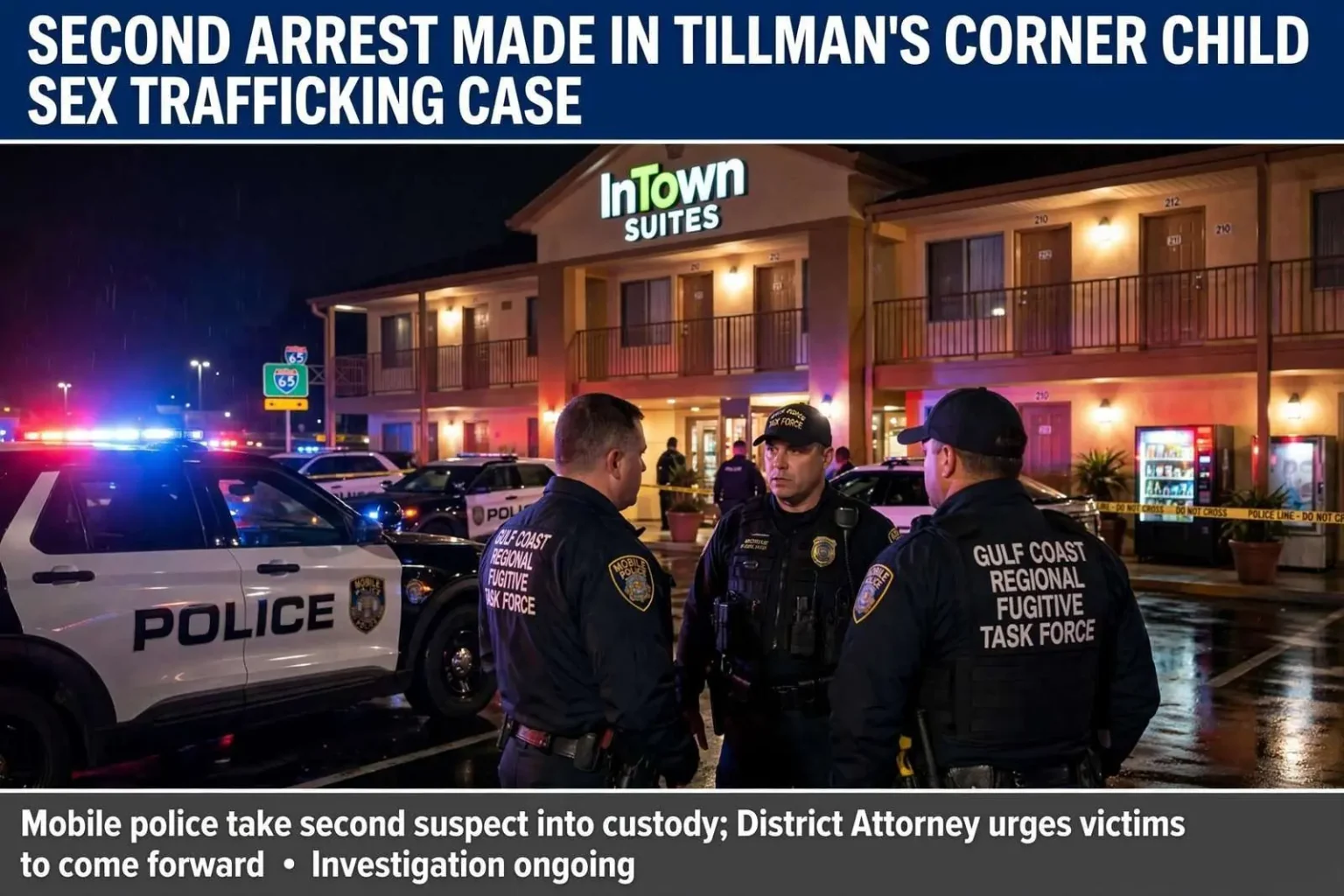
Mobile police have taken a second person into custody in connection with the sex trafficking of a 13-year-old girl at a Tillman’s Corner motel, and prosecutors have released new details about the case. This report contains descriptions of alleged crimes against a child; the details below are drawn from statements by the Mobile County District Attorney’s Office.
Grover Stone was arrested Wednesday night by the Gulf Coast Regional Fugitive Task Force at the InTown Suites off Interstate 65 in Mobile. He was wanted on sodomy, rape, and sexual assault charges involving the teenage victim, and his capture by the multi-agency task force — a unit that combines federal, state, and local officers to track down fugitives across the central Gulf Coast — ended a days-long search following the first arrest in the case.
His arrest came days after Brandie Mckee was booked on charges of human trafficking and facilitating the travel of a child for an unlawful sex act. The two arrests, coming within days of each other, marked the rapid escalation of an investigation that began with a report last spring and has grown into one of the more serious child exploitation cases prosecuted in the county this year.
How the case came to light
According to the Mobile County District Attorney’s Office, the allegations stem from a report made last May at the Extend-a-Suites on Coca Cola Road in Tillman’s Corner, just off Interstate 10. The extended-stay motel corridor along the interstate crossings in Tillman’s Corner — a busy commercial district in southwest Mobile — has been a recurring focus of local and federal anti-trafficking enforcement, where transient lodging can conceal exploitation from neighbors and passersby.
Prosecutors allege Stone received sexual acts from the 13-year-old and paid Mckee for them with drugs and money. Investigators said Mckee and the victim knew each other, and they do not believe other children were involved — a determination that shaped the scope of the charges brought so far, though officials stressed that the investigation remains active.
The May report set in motion a months-long investigation involving police detectives and prosecutors who handle crimes against children. Cases of this kind move deliberately: investigators corroborate a young victim’s account, gather motel records and communications, and coordinate with the District Attorney’s Office before arrests are made — which is why charges arrived months after the initial report.
DA urges victims to come forward
District Attorney Ashley Rich said the teen came forward to tell her story and encouraged other victims to do the same, noting that human trafficking carries no statute of limitations. “If you have been a victim, if someone has forced you to have sex for their benefit, that is charged as human trafficking, and we take that seriously,” Rich said. The District Attorney added that additional arrests and charges are possible as the investigation continues.
Rich’s emphasis on the absence of a statute of limitations is a deliberate message: in Alabama, trafficking prosecutions are not barred by the passage of time, meaning victims who are not ready to come forward now do not forfeit justice later. That legal reality matters in exploitation cases, where victims often remain under the control of their traffickers — or fear them — for months or years before feeling safe enough to speak.
The two arrests also illustrate how trafficking cases typically unfold in practice. Rather than a single defendant, cases like this one often involve a chain of participants: the person who facilitates the exploitation, and those who pay for it. Mckee’s charges — human trafficking and facilitating the travel of a child for an unlawful sex act — and Stone’s charges arising from the acts themselves represent both ends of that chain, and prosecutors have indicated that the file remains open.
For now, the case stands as both a prosecution and a public warning. A 13-year-old girl reported what happened to her, investigators built the case, and two people are in custody facing charges that could keep them imprisoned for decades. District Attorney Rich’s message to any other child in a similar position remains the same: come forward, tell your story, and know that the law does not run out the clock on those who exploited you.
The Gulf Coast Regional Fugitive Task Force that took Stone into custody is one of the region’s key law enforcement tools for exactly this kind of case. Built on partnerships among the U.S. Marshals Service, local police departments, and county sheriff’s offices, the task force specializes in locating suspects who have gone underground after charges are filed — moving between motels, temporary addresses, and jurisdictions to delay capture. Stone’s arrest at the InTown Suites off Interstate 65, days after charges were announced, shows the unit working exactly as designed.
Tillman’s Corner itself, the southwest Mobile district where the alleged exploitation occurred, sits at the junction of two major interstate corridors — Interstate 10 running east-west and Interstate 65 running north — an intersection that brings both commerce and the transient traffic that trafficking investigators watch closely. The district’s extended-stay motels along Coca Cola Road and the surrounding commercial strips have appeared repeatedly in local enforcement efforts, part of a broader pattern that anti-trafficking advocates have documented across the Gulf Coast’s interstate hubs.
The broader fight against trafficking
The case arrives amid growing awareness across Alabama of how human trafficking operates close to home, far from the sensationalized images the term can evoke. Prosecutors and victim advocates stress that trafficking frequently involves victims who know their exploiters, who are groomed over time, and whose exploitation is funded not by shadowy strangers but by ordinary buyers — paid, as alleged in this case, with drugs and money exchanged in ordinary-looking rooms along a commercial strip.
The District Attorney’s Office has made trafficking prosecutions a stated priority, pairing felony charges with public appeals for victims to come forward. Advocates note that young victims often face barriers to reporting: fear of their exploiters, shame, distrust of authorities, or the simple fact that they are children with nowhere else to go. That is why officials treat a victim’s decision to come forward — as the 13-year-old in this case did — as the pivotal moment on which an entire prosecution turns.
Resources exist across Mobile County for victims and their families. School counselors, pediatricians, and faith communities are often the first adults a child confides in, and law enforcement encourages anyone who suspects a minor is being exploited to report it rather than assume someone else will. Tips from the public have repeatedly proven decisive in trafficking investigations, matching the role that neighbors and witnesses play in other serious crimes.
As the investigation continues, prosecutors say additional arrests and charges remain possible, and the case file is expected to grow as evidence gathered since the May report is reviewed. The two defendants face charges that rank among the most serious in Alabama’s criminal code, and with no statute of limitations standing in the way, prosecutors have made clear that time is on the side of any victim — this one, and any others still waiting for the courage this 13-year-old found to tell her story.
The legal distinction at the heart of Mckee’s charges is worth understanding. Alabama’s human trafficking statute reaches anyone who knowingly benefits from forcing or enticing another person into a sexual act for their benefit — which is why facilitating a child’s travel for an unlawful sex act carries trafficking-grade penalties. Prosecutors treat the facilitator and the buyer as two halves of the same crime, a framework designed to dismantle the entire arrangement rather than punish only its most visible participant.
Charges of this severity carry the possibility of decades in prison upon conviction, and the involvement of a 13-year-old victim places the case in the category prosecutors treat as among the gravest on the docket. Convictions in child trafficking cases also typically require registration as a sex offender, adding lifelong consequences beyond any sentence imposed.
For the Tillman’s Corner community, the case’s visibility serves a preventive purpose. Business owners, motel employees, and residents along the corridor are often the first to notice the signs — a child present at odd hours, adults controlling a young person’s movements, cash-and-drug exchanges that repeat night after night. Investigators consistently credit observant neighbors and workers with generating the tips that open these cases, and the District Attorney’s public statements are aimed, in part, at keeping that awareness sharp.
What comes next
The defendants now face the court process: initial appearances, preliminary hearings, and ultimately indictments and trial dates as the District Attorney’s Office presents the evidence gathered since the May report. Prosecutors emphasized that the investigation remains open — meaning investigators continue to review evidence, interview witnesses, and evaluate whether further participants played roles in the exploitation.
Officials have not released details about the condition of the victim beyond confirming her cooperation, and advocates stress that the recovery process for a child who has survived trafficking is long, requiring trauma-informed counseling, stable housing, and family or foster support. The outcome of the criminal case is only one part of that recovery; the safety and stability of the child remains the stated priority of everyone involved in the prosecution.
What remains certain is the sequence the community watched this week: a 13-year-old’s report from last May, a months-long investigation, two arrests in two days — first Brandie Mckee on trafficking charges, then Grover Stone, taken by the Gulf Coast Regional Fugitive Task Force at an InTown Suites off Interstate 65 — and a District Attorney promising that no other victim’s story expires with the calendar. The case continues, and the District Attorney’s Office has asked anyone with information to come forward.