
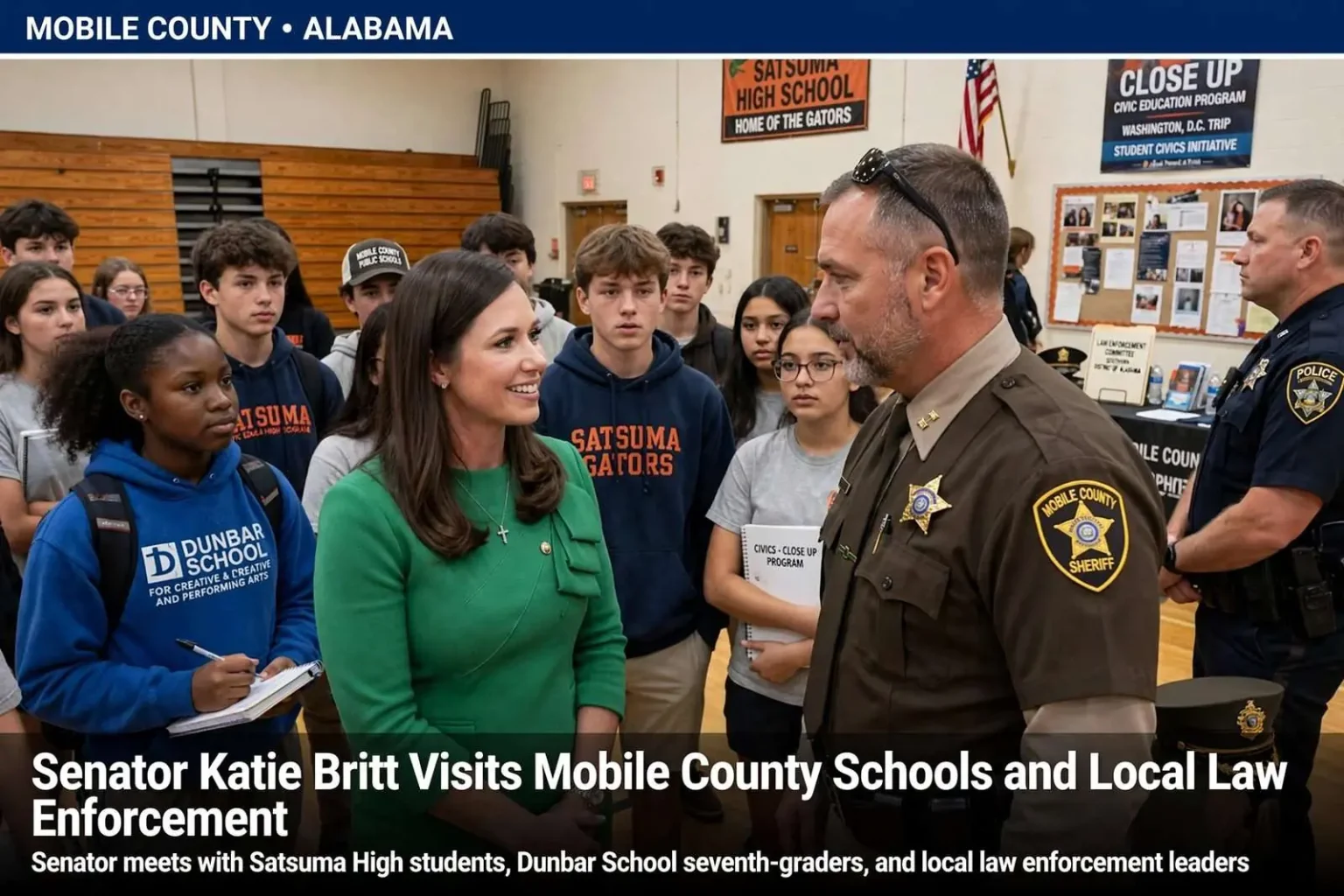
U.S. Senator Katie Britt made a series of stops across Mobile County last week, visiting local schools and meeting with law enforcement leaders in the Southern District of Alabama, a swing through the county that put Alabama’s junior senator face to face with students, teachers, and the officers and deputies who patrol the state’s second-largest metro area.
The visits blended the two themes that have defined Britt’s early Senate tenure — education and public safety — and gave her the kind of unscripted, local-level contact that senators from both parties treat as essential to representing a state as geographically and culturally varied as Alabama. From a high school gymnasium in Satsuma to a civics classroom in Mobile and a committee room full of police chiefs and sheriffs, the itinerary covered a cross-section of the county’s civic life.
At Satsuma High School
Britt stopped at Satsuma High School, where she met with students and teachers who participated in the school’s “Close Up” program, a civic education initiative that brings students to Washington, D.C., to learn about government firsthand. For students who have made the trip, Close Up is often a formative experience: the program pairs classroom preparation with a week in the capital, where participants visit the institutions they have studied, attend workshops with peers from around the country, and see the mechanics of federal government up close.
Britt’s conversation with the Satsuma group gave the students a chance to describe what they saw and ask the questions that occur to people who have just watched the system operate from the inside — how bills actually move, what a senator’s day looks like, and how a lawmaker balances national business with the needs of constituents back home. For a program whose purpose is to make government tangible, a visit from a sitting senator is a natural capstone, and Britt’s office has treated school visits as a standing part of her schedule since taking office.
Satsuma, a small city in northern Mobile County, sits among the county’s suburban and industrial corridor along Highway 43, and its high school serves a student body drawn from the surrounding communities. The Close Up group represents a small slice of the school but an ambitious one, and teachers who run such programs often spend a year fundraising and organizing before the trip itself.
Questions From Seventh-Graders
Engaging with students at Dunbar School for Creative and Performing Arts, Britt took questions from seventh-graders in a civics class about current events. The session put the senator in front of middle schoolers — an audience less filtered than any other she faces — and questions about the news of the day from seventh-graders tend to be direct in ways that lobby questions are not.
Dunbar’s identity as a creative and performing arts school gave the visit a particular character. The school, a long-standing part of Mobile County Public Schools, integrates arts training into its academic program, and its students are accustomed to performing and presenting — which tends to produce confident questioners. Britt’s stop fit a pattern she has followed across the state of visiting schools at every level, from elementary classrooms to university campuses, and talking about the institutions that shape Alabama students’ futures.
According to a Facebook post from Mobile County Public School administration, Britt also gave a pep talk during a school-wide assembly, encouraging students to “get back up if they are ever knocked down.” The message — resilience over perfection — is a staple of school assemblies, but it carried additional weight coming from a senator who has built her public profile partly on her own biography, and who frequently frames her work in Washington around opportunity and mobility for Alabama families.
For the school system, the visit was also a moment of visibility. Mobile County Public Schools is the largest school system in Alabama, serving tens of thousands of students across urban, suburban, and rural attendance zones, and the district’s leadership regularly invites state and federal officials into its buildings to see the range of programs it operates, from magnet arts schools like Dunbar to career and technical academies across the county.
Meeting With Law Enforcement
Britt also attended a meeting of the Law Enforcement Committee for the Southern District of Alabama, where she expressed her gratitude to local law enforcement agencies. The committee brings together the chiefs, sheriffs, and federal partners whose jurisdictions overlap across the southern tier of the state — from Mobile city police and the Mobile County Sheriff’s Office to municipal departments and the federal agencies that share their caseloads — and its meetings are where interagency coordination gets worked out in practice.
Mobile County Sheriff Paul Burch was among the attendees. Burch leads the sheriff’s office responsible for the county’s unincorporated areas and the contract policing of some municipalities, a jurisdiction that spans neighborhoods, farmland, and the county’s extensive waterways. The committee setting gave Britt the chance to hear directly from the people managing the region’s most persistent public safety challenges — staffing shortages that have touched departments across the country, the flow of illegal drugs through Gulf Coast corridors, and the funding streams, including federal grants, that local agencies rely on to supplement their budgets.
For senators, meetings like this one do double duty: they provide the thank-you moment that local agencies appreciate, and they feed the detail work of a Senate office that helps communities pursue federal grants, supports hiring programs, and weighs the legislation that shapes how local police departments operate. Britt has made public safety one of her signature issues in her first term, and appearances with law enforcement are among her most frequent public events.
Why Mobile County Matters to the State’s Politics
Mobile County occupies a distinctive place in Alabama politics and civic life. It is one of the state’s most populous counties, home to the port of Mobile, a major shipbuilding and aerospace industrial base, and a school system whose size rivals small states’ districts. For a statewide officeholder, a day in Mobile County reaches audiences that no other single county can match, and Britt’s itinerary — a suburban high school, a city arts school, and a law enforcement committee — was a compressed tour of the constituencies that matter most to the region.
Britt, who won election to the Senate in 2022 after serving as president and CEO of the Business Council of Alabama and as chief of staff to her predecessor in the seat, has emphasized school visits and law enforcement meetings as the two most consistent elements of her in-state schedule. Her office describes those engagements as the input side of her legislative work: the conversations that shape what she pursues in Washington, from education funding and workforce programs to the public safety grants that flow to local agencies.
What Students Took Away
The student-facing stops are the ones likely to endure for the participants. Middle and high school students rarely have direct contact with federal officials, and a civics class that can ask a United States senator about current events — and get a direct answer — experiences government in a way no textbook can replicate. For the Close Up students at Satsuma, the senator’s visit bookended their Washington trip with a reminder that the officials they saw in the capital are accountable back home, in gymnasiums and classrooms exactly like theirs.
Teachers and administrators note that such visits also raise the profile of the programs that host them. Civic education initiatives like Close Up compete for attention and funding within crowded school calendars, and a senator’s presence validates the work of the teachers who organize it. At Dunbar, the assembly pep talk and classroom questions alike sent the school’s students a message about their own potential at a formative age.
The Message to Law Enforcement
For the law enforcement leaders in the room, Britt’s expression of gratitude was paired with the practical listening that committees like the Southern District’s exist for. Local agencies across Alabama have spent recent years navigating recruitment and retention pressures, evolving expectations about policing, and the operational demands of the region’s geography — a port city, interstate corridors, rural county stretches, and the waterways of Mobile Bay. Federal partnership, from grant programs to task force coordination, is a recurring theme in those discussions, and a senator’s attendance signals that the concerns raised in the room have a route to Washington.
Burch’s presence alongside chiefs and other sheriffs reflected the county’s position at the center of the region’s public safety network. The Southern District of Alabama — the state’s federal judicial district spanning Mobile and the counties to its north and east — provides the frame within which local, state, and federal agencies coordinate on the cases that cross jurisdictional lines, and the committee meeting gave Britt a window into how that coordination is working on the ground.
Together, the week’s stops painted a picture of a senator working the district the traditional way: one classroom, one assembly, and one committee room at a time, collecting the conversations that will follow her back to Washington. For Mobile County’s students and officers alike, the visits offered direct access to the office-holder, and for Britt they offered the unfiltered sound of the constituency she represents.