
Severe Weather Prompts Closings and Cancellations Across Mobile and Baldwin Counties
Severe weather prompted closings and cancellations across Mobile and Baldwin counties, including an I-10 ramp closure and postponed school events.
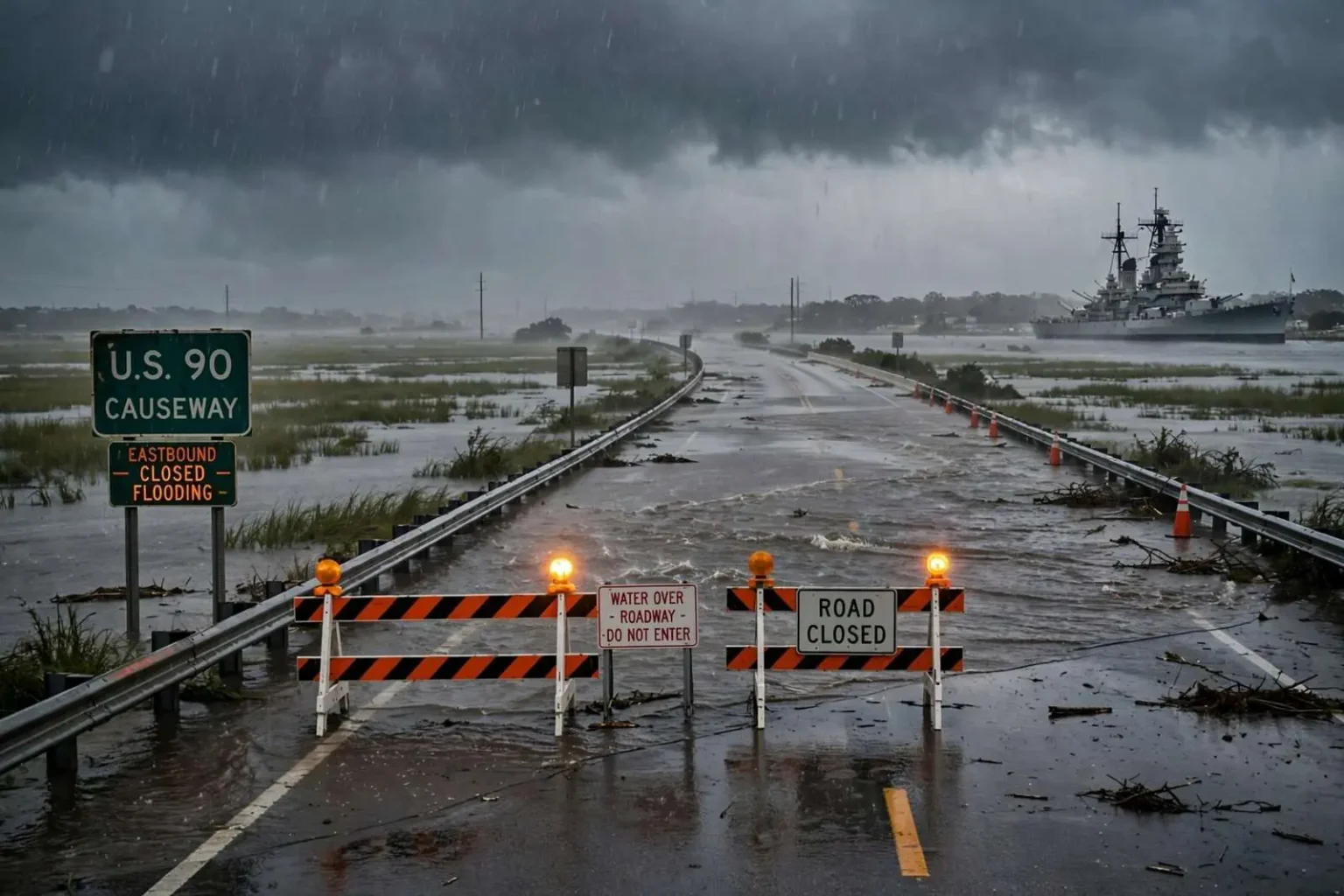
MOBILE, Ala. — With severe weather approaching the Gulf Coast, a string of closings and cancellations went into effect Friday night and Saturday, touching government offices, schools, colleges and attractions on both sides of Mobile Bay. The list of changes grew through the evening as rain moved in and water began to pool along some of the area’s most flood-prone roads.
ALDOT’s Mobile office said the eastbound I-10 on-ramp was closed because water covered the Causeway, and crews could soon close the outside eastbound lane as water levels kept rising. The U.S. 90 Causeway, which carries traffic across the northern end of Mobile Bay alongside the interstate’s Bayway, is among the first roads in the region to flood whenever heavy rain and high water coincide, and state transportation officials monitor it closely during coastal storm events.
When water sheets across the Causeway, drivers lose their alternative to the I-10 bridge, funneling traffic onto the interstate and stretching travel times across the bay. That is exactly what a closing announcement on a storm weekend signals: plan around it, and stay off flooded roads altogether, since water-covered pavement hides road damage and stalls engines in depths that look deceptively shallow from behind the wheel.
Schools and colleges act first
Mobile County Public Schools postponed all Saturday sporting and extracurricular activities, events and practices, the district’s standard move whenever forecasts put storms over the county during hours when buses, families and student athletes would normally be on the roads. The blanket postponement covered dozens of scheduled events across the county’s far-flung campuses, from Friday night follow-ups to weekend tournaments and band events.
Across the bay, Baldwin County Public Schools canceled all school events scheduled for Saturday, the same precaution applied to Alabama’s largest county by area. Baldwin’s campuses spread from the bay shore to the beach communities, and a single countywide cancellation spared families in Foley, Fairhope, Bay Minette and Gulf Shores from making their own calls about whether to venture out.
Bishop State rescheduled Saturday basketball games for Sunday, giving the community college’s athletic calendar a one-day slide rather than a loss. Home games draw students, families and fans to the campus, and moving them by 24 hours is the kind of adjustment institutions prefer when the forecast suggests the weather will clear as quickly as it arrived.
Attractions and government offices
Battleship Memorial Park closed Saturday because of the weather. The park, home to the battleship USS Alabama and the submarine USS Drum along the Mobile Bay shore, sits on low ground beside the Causeway approach, and its outdoor-heavy visitor experience — deck tours, aircraft displays and sprawling grounds — is no place for visitors in lightning and driving rain.
The Mobile Police Department rescheduled its 5th annual Chili Cook-Off, joining the long list of community events pushed off the storm weekend. Outdoor festivals and fundraisers are particularly exposed to weather cancellations, and organizers typically announce new dates once the weekend’s conditions are known.
Baldwin County driver license offices delayed their Saturday opening hours, a practical change for the state offices that handle licensing transactions on the weekend. Residents who planned Saturday morning trips to handle renewals were advised to check the updated hours before driving, since a delayed opening could cost them a wasted trip across town in worsening weather.
Dialysis patients and the priority of continuity
The FKC Dialysis Clinic in Jackson planned to open an hour early, asking patients to call the clinic at 251-246-6667 if staff had not already reached them. The adjustment reflects a reality of severe weather that easy to overlook: dialysis patients cannot simply skip a treatment because a storm is coming. Missed sessions carry serious medical consequences, so clinics shift their schedules — opening early, treating patients before conditions worsen, and working through patient lists by phone to make sure no one is left guessing.
Jackson, the seat of Clarke County, sits inland enough that its clinic serves patients from surrounding small communities who may drive 20 minutes or more for treatment. Getting those patients treated and home before the worst weather arrived was the point of the early opening, and the clinic’s request that patients call if they had not been contacted was a belt-and-suspenders measure to account for phone failures and missed messages.
Dialysis continuity is one of the standard checkboxes in Gulf Coast storm planning. Emergency management agencies work with healthcare providers across the region to identify patients who need treatment on fixed schedules, and providers in turn build weather contingency plans — generator fuel, extra staffing, shifted shift starts — that activate whenever a storm threatens the service area.
Why the cancellations pile up
Lists of closings like Friday night’s reveal how interconnected the region’s weekend schedule is. A single storm system touches school athletics, collegiate sports, municipal events, tourism operations and government services all at once, and each institution makes its own call on roughly the same forecast. The public-facing result is a cascade of announcements on Friday evening as organizations decide ahead of the weather rather than during it.
The decisions lean on a shared principle: nothing on a weekend schedule is worth a rescue. Emergency managers across the two-county area repeatedly stress that events can be rescheduled but stranded motorists, water rescues and storm injuries cannot be undone. Closing an attraction or postponing a game costs organizers revenue and families inconvenience; holding them in dangerous weather costs first responders.
For residents, the guidance that accompanies every such list is consistent. Stay off flooded roads — especially the low-lying routes across the bay, where water can rise faster than a car can turn around. Check with organizations directly before traveling to anything still showing on a schedule. And treat every barricade and closed ramp as the warning it is, placed by crews who have seen what Gulf Coast water does to drivers who chance it.
Looking past the weekend
Storm systems that sweep the central Gulf Coast typically clear quickly, and most of the affected events — the chili cook-off, the Bishop State games, the school activities across two counties — were expected to find new dates within days. The rescheduling work that follows a weather weekend is unglamorous but routine: athletic directors negotiating open dates, event organizers securing venues a second time, and families updating their own calendars to match.
The infrastructure impacts take longer to wash out. Standing water on the Causeway and other low roads has to drain before lanes can safely reopen, and crews spend the hours after a storm clearing debris and checking for washouts. By the time the region’s weekend events returned to their schedules, the transportation disruptions of Friday night were expected to be a memory — until the next system lined up over the Gulf and the cycle of closings began again.
The geography of Gulf Coast flooding
The Mobile Bay area’s flood problems concentrate along its margins. The Causeway and the communities around it sit at the bay’s northern edge, where the Mobile and Tensaw rivers deliver runoff from a vast inland watershed and where tide and stormwater meet. When heavy rain falls while the rivers are running high, the low roads across the delta flood first and reopen last, which is why transportation officials watch them as leading indicators for the whole network.
South of the city, the topography changes but the vulnerability does not. Streets in the older neighborhoods near the port drain slowly during downpours, roads through the western suburbs pond where ditches clog, and across the bay in Baldwin County, flat coastal terrain turns cloudbursts into standing water that lingers for hours. A storm weekend like this one touches every one of those places, and the closings reflect a region that has learned its own drainage map through repetition.
How residents track the changes
The announcements flowed through the usual channels: agency social media accounts, newsroom aggregations of closings, and direct notifications from the schools and organizations themselves. Residents in the middle of a storm weekend typically run a rotating checklist — the district’s page, the college’s athletics feed, the attraction’s website — and the advice from emergency officials is to confirm with the source rather than trusting word of mouth, since statuses can change between dinner and bedtime as the forecast shifts.
Transportation information moves the fastest of all, because it changes the most. Road closures during a coastal rain event can appear within minutes as water rises, and the state and county crews that post them update throughout the event. Drivers heading out Saturday morning were advised to assume that any road across the delta could be closed and to check before they left home rather than discovering a barricade at the water’s edge.
The weekend’s list of closings, in the end, did what such lists are designed to do: it kept thousands of people — students, fans, festival-goers, patients, tourists — out of the weather’s path while the system passed through. The cost was a reshuffled calendar across two counties; the benefit was a region that rode out the storm with everyone where they were safest, waiting for the water to recede.