
Shattered Vehicle Windows in Saraland Spark Rumors, But Police Find No Evidence of Gunfire
Several Saraland vehicles had windows shattered in December 2019. Police say investigations found no evidence bullets struck any of them.
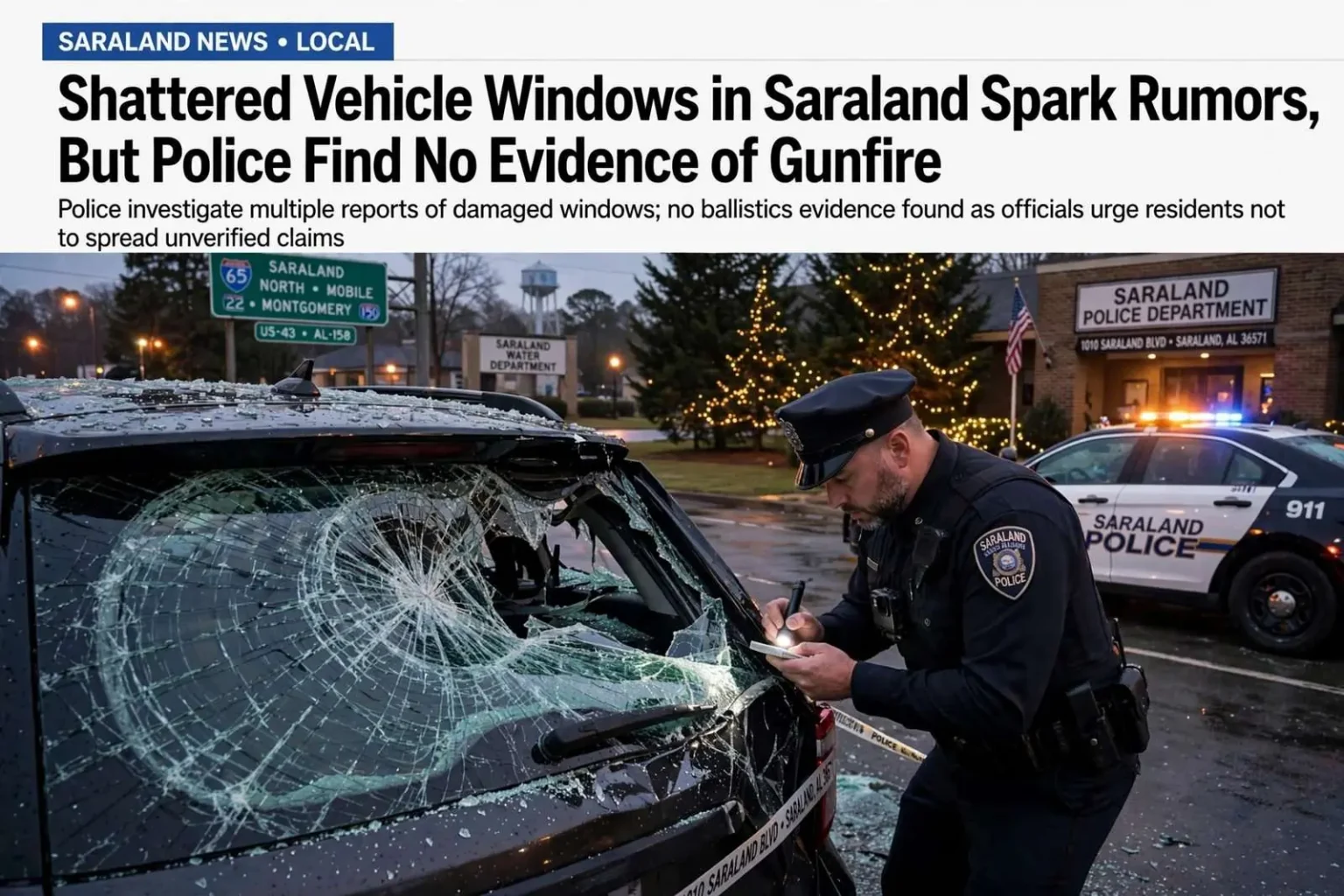
Saraland police are working through a string of reports involving damaged vehicle windows across the city, and they are also trying to tamp down a wave of social media speculation suggesting that someone was shooting at cars. The rumors spread quickly after photographs of a shattered rear windshield began circulating on Facebook, prompting worried residents to ask whether a gunman was targeting drivers along busy corridors such as U.S. 43 and Interstate 65. Investigators with the Saraland Police Department say that so far, nothing in the evidence supports the gunfire theory, and they are urging residents not to let speculation outrun the facts.
The most widely shared account came from a family that was driving to look at Christmas lights on a Thursday evening when something struck their rear window as they passed near the Saraland Water Department. The driver pulled over a short distance away and found the back windshield shattered, with a small hole visible in the glass. No one inside the vehicle was hurt, and it remained unclear exactly what object caused the damage. The family shared photographs of the broken window online, and the images circulated widely on Facebook within hours, drawing hundreds of comments from neighbors who reported similar damage to their own vehicles in recent weeks.
Saraland sits in the northern reaches of Mobile County, wedged between Prichard and Satsuma along the I-65 corridor that carries commuters and freight between Mobile and the rest of the state. With roughly 16,000 residents, it is the kind of city where a single alarming Facebook post can reach a large share of the population in an evening. That speed is exactly what worried police officials as the broken-window reports piled up, because unverified claims about shooters on the roadway can cause genuine panic even when the underlying damage turns out to have an ordinary explanation.
By the time investigators finished their first round of interviews, a clearer picture had begun to emerge. What looked like a coordinated attack on motorists appeared, at least so far, to be a series of separate incidents with a variety of possible causes, each of which needed its own documentation and follow-up.
Police: No Bullet Evidence Recovered
A separate social media post claimed teenagers had shot at a car on Interstate 65, amplifying fears that drivers were being targeted at random. But investigators with the Saraland Police Department said their review of multiple broken-window cases reported across the city turned up no evidence that any of the windows had been struck by a bullet. In a statement, the department said it had located and spoken with everyone involved in one of the incidents, which has since been closed, while the remaining cases continue to be investigated as leads develop.
The distinction matters to residents because the response to each kind of incident is different. A shooting investigation brings in ballistics work, searches for expended rounds and coordination with neighboring agencies along the interstate. A vandalism or road-debris case is handled as a property crime report, with officers documenting the damage and looking for witnesses or camera footage from nearby homes and businesses. Until physical evidence says otherwise, Saraland police are treating the cluster as a set of individual cases rather than a single string of attacks.
Officers have not ruled anything out, and they have continued to ask the public for help. Anyone whose vehicle window is damaged is encouraged to file a police report so each case can be documented, mapped and investigated on its own merits. Pattern analysis of that kind is often what separates a coincidence from a real trend, particularly in a city where thousands of vehicles pass through on the interstate every day.
How Investigators Separate Gunfire From Other Causes
When a windshield or rear window fails with a small hole in the glass, the fracture pattern tells investigators a great deal. A bullet striking tempered glass typically produces a distinctive cone-shaped break, with fragmentation radiating outward from the impact point and a spray of debris on the far side. Glass technicians and crime-scene officers are trained to look for that signature, along with any projectile fragments, powder residue or transfer marks embedded in the glass or the vehicle interior.
Ordinary road hazards produce very different results. Gravel kicked up by trucks, discarded debris from unsecured loads, failing windshield wiper arms and even sharp ice or hard-packed mud can all crack or punch through glass, and none of them leave the telltale signs of a firearm. Objects thrown from overpasses or passing vehicles are another recurring culprit on highways like I-65, and they can do dramatic damage that photographs easily misrepresent as gunfire.
Investigators also work the timeline and the geography. Reports that cluster along a single stretch of road at a particular hour suggest one cause, while damage spread across neighborhoods over several weeks points to unrelated events. In the Saraland cases, the reports came from different parts of the city and involved different vehicles at different times, which is consistent with the department’s public conclusion that no single actor appears to be responsible so far.
For the family involved in the most talked-about incident, the damage was more than an inconvenience. A shattered rear window in the middle of the Christmas light season means a compromised vehicle, a repair bill and the lingering question of what, exactly, came through the glass. Modern rear windows are made of tempered glass, which is designed to break into small granular pieces rather than sharp shards, so a single impact can cause the entire pane to fail at once. That dramatic result looks alarming in photographs, but it also makes the underlying cause harder to identify after the fact, since the glass typically cannot be reassembled the way laminated windshield glass sometimes can.
Insurance coverage for the repair depends on the circumstances. Comprehensive auto policies generally cover glass damage regardless of cause, though the policyholder’s deductible applies. When the damage results from a criminal act, a police report becomes important documentation for the claim, which is one more reason investigators want every affected driver to come forward rather than simply posting photos online.
When Rumors Outrun the Evidence
Law enforcement agencies across the Gulf Coast have learned to move quickly when social media rumors about shootings begin to spread. Unconfirmed reports of someone firing at vehicles can change driver behavior, prompt schools and parents to alter routines and generate a flood of 911 calls that compete with genuine emergencies. In communities along the I-65 corridor, where a shooter story can travel from Saraland to Satsuma to Mobile in a single evening, police departments have increasingly used their own social media accounts to correct the record as soon as preliminary findings allow.
That is effectively what the Saraland Police Department did with its statement. Rather than letting the gunfire narrative harden, the department confirmed which claims had been checked, disclosed that one incident had been resolved after investigators spoke with everyone involved, and kept the door open on the cases still under review. The approach reflects a balance familiar to public information officers everywhere: say enough to calm fears, but not so much that it compromises an active investigation.
Residents who want to help can do several things that genuinely assist the inquiry. Photograph the damage before any repairs, note the time and location where it may have occurred, check whether home security or doorbell cameras in the area captured anything, and file the police report even when the damage seems minor or the cause seems obvious. A pattern built from complete reports is far more useful to investigators than a pattern reconstructed from social media posts after the fact.
Drivers who discover shattered glass while on the road should pull over safely before inspecting the vehicle, both for their own protection and to avoid creating a hazard for other motorists. Tempered glass that has failed can collapse without warning, and driving with a missing rear window kicks fragments and dust through the cabin. If the damage occurs on the interstate or another high-speed roadway, the safest move is to exit at the next opportunity and call from a parking area rather than stopping along the shoulder.
What Comes Next in Saraland
The department has said the remaining cases continue to be investigated as leads develop, and additional reports from affected drivers could still sharpen the picture. If a genuine pattern does emerge, investigators would look for common factors in location, time of day, type of vehicle or type of damage. If the cases remain scattered and unconnected, the most likely outcome is that each one is resolved individually, with some attributed to road debris, some to vandalism and some closed for lack of evidence.
What the episode has already demonstrated is the speed at which a local mystery can grow online. A single family’s broken rear window, photographed and shared near the Saraland Water Department, became a citywide conversation about highway shootings within days. The Police Department’s message to residents has been consistent throughout: report the damage, document everything, and let the evidence rather than the speculation determine what actually happened. Anyone with information about any of the damaged-vehicle cases is encouraged to contact the Saraland Police Department directly.


