Sheriff Burch: Deputy With 2,613 Overtime Hours ‘Cheated the System’
Mobile County Sheriff Paul Burch says Sgt. Daniel Holifield cheated the overtime system while collecting $148,000 in OT pay in 2022.
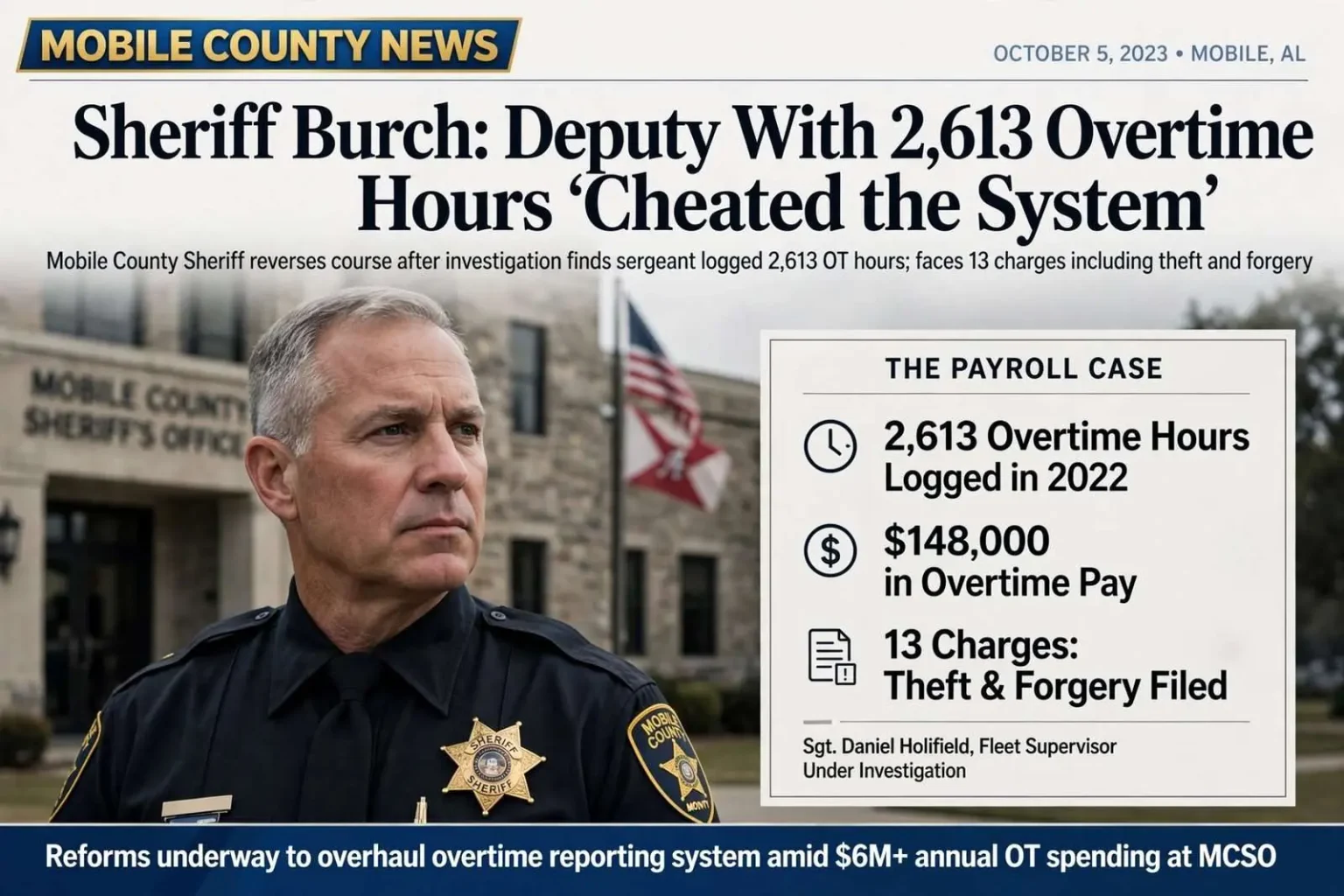
Mobile County Sheriff Paul Burch has reversed himself on one of the most striking payroll cases in his department, announcing that the sergeant who logged 2,613 hours of overtime in a single year was gaming the system. The admission marked a sharp turn for a new sheriff who had initially defended the pay, and it opened a public accounting of how overtime is recorded, approved and paid inside one of Alabama’s largest law enforcement agencies.
Burch had previously defended the overtime pay of Sgt. Daniel Holifield, head of the sheriff’s office vehicle fleet, telling reporters earlier this month that no one had cheated the system. That defense collapsed after Burch launched an investigation into Holifield’s overtime sheets, an inquiry prompted by Holifield’s arrest on 13 charges including first-degree theft of property and ten counts of second-degree criminal possession of a forged instrument.
“I was not correct when I said there is no way to cheat the system,” Burch said in a statement Thursday. “I launched an investigation into Daniel Holifield’s overtime sheets, and I found there is a way to cheat the system. Daniel Holifield cheated the system.”
The sheriff said he shared his findings with the District Attorney’s Office and would make no further comment on the case. The referral places the overtime question alongside the criminal charges already pending against Holifield, and it means the case will now be examined by prosecutors independent of the sheriff’s office that employed him.
From Defense to Investigation
The reversal came in stages. When the scale of Holifield’s overtime first surfaced, Burch stood by the payroll record and rejected the suggestion that anyone had found a way around the office’s controls. The arrest on theft and forgery charges changed the calculus entirely, giving the sheriff both a legal predicate and a political imperative to pull the overtime sheets apart and examine them line by line.
The investigation that followed examined how a fleet supervisor, a position whose duties revolve around the care and assignment of the agency’s vehicles rather than emergency response, could accumulate more overtime than any deputy working patrol shifts. The answer, according to Burch, was that the system itself contained gaps, and that Holifield had found and used them. The sheriff’s blunt retraction, issued in his own name and quoting his own earlier words, was an unusual public self-correction from a department head.
The Numbers Behind the Case
Holifield collected $148,000 in overtime pay during 2022, according to an investigation earlier this month. Payroll records show his 2,613 overtime hours would have averaged out to 92-hour work weeks across 50 weeks if he took two weeks off, or 12.6 hours a day, every day of the year, if he never rested. Either way, the arithmetic describes a schedule that would leave little room for anything else, and it is the implausibility of the numbers that turned a payroll dispute into a fraud investigation.
Overtime on that scale also carries a price tag that ripples through a department budget. At the rates the sheriff’s office pays, $148,000 in extra pay for a single sergeant represents a substantial slice of the office’s overtime spending, money that Burch and county commissioners must find in a budget funded by Mobile County taxpayers. The revelation that some of that spending may rest on falsified records added a financial dimension to a case that was already a criminal matter.
The criminal charges against Holifield give the overtime question its legal frame. First-degree theft of property is the most serious tier of theft in Alabama’s criminal code, typically reserved for the highest dollar amounts, and second-degree criminal possession of a forged instrument targets the possession of forged documents with intent to use them. Ten counts of the forgery charge alone suggested a pattern rather than an isolated incident, and the overlap between those charges and the overtime sheets was the thread Burch’s investigation pulled.
Under Alabama law, sheriffs are independently elected constitutional officers who run their departments with considerable autonomy, which means the accountability for payroll practices inside the Mobile County Sheriff’s Office rests with the sheriff himself. Burch, who took office in January after winning the post, inherited the overtime system he now acknowledges was vulnerable, and the case has become an early defining test of his administration’s promise to run a tighter operation than the one he took over.
A Broader Overtime Picture
The sheriff’s office paid more than $6 million in overtime last year overall, a figure that dwarfs the individual cases and reflects the chronic staffing pressure on an agency responsible for patrolling Alabama’s most populous county, running the county jail and providing law enforcement coverage across unincorporated Mobile County. Holifield wasn’t alone in extreme territory: another sergeant logged roughly 2,392 overtime hours for about $142,000 in extra pay, a total that approaches Holifield’s despite drawing no criminal charges.
And the extremes extend beyond the top two. Eighteen MCSO employees each topped 1,000 overtime hours, at least 20 extra hours a week on top of their regular schedules, combining for $1.3 million in additional pay. Viewed together, the numbers describe an agency in which heavy overtime was not an anomaly but a structural feature, whether driven by understaffing, by the demands of running a large jail, or, in at least one case, by manipulation of the reporting system itself.
Overtime dependence of that magnitude is a familiar problem for sheriff’s offices across Alabama and the country. Deputies must staff patrols around the clock, jails must be covered at all hours regardless of vacancies, and when hiring lags behind attrition the gap is closed with overtime. The costs compound quickly, both in budget dollars and in fatigue among the officers carrying the extra hours, which is why the integrity of the overtime reporting system matters as much as its price.
The Reforms Already Underway
Burch said reforms already made to the overtime system cover how, when, and to whom employees report their hours, adding more oversight to a process that had allowed one supervisor to accumulate the equivalent of a second full-time job on paper. The changes shift the office toward a model in which overtime is reported through defined channels and reviewed before payment rather than after, closing the specific pathway the investigation found.
The case has also become part of a larger public conversation about pay and accountability inside the sheriff’s office. Rank-and-file deputies who worked legitimate extra hours to cover understaffed shifts watched the Holifield case unfold with frustration, knowing that every dollar paid on falsified sheets was a dollar unavailable for the overtime the agency genuinely needs. Burch’s willingness to publicly repudiate his own earlier defense signaled that the office intends to treat the payroll system, not just the individual, as the object of reform.
With the findings now in the hands of the District Attorney’s Office, the criminal process will determine what consequences follow for Holifield, whose forgery and theft charges already carry serious penalties. The sheriff’s own accounting, delivered in a statement that conceded his earlier defense was wrong, closed the loop on the immediate question and left the office to absorb the lesson: the system that allowed 2,613 hours of paper overtime has been changed, and the man accused of exploiting it now answers to prosecutors rather than payroll.
The vehicle fleet assignment at the center of the case deserves particular attention. Fleet supervision is a support role, essential to any agency that runs hundreds of vehicles across patrols, investigations and jail operations, but it is not a position where emergencies generate overtime the way a patrol shift or a jail housing unit does. That an administrator in that role could out-earn officers working active duty overtime was precisely what made the payroll records so conspicuous once questions were asked.
The arrest that triggered the review also raised the question of what, exactly, the forged instruments were. Prosecutors have not detailed the evidence publicly, and Burch declined to elaborate beyond his statement, but ten separate counts of criminal possession of a forged instrument point to a series of documents rather than a single act, consistent with a pattern of falsified records submitted over time. The District Attorney’s Office will now weigh those charges alongside whatever the overtime investigation produced.
For Mobile County taxpayers, the episode lands at a moment of general scrutiny of public safety spending. More than $6 million in annual overtime is not a secret expenditure; it is an ordinary line in a large agency’s budget, approved year after year because the work it covers must be done. What turned this year’s figure into a scandal was not its size but its shape: the concentration of extreme payouts in a handful of records, one of which the sheriff now says was fraudulent.
Burch’s first months in office have therefore been defined by an unwelcome discovery and a choice about how to handle it. He could have resolved the case quietly through internal discipline. Instead, he retracted his own public statement, ordered an investigation, referred the findings to prosecutors and began rebuilding the reporting rules that failed. Whether those reforms hold will be measured in next year’s payroll, in the overtime totals of the eighteen employees who crossed the thousand-hour mark, and in whether the county’s largest law enforcement agency can cover its shifts without paying twice for the same hour.