Sheriff’s Office Joins School Investigation Into Threat at Grand Bay Middle
Mobile County schools and the sheriff's office are investigating a letter threatening Grand Bay Middle School, which officials say is not credible.
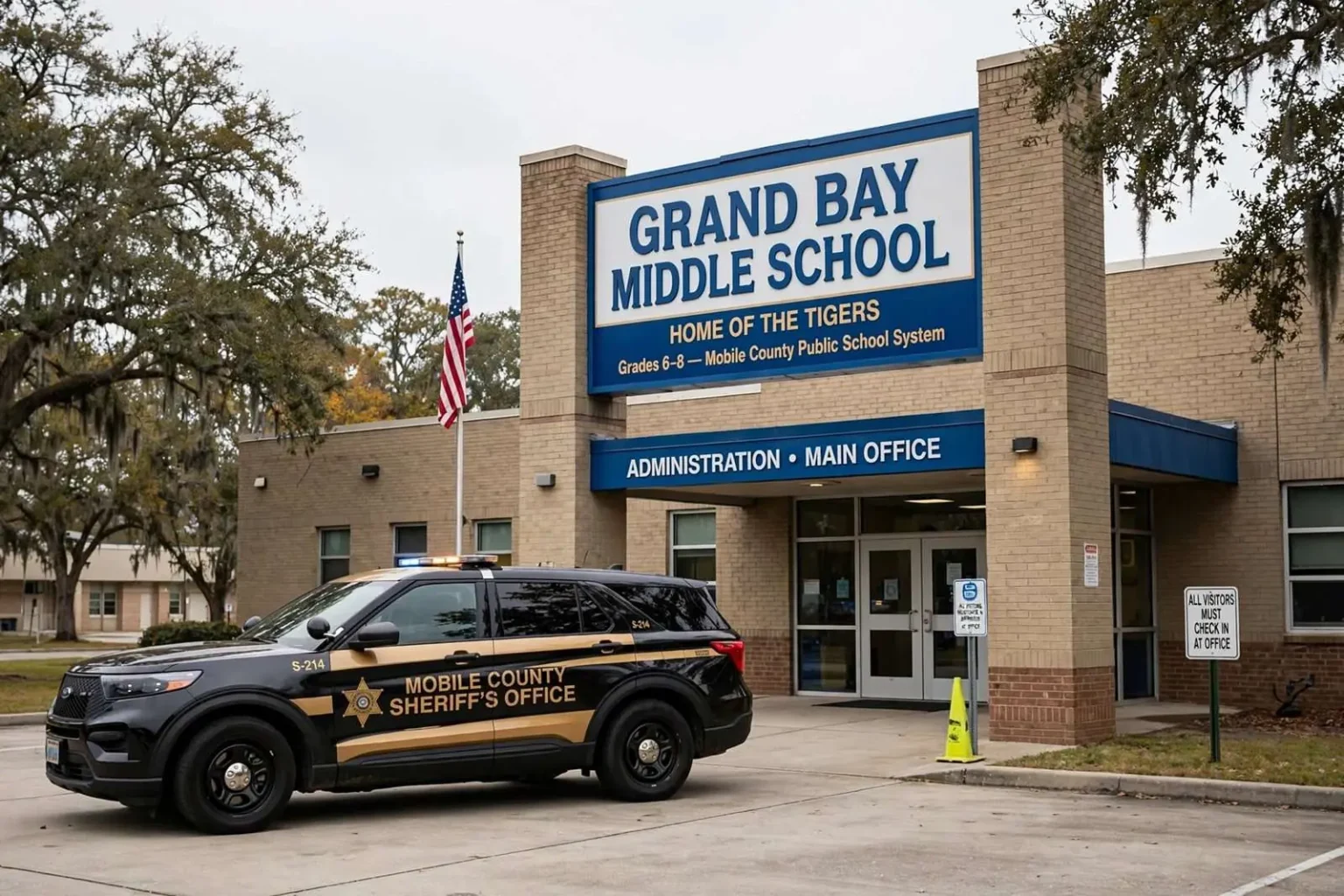
Officials with the Mobile County Public School System and the Mobile County Sheriff’s Office are investigating a threat directed at Grand Bay Middle School after a letter was delivered to the campus on Friday. District officials said there is no evidence the threat is credible, and no changes to the school day were announced. The response has followed the pattern school leaders in Mobile County apply to threats of any kind, whether they arrive by letter, phone call, or social media post, and it reflects a growing expectation across Alabama that even unsubstantiated threats against a campus will be documented, investigated, and referred to prosecutors when a responsible party can be identified.
What Officials Say Happened
According to school officials, the campus received a letter Friday containing the threat. Administrators immediately notified the district’s central office and law enforcement, which triggered a joint review involving investigators from the Mobile County Sheriff’s Office. Grand Bay Middle School serves students in the fast-growing southwestern corner of Mobile County, an area along U.S. Highway 90 that sits between the industrial corridor of Pascagoula, Mississippi, and the western edge of the city of Mobile, drawing families from the Grand Bay community and surrounding rural neighborhoods.
The Mobile County Public School System is the largest school district in Alabama, serving tens of thousands of students across more than 90 schools spread over more than 1,200 square miles, from downtown Mobile to the small communities near the Mississippi state line. Because the district is so large, threats against any single campus are handled locally by school resource officers and deputies assigned to that part of the county, with support from specialized investigators when circumstances warrant. Officials have said before that each report is reviewed individually before the district decides whether extra security or a schedule change is needed, and that the same framework was used here.
Principal Moves to Reassure Parents
Grand Bay Middle School principal Shawn Butler addressed families directly in a message posted to the school’s social media page, telling parents he is “absolutely comfortable that Grand Bay Middle School is a safe place to be.” The message was an attempt to get ahead of the rumors that tend to spread quickly in close-knit communities whenever word of a school threat begins to circulate among parents on social media and text messages. In communities like Grand Bay, where the school functions as a civic anchor as well as an educational one, that kind of direct communication from a principal carries weight that a generic district statement does not.
The notice told parents that the school was working with the sheriff’s office on the matter. It also asked families to reach out to administrators directly with questions rather than rely on secondhand accounts circulating in the community, a step district leaders routinely emphasize because inaccurate details can escalate anxiety and complicate the work of investigators. School systems across the Gulf Coast have learned in recent years that a single garbled social media post about a threat can do more damage to attendance and morale than the threat itself, and principals are increasingly expected to serve as the first and most trusted source of information for their own school families.
A Standard Response for Campus Threats
Threats made against schools in Mobile County are routinely referred to law enforcement even when investigators find no substance to them. The district has said before that it reviews each report before deciding whether extra security or a schedule change is warranted. In this case, school officials said there was no evidence the threat was credible, and classes proceeded on a normal schedule. That decision tracks with established practice: when a threat cannot be substantiated, districts generally avoid wholesale schedule changes that disrupt working families, while still maintaining heightened awareness on campus through additional staff presence or coordination with deputies.
School safety specialists generally describe a tiered approach to threats. The first step is assessing whether the communication names a specific time, method, or target, and whether the person responsible can be identified. Investigators also consider whether the threat was written by a student, an outsider, or someone attempting simply to disrupt the school day. Written threats delivered by letter are less common than those made online or by phone, but they are treated with the same seriousness, because every threat interrupts learning, consumes investigative resources, and unsettles families who entrust their children to the school each morning.
Under Alabama law, making a threat against a school or its occupants can carry serious criminal consequences, and prosecutors in Mobile County have historically pursued charges in cases involving threats to campuses, even when the threat turned out to be a hoax. School officials say the swift involvement of law enforcement serves two purposes: it protects students and staff, and it sends a clear message that threats against schools will not be brushed aside as pranks. Districts in the county have also adopted reporting tools that let students and parents pass along concerns anonymously, an approach credited with helping investigators resolve several past incidents before they could escalate.
The Sheriff’s Office Role
The Mobile County Sheriff’s Office is the primary law enforcement agency for unincorporated Mobile County, including Grand Bay, and it provides school resource deputies to campuses outside the city limits of Mobile and other incorporated municipalities. Deputies assigned to the southwestern district know the Grand Bay community well, and that familiarity often shortens the investigative timeline when something like this happens, because investigators already have working relationships with school staff and community members.
In threat investigations, sheriff’s investigators typically examine the physical evidence, interview staff and any witnesses, and review security footage from the campus and surrounding area. When a threat arrives in written form, document handling and analysis can become part of the process, and investigators may also look at digital evidence if the letter is connected to online activity. The sheriff’s office has not detailed the specific steps it is taking in this case, but the joint announcement with the school system signals a coordinated response, with both agencies sharing information as the review moves forward.
What This Means for Families
For parents in Grand Bay, the most immediate concern is whether their children are safe on campus, and school leaders have tried to answer that question directly. The message from the principal emphasized that the school remains a safe place and that administrators are available to answer questions. Families who want more information are encouraged to contact the school office rather than speculate online, and the district has historically reminded parents that direct communication with campus leaders is the fastest way to separate fact from rumor during an active investigation.
Communities across the Gulf Coast have seen a steady stream of school threats in recent years, both real and fabricated, and districts have learned that clear, early communication is one of the best tools for keeping panic to a minimum. When a threat cannot be substantiated, officials generally avoid major schedule changes, which can disrupt working families, while still increasing visibility on campus through additional patrols or staff presence. Counselors and school administrators in Mobile County have also stressed the importance of talking with students about the consequences of making threats, even as a joke, since a single message can lead to criminal charges, expulsion proceedings, and a lasting mark on a young person’s record.
No Changes to the School Day
No changes to the school day were announced at Grand Bay Middle, and regular operations were expected to continue while the investigation runs its course. District officials said updates would be shared with families if the investigation produces anything that changes the assessment of risk. The school system has asked anyone with information about the letter to contact the school or the sheriff’s office, and officials have noted that community cooperation is often what allows these cases to be closed quickly.
Grand Bay itself has grown steadily over the past two decades, with new subdivisions spreading along Highway 90 and the old fishing and farming community giving way to commuter families who send their children to the area’s schools every morning. That growth has made clear communication between the school and its families more important than ever, since many parents commute long distances and depend on timely, accurate updates from campus leaders whenever an incident occurs.
The investigation remains active, and both the Mobile County Public School System and the Mobile County Sheriff’s Office have said they will continue working together until the matter is resolved. Officials reiterated that threats of any kind against a school are treated as serious matters, that every report is documented, and that the safety of students and staff remains the district’s first priority as the review continues. For now, families in Grand Bay have been left with a simple message from their principal: the school is safe, the proper agencies are involved, and parents with concerns should come directly to the people who can answer them.