Silent Classic ‘The Wind’ Screens at Crescent Theater with Live Score by the Invincible Czars
The 1928 silent film The Wind screens at Mobile's Crescent Theater with a live score by the Invincible Czars and a homemade wind machine.
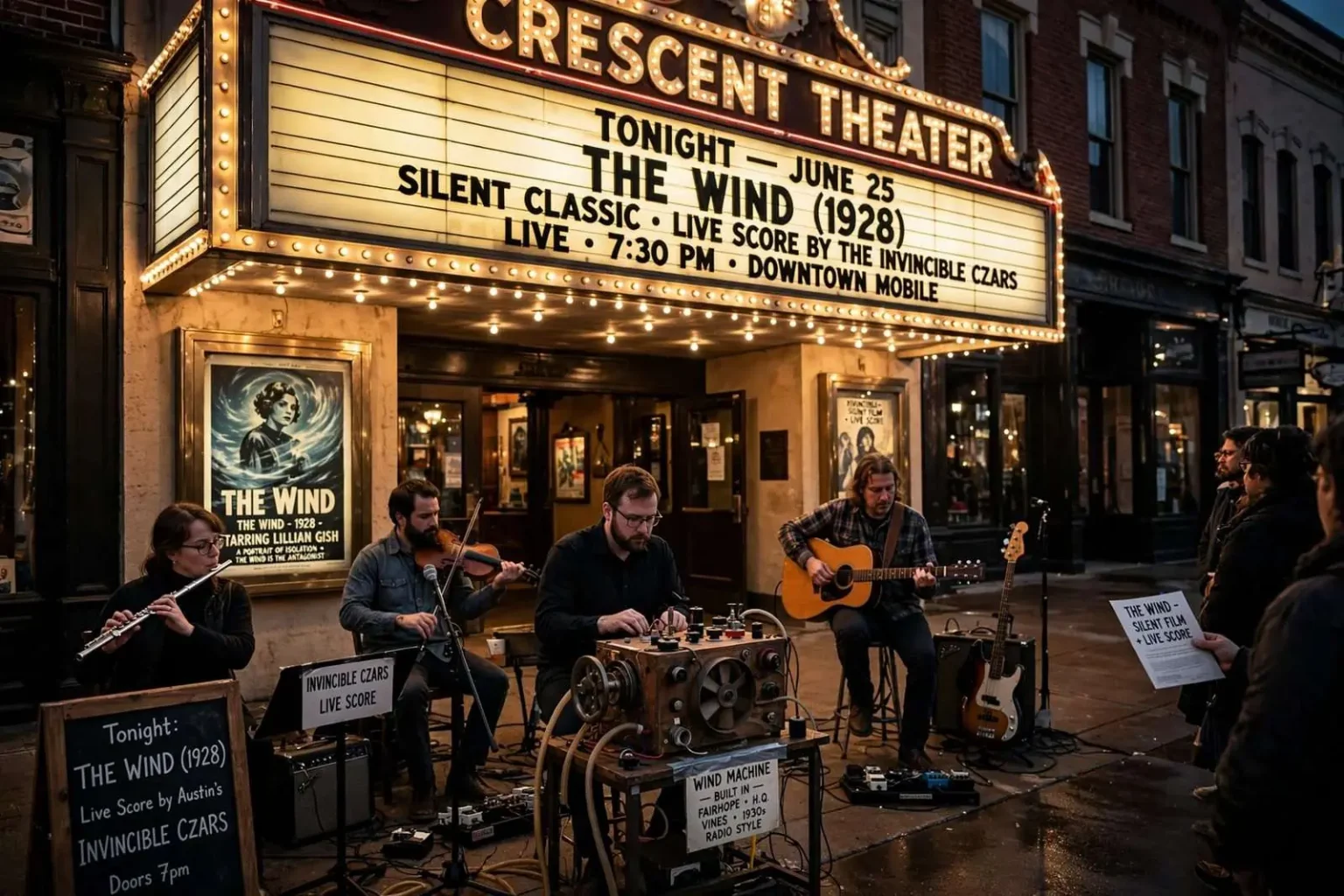
The Dust Bowl was headed to downtown Mobile’s Crescent Theater, where the 1928 silent film classic “The Wind” screened June 25 with a brand-new score performed live by Austin’s Invincible Czars. The pairing brought one of the silent era’s most celebrated and unsettling films to the Gulf Coast in the form cinephiles prize most: projected as intended, with live musicians answering the images in real time.
Based on Dorothy Scarborough’s novel of the same name, “The Wind” stars Lillian Gish in one of the silent era’s most haunting roles. Gish — already a legend by 1928 thanks to her work with director D.W. Griffith — plays Letty Mason, a young woman from Virginia who moves to the flat, treeless expanses of west Texas and finds herself slowly undone by the constant, shrieking wind and the isolation of life on the prairie. The film is widely regarded as one of the last great achievements of American silent cinema, released just as sound was about to sweep the industry away.
The book itself carried a bit of controversy: originally published anonymously, it so angered West Texas community leaders with its bleak depiction of life on the plains that they insisted its author could never have visited the region. Scarborough, who had in fact grown up on the Texas plains, eventually acknowledged her authorship, and the novel’s realism — the loneliness, the grit, the relentless elements — became part of a larger literary conversation about how the West was portrayed. The 1928 film adaptation leaned into that bleakness, and its famous ending remains one of the most debated conclusions of the silent era.
A Stripped-Down Score with a Fairhope Connection
The Invincible Czars’ dramatic soundtrack matched the film’s stark portrayal of west Texas, but the touring arrangement was anything but sprawling. The band performed as a four-piece — flute and clarinet, violin, electric bass and acoustic guitar, woven together with looping technology. Looping allowed the players to layer parts live, building a score with the texture of a much larger ensemble while keeping the touring footprint small enough to bring the film to theaters far from the major markets.
The group also brought along auxiliary instruments, most notably a homemade wind sound-effect generator built in the style of 1930s radio-era devices by bass player Henry Q. Vines — Fairhope’s own contribution to the evening. The device was more than a gimmick: in a film where the wind is effectively the antagonist, a physical, mechanical wind sound produced on stage gave the Mobile audience something movies with recorded soundtracks cannot quite replicate — the sense that the elements themselves were performing in the room.
The Crescent screening gave Mobile audiences a chance to experience the film the way its first audiences did — with the score unfolding live in the room — while also connecting the movie to the very landscape it depicts. Scarborough’s novel and the film both draw their power from a specific place: the Llano Estacado of west Texas, a region so flat and treeless that the horizon offers no shelter from the elements. The novel’s anonymous publication and the uproar that followed turned it into a piece of Texas literary history, and the film’s fidelity to that bleak vision is a large part of why it still commands attention nearly a century later.
Gish herself considered it among her finest work. She and the production traveled to the Mojave Desert for the exterior sequences, using real wind and sand rather than studio effects, and the physical toll of the shoot — sand driven by airplane propellers, temperatures well over a hundred degrees — shows on screen. The film’s visual style, with its mounting imagery of dust and motion, was designed for exactly the kind of immersive presentation the Invincible Czars’ score provides.
For downtown Mobile, the June 25 screening added one more entry to the Crescent’s reputation as a venue willing to take chances on unusual programming. In a market dominated by multiplexes, an art house that can fill seats for a 1928 silent film with a four-piece band and a Fairhope-built wind machine is doing something no streaming service can imitate. The format asks a little more of its audience — silence, attention, a willingness to meet a film on its own century-old terms — and rewards it with an evening no algorithm can replicate. Gulf Coast audiences turned out to prove it.
The screening also served as a reminder of how much quieter programming — film societies, repertory nights, director retrospectives — depends on venues like the Crescent. When a city loses its independent theater, it loses the only room where a night like this can happen: the 1928 print, the touring quartet, the instrument built in a Baldwin County workshop, and the audience all in one place. Mobile has held onto that room, and June 25 showed why it matters.
Silent Film, Live Music
Screenings pairing silent films with original live scores were a rare treat on the Gulf Coast, and the Crescent Theater — long a home for independent and specialty cinema in downtown Mobile — provided an intimate setting for the fusion of classic Hollywood and contemporary instrumental music. The theater’s single-screen, art-house character made it a natural fit for a film like “The Wind,” which benefits enormously from an attentive audience and a room quiet enough to hear every dynamic shift in the score.
Live-scored silent films have enjoyed a genuine revival in recent decades. In the silent era itself, theaters employed organists, pianists, and even full orchestras to accompany films, with scores ranging from published cue sheets to fully original compositions. When sound ended that tradition almost overnight, the art of live accompaniment nearly vanished. Modern revivals treat the score as a creative act in its own right — new music written for a century-old film, performed by working bands — and audiences respond to the unpredictability of it: no two performances are ever quite the same.
The Invincible Czars have built a national reputation on exactly that formula, touring silent film classics with original scores that draw on classical, rock, and experimental influences. For a band from Austin — a city with its own deep music-film culture — the road show format lets them bring both their musicianship and a piece of film history to cities that rarely host such events, and Mobile’s June 25 screening was a stop on that circuit.
Why “The Wind” Still Haunts
Part of the film’s endurance is its psychological intensity. Unlike many silent features that played as melodrama or spectacle, “The Wind” works as a portrait of a mind under siege — a woman alone among strangers, threatened by both the landscape and the people around her. Critics have long read it as one of the era’s most candid depictions of fear and isolation, and Gish’s performance, all shadow and stillness punctuated by the storm outside, remains a benchmark for actors and directors working a century later.
That intensity is what makes the live-score format so effective. A recorded soundtrack can be skipped past; a live quartet in the same room as the audience makes the film’s tension physical. When the wind machine on stage kicked in — built by hand, in the style of the radio era, by a bass player with Fairhope roots — the boundary between the 1928 image and the 21st-century room blurred in exactly the way live cinema revivalists hope for.
A Win for Downtown Mobile’s Art House
For the Crescent, the screening was also a statement of purpose. Independent theaters across the country have survived the streaming era by offering what home viewing cannot: community, curation, and events. A live-scored silent classic is the purest expression of that strategy — an evening that exists only in that room, on that night, with those musicians. Downtown Mobile’s theaters have long played that role in the city’s cultural life, and an event built around a 1928 film and an Austin band showed the range of what a small art house can program.
The event also highlighted the connections between Alabama’s art communities. A Fairhope musician building a period-style instrument for an Austin band touring a Hollywood silent classic — all converging in a Mobile theater — is the kind of cross-pollination the Gulf Coast arts scene has cultivated through festivals, galleries, and independent venues from Mobile to Fairhope to Pensacola. Eastern Shore audiences have long supported the Crescent’s programming, and a film with a Fairhope-built sound effect gave Baldwin County residents an extra reason to cross the bay.
For those who missed the June 25 screening, the lesson of the evening was straightforward: silent film is not a dead art form but a living one, and when a touring band and a hometown-built wind machine meet a Lillian Gish masterpiece in a dark theater downtown, the movies feel new again. The Invincible Czars’ rendition of “The Wind” joined a growing list of Gulf Coast screenings proving that the oldest films, paired with fresh music, can still fill a room.